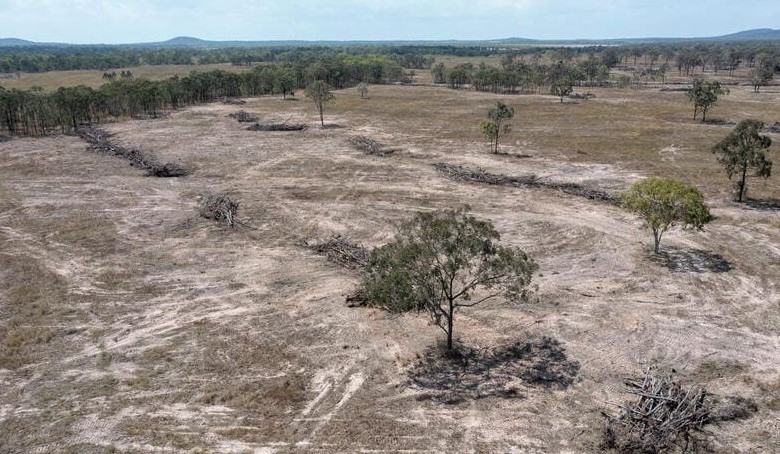
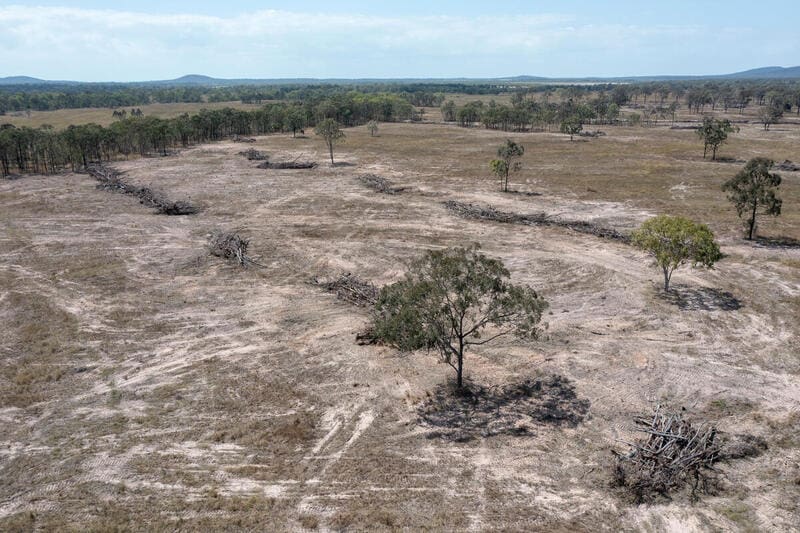
One of Greenpeace’s examples of recent deforestation in Queensland. Photo: Greenpeace
WOOLWORTHS has become the first of Australia’s two big supermarkets to officially commit to zero deforestation, announcing it in its annual report today.
Similar to the European Union’s deforestation-related import rules that are set to come into play on December 30 this year, Woolworths has put beef on a list of “high risk” commodities, alongside paper pulp and timber, palm oil, cocoa and soy.
Woolworths’ deforestation policy is set to come into play later this year.
“We are committed to sourcing beef sustainably in partnership with our farmers and suppliers,” a Woolworths spokesperson said.
“We understand that the majority of Australian producers already practice responsible land management, and we believe our no deforestation goal will help promote the sustainability credentials of Australian red meat.”
Definitions of forest have been heavily debated this year, with the industry currently working through its own definition of deforestation.
The Woolworths Group spokesperson said local definitions were the company’s preference.
“We support the creation of a localised definition which recognises Australia’s unique landscape and vegetation, while ensuring responsible land management and meeting international expectations,” the spokesperson said.
Groups like the ACF, the Wilderness Society and Greenpeace, who have been campaigning for Woolworths and Coles to commit to zero deforestation most of this year, have picked a battle they knew they were going to win all along.
Both supermarkets are signed up to an organisation called the “Science Based Targets initiative” (SBTi), which has made “zero deforestation” targets a condition of membership.
Woolworths had a “net-zero deforestation” target in place and has now put that into “no deforestation” across the selected commodities.
Coles only signed up to SBTi at the end of last year and has stopped short of making the commitment. However, its sustainability report said it was addressing deforestation.
“We are currently developing commodity roadmaps to address the potential risk of deforestation,” the report said.
“These roadmaps build on existing programs of work across cocoa, palm oil, timber, pulp and paper, and lay the foundations for future work in beef and soy used in feed for livestock and aquaculture.”
Definitions of forests the centre of debate
An ABC article earlier this week featuring work from former WWF campaigners and the Australian Conservation Foundation claimed that the industry had been pushing back against a global effort to take deforestation out of supply chains and was weaponising definitions of forests to further its cause.
The report conveniently left out the fact that the industry’s peak body Cattle Australia has been working with other supply chain stakeholders to develop a Australian definition of deforestation – even the WWF has been involved in that process.
Ironically, one of the biggest criticisms of the deforestation definition has come from producers who felt they had not been adequately consulted through the first stage of the process.
CA released an “information paper” in June and has told Beef Central that the release of the definition is “imminent”.
Another point that the ABC article did not mention was that the ACF, the Wilderness Society and Greenpeace have been armed with their own definition and “policy guidance” – which is wanting all regrowth that is either 15-year-old or resembles a forest to be classed as a forest.
WWF has kept preferred definitions close to its chest. It has been critical of the CA information paper, but also said CA’s work is a step in the right direction.
With a ‘no deforestation’ policy, Woolworths will need to stop using power from solar and wind farms which are devastating forests around Australia.
The influence by radical environmental activists is creating a smokescreen at board level and media level to the massive deforestation occurring in solar and wind power construction.
What about a protest with placards outside Woolworths insisting Woolworths adhere to its no deforestation policy in relation to power use?
What else will these people pick on to try to destroy the people who grow food for the world?
This is a ridiculous jumping on the activist bandwagon by Woolworths.
The EU may have put beef on a list of “high risk” of deforestation products but Australia is not on their primary list nor their secondary list of “at risk” countries, although our activist organisations are working hard to get us there.
Not until the end of December is the EU announcing its list of low, medium and high risk countries. It is concerned about putting countries on a false “high risk” list and is inviting countries and organisations to put in submissions.
Meanwhile the activists are submitting that clearing of every woody weed is deforestation but studiously ignoring that the only true deforestation is occurring for renewables. This reckless destruction will be attributed to agriculture.
True zero deforestation will means no fire breaks which even urban dwellers should be able to recognize as hugely dangerous, no tracks, no fencelines, no new infrastructure, no drought fodder feeding in mulga country and regrowth is not acknowledged.
Woolworths, you should hang your head in shame for this mindless, activist attack on rural Australian businesses.
My advice to Woolworths is not to meddle in areas you do not understand. “Deforestation” is most definitely one of them.
Pot calling the kettle black, big time.
Absolute hypocrisy.
Woolworths need to stay in their lane!
Let’s quickly evaluate the resources that Woolworths employ to operate their business and make money!
Buildings and parking lots- complete deforestation.
Electricity for lighting, refrigeration, cleaning, cooking- If it’s green energy, massive swathes of deforestation for solar, wind and electricity network.
Freight network- deforestation for truck and transport depots.
All food, accept wild caught seafood- deforestation for all meats including cattle, sheep, pigs, chicken.
All dairy products including milk, butter, cheese, yoghurt, cream.
All land-farmed fish and prawns.
All vegetables, fresh, frozen and tinned including grapes and berries.
All wheat and other grain products including bread, biscuits, cakes, pastry products.
All tinned food- peas, corn, pineapple, beetroot, olives and fruit.
All wine and alcohol products sold at Woolworths owned Liquor stores, Dan Murphys and BWS.
The list is massive.
In summary, Woolworths wouldn’t exist without clearing native vegetation on a massive scale.
I’ll say it again, they wouldn’t exist!!
Are the vegetarians going to eat beans etc that have been grown on deforested land?
I wonder if there is an offset function for those farmers who plant trees?.. perhaps they need to be informed as to what industry group is the largest planters of trees ?.. any guesses?
It is a bit ironic that the sort of beef that goes to the supermarkets comes from very high quality land that the vast majority of it was heavily timbered before it was extensively cleared and the fertility of the cleared land allows cattle suitable for the local supermarkets to be grown there.
It is not like the supermarkets are buying beef from cattle run on heavily timbered poor quality country.
In essence those organisations going on about only buying beef from deforestation free land are supporting deforested land.
Much like Coles and the EU and no doubt others banning the use of HGP's when HGP's actually increase productivity and their use is better for the environment.
Watch these woke fools go broke
Coles and Woolworths go broke, mate you have rocks in your head.