
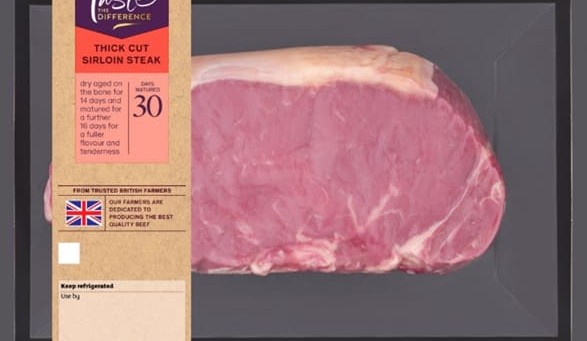
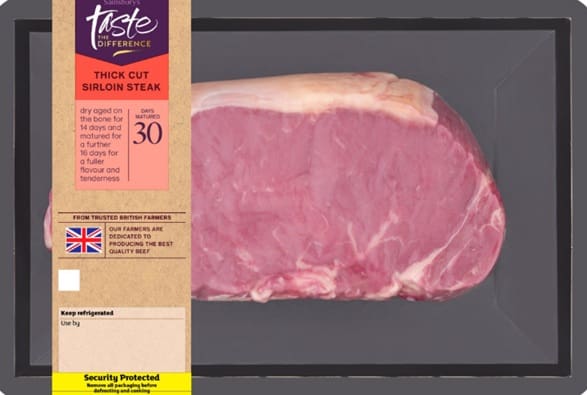
Major UK supermarket chain Sainsbury’s 30 Days Matured British Beef Thick Cut Sirloin Steak sells for the equivalent of £33.13/kg or A$69/kg
FARMERS in the United Kingdom are outraged to see imported beef, including that from Australia, being sold on local supermarket shelves cheaper than their beef, claiming that the import countries have lower welfare standards.
An opinion piece by the National Farmers’ Union (NFU), a representation body for agriculture in England and Wales said retailers had reneged on their commitment to source British beef from British farms with produce such as beef from Uruguay and Australia on shelves.
“This undermines the confidence of British farmers, particularly where imported produce is potentially produced to lower welfare standards than British produce,” said NFU Livestock Board Chair, David Barton.
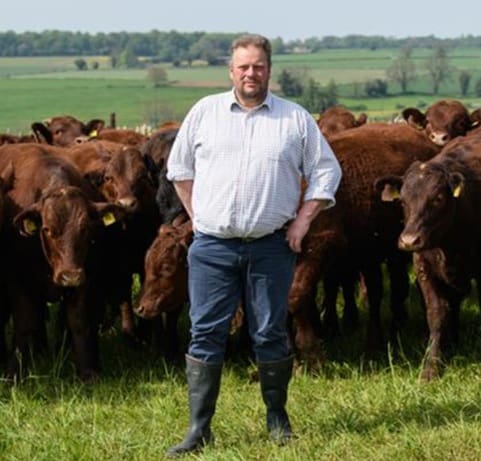
David Barton
“Confidence among British beef producers is already at an all-time low. The cattle population is down 1.7 percent at 7.54 million head as of April 2025.
“We need retailers and our processors to be encouraging and investing in British food and ensuring that high quality British produce has pride of place on supermarket shelves.
“The public strongly supports British farmers who produce food to the highest welfare and environmental standards.
“Clear labelling of produce is essential to ensure that consumers who value the high quality of British produce can make informed decisions and be confident about what they are purchasing.”
UK’s concerns about animal welfare in Australia
In one report from the Daily Mail it quoted World Animal Protection, a global animal welfare organisation that has an Animal Protection Index which is assessed according to 10 indicators, grouped into four goals, which address key animal welfare issues found around the world.
The four goals are:
- Recognition of animal sentience and prohibition of animal suffering
- Presence of animal welfare legislation
- Establishment of supportive government bodies
- Support for international animal welfare standards
50 countries have been given a score from A to G, with A being the best. No countries currently have an A rating, but the UK has an animal welfare standards ranking far above all the other countries – listed as B.
While Australia has a D rating along with Thailand, Kenya, Tanzania and the United States.
New Zealand, India, Mexico and many European countries are scored C.
Chris McCullough, UK-based international agricultural journalist, said farmers in the UK want meat from imported countries to meet similar welfare standards as they do.
“There has been a lot of attention on the welfare of beef cattle in the US recently, and South America, as UK farmers call for equal welfare standards for fairer marketplace competition,” he said.
“The NFU has, in the past, cited issues with Australian beef coming from feedlots, where the welfare standards do not meet the same in the UK where they are finished on grass-based systems.
“Hormone use in Australian beef production is quite a big concern for UK farmers as are long distance haulage and hot branding.”
He said imported beef is selling for close to 20pc less than the UK meat for prime cuts such as sirloin.
 “Beef prices are currently very strong in the UK, both at the farmgate and on the supermarket shelves.
“Last week the overall average price for premium beef was 633 pence per kilogram deadweight (which works out to be over $13 per kg carcass weight in Australia). Even cull cows are making 533p/kg deadweight (over $11 per kg carcass weight).”
Mr McCullough said it is mandatory for the country of rearing and the country of slaughter to be clearly labelled on meat.
Australia defends its animal welfare standards
In response to the claims Australia’s welfare standards are lower than in Britain, Cattle Australia said that sort of flawed logic was a joke.
“What rubbish to try to compare Australia’s grass-fed cattle production system with those of the UK or any other country,” said CA Chief Executive, Dr Chris Parker.
“Unlike plenty of other countries, our cattle enjoy the freedom of movement across extensive landscapes where they can express their natural behaviours.
“Our producers take animal welfare incredibly seriously and are subject to national standards and guidelines underpinned by State-based legislation.
“These include guidelines covering the safe handling of stock, animal health procedures, access to feed and water, transport, and processing.
“Adherence to these high standards of care is vital to maintaining the trust of consumers all around the world, and market access to more than 80 countries.
“Australian producers also accept their place in a global competitive market and contribute to global food security as well as animal welfare outcomes without the significant financial subsidies British beef producers receive.”
How much beef does the UK import from Australia?
Meat and Livestock Australia said in 2024 Australia exported 6296t of beef to the UK, which was equivalent to about 0.9pc of total UK beef supply.
“Australia is one of the most efficient producers of beef in the world, which allows Australian beef to be competitive in global markets,” said an MLA spokesperson.
“Renowned for its high quality and exceptional taste, Australian beef offers outstanding value for money.
“Comparing systems between Australia and the UK is trying to compare two different systems and is very disingenuous.
“Australia delivers exceptional animal welfare outcomes, despite the regulations, systems and pathways looking different to those in the UK.”
Changes to UK subsidies pushing up the cost of meat
Mr McCullough said while subsidies still exist in the UK, the Labour government had made several shock changes to the policies around them.
“Farm subsidies keep the cost of food in the UK lower and if they disappear, those prices will shoot up, potentially leaving the door open for more cheaper food imports,” he said.
“Farmers in UK still have subsidies, but the ethos of the subsidies is changing to focus more on being paid for environmental programmes, or sustainable farming schemes rather than a headage payment or payment for number of hectares owned and farmed.”
While I am an advocate of British beef, I do feel it is unfair to say that the animal welfare standards in Australia is worst than the UK. The price difference has purely been driven by global demand and supply. The fact that UK beef is in high demand from the British consumers (which is a good thing), is pushing prices up, The supply of Australian beef being high with less demand for it globally, does bring this anomaly in beef pricing.
I am a cattle farmer in Australia and there is zero hormone added to our cattle. our cattle which is 99% of Australia is hormone free.
ours is 💯% grass fed . zero additives at all. to state that we Australians don't look after our cattle is insane. That is our main income why wouldn't we look after our cattle. yes there is some scrub cattle imported but the size of farms here compared to uk is insane. but as a breeder of cattle I can state ours is 1000% grass fed only and we don't put additives in our feed at all
<strong>To clarify, Pat - beef is produced in Australia under both HGP-free and HGP-included programs. A significant majority of grainfed beef produced in Australia in fact receives an HGP implant. It is simply not true to say that "99% of Australia is hormone free". But equally, Australia has successfully supplied HGP-free beef to the United Kingdom for close to 50 years - both systems can, and do, happily co-exist. Editor </strong>
"premium beef was 633 pence per kilogram deadweight (which works out to be over $13 per kg carcass weight in Australia)" ..... am I correct in reading this as premium Australian beef is cheaper to by retail in the UK than on our own domestic supermarket shelves??
surely not.
Please clarify?
<strong>Current carcase weight price for grass four-tooth ox in southern Queensland is 620-630c/kg, Michelle. Grainfed forward contracts for October delivery 700c/kg. That's about half what UK carcase beef is, based on the $13/kg cw figure. For retail prices, note the image at the top of the page: The Sainsbury's sirloin steak was the equivalent of A$69/kg. Woolworths porterhouse (sirloin) this week is $53/kg. Editor </strong>
Thankyou editor for the additional information.
The article says that Australian beef is selling cheaper than UK beef in the UK .. what is the retail price of Aussie beef selling in the UK?
The quoted Sainbury sirloin appears to be a local UK product?
Thankyou
While not all of the Australian export meat sector uses the AMIC AAWCS, around 80% of our red meat is processed at facilities certified under AAWCS.
AMPC recently published an international benchmarking of how AAWCS stands up to other international systems, including that used by the UK sector.
AMPC found that AAWCS was aligned with (or stronger) in every aspect of animal welfare compared with the UK, North American, and WOAH standards.
I would trust the work of the AMPC in this space far more than some animal welfare advocacy NGO.
Further to my last, I also struggle to understand which moral footing the UK sector stands on (and the Animal Welfare NGO that has handed them a substantially higher grade than Australia) when almost 30pc of all UK sheep are un-stunned at the point of slaughter.
Less than half (49pc) of the UK's abattoirs have a third-party animal welfare accreditation system (compared to around 80pc in Australia via AAWCS)
Of the UK abattoirs that undertake non-stun halal slaughter, a not-insignificant number of them are not even certified by an identified Halal certifying body, but they undertake slaughter via self-certification without a checker or verifier.
As Mr Wyld comments below, there are further areas of animal welfare hypocrisy from the UK where their livestock may be confined for 5-6 months each year over the winter period. It is illogical for UK consumers and animal welfare advocates to endorse their own domestic system of winter-housing their animals in confinement for 5-6 months however then attack Australian lotfeeding as being inhumane.
Through NFAS/AUS-MEAT regulation, Australian cattle in feedlots have similar (or often better) stocking density, regulated nutrition diet, superior bedding/flooring, and veterinary inspection than UK cattle locked in a barn.
<strong>Thanks for your comment, Sam. We'd add that when the capacity of the 80pc of (larger) Australian processors operating under AAWCS is taken into account, the proportion of Australian cattle processed under the Australian Animal Welfare Certification System would be ever higher - maybe 95pc? Editor</strong>
please Britons buy Australian beef we are a cultural similar and friendly country to you
Beef a very important commodity that this country needs to survive. let's keep helping each other where we can. our beef is good 👍
Farming in UK is virtually a Government job. Their businesses are controlled to an extent unheard of in Australia. Grain production has been decimated and replaced by Government funded stewardship programmes which pay farmers to grow wild plants, bird food mixes, etc.
Livestock are expensively housed for months on end because of poor weather and lack of paddock feed. Their livestock do not enjoy the open grazing that Australian properties offer.
Any criticism of Australian animal welfare is not credible.
<strong>For readers' benefit, John Wyld is a former Cattle Council of Australia president, and is a UK emigrant to Australia. Editor </strong>
Well said, John Wyld.
Maybe the score should include the carbon footprint of the beef. I'm pretty sure British beef would have a lower carbon footprint because of the lower land use. Current carbon accounting methods don't include the land use. This would include consideration of the cost to other species.