
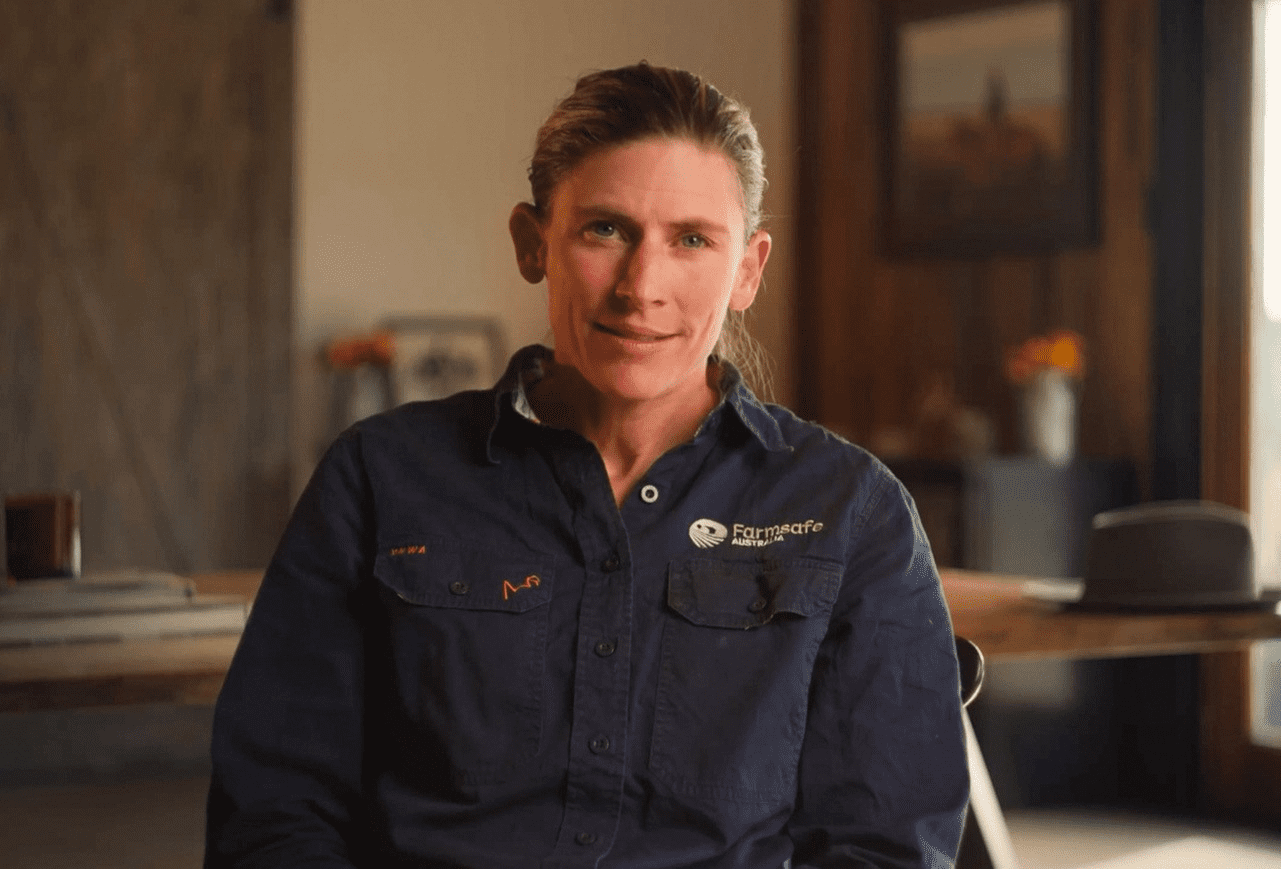
Felicity Richards, Chair of Farmsafe Australia.
“I decided I would take my two girls (aged 4 and 2) out to help brush my horse down,” said Felicity Richards, a Tasmanian beef producer.
“As a person who has been around horses since I was a small child, my focus was on making sure the children were safe around the horse – the horse was tied up, the children knew not to walk behind it, the horse was nice and relaxed standing eating some hay.
“I was enjoying the moment with my children and horse, when my 4-year-old turned to me and said ‘Mum, Esme is in the water trough’.
“I turned to my right and my 2-year-old was caught in a kind of seesaw with her hips caught on the edge of the trough face forward into the water.
“She probably reached out to touch the float and slipped and her little legs were not long enough to touch the ground, and her arms couldn’t reach the bottom of the trough.
“I was less than five metres away from her when this happened.
“When I rushed to grab her, she was startled and upset but luckily there was no lasting harm done.
“But that experience taught me that being present with my children is not the same as actively supervising them.
“It also taught me that my familiarity, my experience with horses had made me complacent and I had become blind to another risk.
“I suspect fatigue was playing a big part too as I was pregnant and had young children so was getting by on a small amount of sleep and all these things came together in an incident that could have had devastating consequences.
“It’s stories like these that can hopefully lead to meaningful change to the way we behave on farms and by sharing our stories hopefully it helps others avoid the same experience.”
National Farm Safety Week
Mrs Richards is also the chair of Farmsafe Australia, the peak industry body which provides information and education to make agriculture a safer place to work.
This week is National Farm Safety Week and the theme is “Second Chances – Who Knows How Many You’ll Get?”
The Second Chances campaign highlights the role of the near miss or close call as a warning sign.
It comes with a call to action: “if you’ve had a near miss on farm, don’t just move on; learn from it, share it safely, and use it to protect those around you,” said Mrs Richards.
“Everyone has a role to play in creating safer farms whether it’s by starting a toolbox talk, sharing a story, or just pausing before a job to check in.
“This is about taking steps. It’s about being conscious and trying to do better every day because safety is about getting home safely to our loved ones every day.”
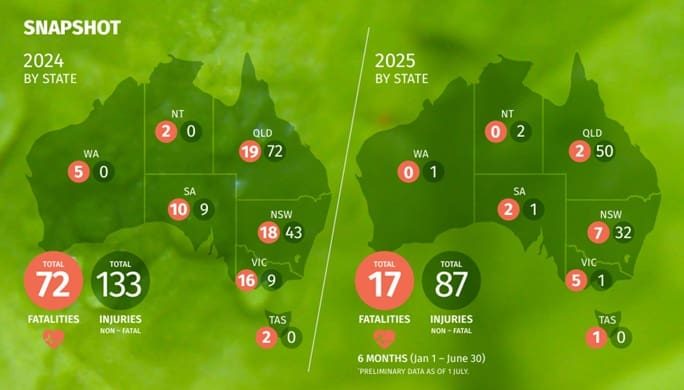
Following a historic low of 32 farm fatalities in 2023, the sector recorded 72 deaths in 2024, the highest fatality figure in more than two decades.
Behind every number is a name. Behind every injury, a life changed forever.
Mrs Richards said this year’s safety week is about cultural change.
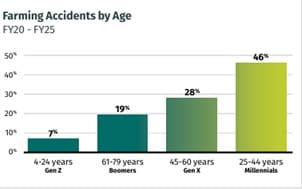
Farming accidents by age.
“So many incidents are preceded by a ‘close call’. A moment when we got lucky. But unless we talk about what almost happened and what we did differently afterwards, we’re missing one of the most powerful tools we have to change behaviour,” said Mrs Richards.
“When we share a near miss safely, without shame, and with a focus on the lesson, we create space for someone else to say, ‘actually, that happened to me too’.
“That conversation can lead to real action: putting seatbelts on in side-by-sides, rethinking fatigue management, changing up how we supervise kids. None of those things happen in silence.”
Side by side vehicles leading cause of fatality in 2024
For the first time, side-by-side vehicles have overtaken quads and tractors as the leading cause of fatality, a major shift in the data trends over the last 10 years.
 “SSV’s have long been promoted as a safer alternative to quad bikes, particularly due to their stability, seatbelts, roll-over protection systems and capacity to carry passengers,” said Mrs Richards.
“But this year’s data shows that the presence of safety features alone isn’t enough and that the way these vehicles are being used matters just as much as the design itself.
“It’s not enough to switch vehicles; we have to shift behaviours. As more farms adopt SSVs in place of quads, we must ensure they’re being used as intended; with seatbelts worn, helmets on, training on correct use, passengers appropriate to the vehicle’s capacity, and terrain assessed.
“Otherwise, we risk repeating history with a different machine. The tools are only safer if we use them safely.”
Key risks identified
The 2025 Safer Farms Report, identified some of the key ongoing risks on farms were related to fatigue, poor communication and child safety.
Each day as part of National Farm Safety Week, Farmsafe have dedicated a day to explore each of these topics:
Sunday 20 July – Every Near Miss Has A Lesson, Let’s Not Miss It
This year’s National Farm Safety Week campaign, Second Chances – Who Knows How Many You’ll Get?, urges everyone on the land to stop, share their stories, and make safety a lived value – not a lucky break.
Monday 21 July – Dead Tired – The Cost of Pushing Through
You’re not lazy – you’re exhausted. And that’s dangerous. Fatigue blurs judgement, slows reflexes and turns everyday tasks into serious risks – and no job is worth the cost of pushing past your limits.
Tuesday 22 July – Familiarity Can Be Fatal – Don’t Let ‘I’ve Done It 1000 Times’ Be The Last Time
Confidence built over years on the land is a strength – but it can also become a blind spot. When we underestimate the dangers of the machines and environments we know so well, we risk letting routine turn deadly. Experience should guide caution, not excuse it.
Wednesday 23 July – The Near Miss You Can’t See Coming – Mental Health Matters
Some of the most dangerous near misses on farms aren’t machinery malfunctions or slips in the yards – they’re the silent struggles no one sees. Mental health challenges can cloud judgement, reduce reaction times, and leave farmers vulnerable to physical and emotional harm. We must treat mental wellbeing as a critical part of farm safety. Because the risk you can’t see is often the one that costs the most.
Thursday 24 July – Between Naps and Knock Off – When Kids, Care and Work Collide
Farming families often juggle childcare with the demands of the day’s work, but the split focus can turn risky fast. With a lack of reliable access to childcare in rural and remote Australia, children may end up in unsafe environments, and parents are left navigating high-risk tasks with distracted minds.
Friday 25 July – Silence Isn’t Safe – Why Every Job Deserves A Conversation
Whether it’s a routine task or a one-off job, assuming everyone’s on the same page can lead to disaster. Clear communication – especially with contractors, seasonal workers and family members can mean the difference between a near miss and a fatal mistake. A quick conversation might just save a life.
Saturday 26 July – The Clock Is Ticking – When Pressure Replaces Planning
In farming, time pressures are real – trucks arrive early, weather windows are tight, and family commitments tug at both ends of the day. But when speed overtakes safety, the margin for error disappears. Rushing leads to skipped checks, missteps, and close calls that too often become tragedies.