
DIRECT consignment slaughter grid prices have strengthened across northern and southern regions of Australia this week.
A little of that, at least, may be some ‘rain insurance’, with prospects of some weather disruptions over the next seven days in some parts of Eastern Australia if BOM forecasts prove correct.
 Part of the reason for the price lift is that the intensity of southern processor interest in sourcing Queensland slaughter cattle has reached new levels over the past fortnight. The situation has now gone well past ‘supplementing’ locally-sourced southern cattle, to providing the absolute core of some southern kills.
One Victorian processor last week secured no less than 1500 head of cattle out of two southern Queensland saleyards, and evidently more out of the paddock.
Stock transport operators report being as busy as they have ever been since the 2019-20 drought period, shifting northern slaughter cattle (plus some feeders) south for processing.
In southern Queensland, some competitive export processors this week have lifted offers by 20c/kg on last week – although some of the most recent adjustments are more about playing catch-up with processing competitors that lifted rates earlier, rather than pushing the market even higher.
Good quality heavy slaughter cows +300kg this week are priced at 580c/kg dressed weight in southern parts of Queensland, with four-tooth grass ox at 650c/kg (some of those offers no-HGP only).
 The effects of southern competition and being a little more current in bookings has driven the latest rises.
Central Queensland sheds have also risen by a similar amount, but remain 10-20c behind those rates based on freight differential, with North Queensland another 20c behind that.
In the southern states, quotes seen out of the eastern regions of South Australia have cows on 660c/kg and four-tooth grass steers, 730c, both up 20c, while southern regions of NSW are also up 20c, with cows 660c and steer 730c. Both reflect the fact that local killable cattle are very very hard to find, heading into August.
Northern Territory cattle, especially some Certified Organic, are helping supplement some SA and Victorian kills.
Cow prices continue to boom
The NLRS slaughter cow indicator (saleyards transactions for processor-bought cows +400kg, all muscle and fat scores) currently sits at 316c/kg liveweight, not far off the 2025 season-high of 318c that was hit briefly back in April.
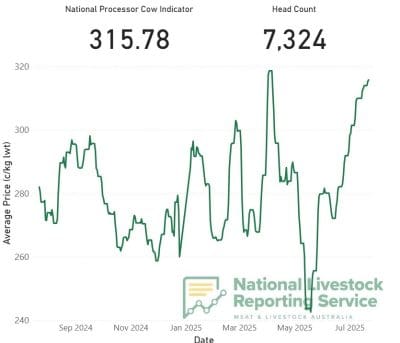 For the record, the all-time processor cow indicator high was 379c/kg, reached briefly during the depths of the post-drought herd recovery back in February, 2022. That’s the equivalent of close to 730c/kg dressed weight on a really good cow dressing 51.5pc.
The current indicator is still a long way off those levels, but certainly the best of the cows being sold in numerous saleyards centres in recent weeks have hit that level, fueled by growing international demand for trimmings.
Attractive heavy cows at Gunnedah this morning sold to a top of 374c/kg, and as high as 376c/kg in a Dubbo yarding of almost 5000 on Thursday, where good cows averaged 350c. Most were headed to Victoria, but one northern processor said the prices reflected a value delivered plants in southern Queensland around 700c/kg, landed.
The biggest saleyards money we’ve seen for cows in the recent rally is 400c/kg, paid for quality Angus cows (notable in part, because the breed was identified in the report commentary) at Echuca last week.
Slaughter numbers tail-off
Weekly national slaughter has tailed-off a little since the season-high was set back on week-ending June 27.
Last week’s national tally recorded by NLRS (about 15pc below the true number, due to some processors choosing not to report) reached 153,415 head. Al states bar Tasmania and WA were lighter in throughput, despite a few Saturday boning shifts still appearing.
Local regional Queensland show holidays may now be suppressing some weekly kills in the northern state, in the lead-up to the Brisbane Ekka next month. Evidence of this is seen in the state’s weekly kills back 3.6pc or 3000 head on this time last month. The graph comparing the past three years for national weekly kills show a small, but consistent dip during the second week in August, reflecting the Ekka public holiday observed by the big concentration of beef processors in the state’s southeast corner.
National female slaughter ratio continues to sit marginally above the 47pc number that represents the tipping point between herd liquidation and expansion, mostly in the 48s for the past four weeks.
Reflecting the large uplift of northern slaughter cows heading south for processing over the past month or so, Victoria’s female slaughter ratio last week hit 75pc, having peaked at 77pc over the past month.