
CATTLE sold through Meat Standards Australia-certified saleyards are now eligible for MSA grading if slaughtered within 48 hours of leaving their property of origin.
MSA business development manager Kate Neath explained the increase from 36 hours at the National Saleyards Conference in Wagga Wagga last week.
“The timeframe from farm to slaughter is now extended for 36 hours to 48 hours via an MSA licensed saleyard or livestock exchange.”
Ms Neath said research tested beef slaughtered within 48 hour, 72 hour, plus seven and 14 days with re-feeding.
“With those longer timeframes it was inconclusive, we need to do more research into that area.”
But she said the 48 hour timeframe showed there was no additional impact on beef eating quality compared to a 36 hour timeframe, allowing the extension.
She said the MSA minimum requirements and responsibilities stay the same with the new timeframe.
“But if you’re an agent, obviously you need to register, complete the training and obviously adhere to MSA standards.”
She said saleyards are required to have an MSA licence and in-person training is available for saleyard managers and staff.
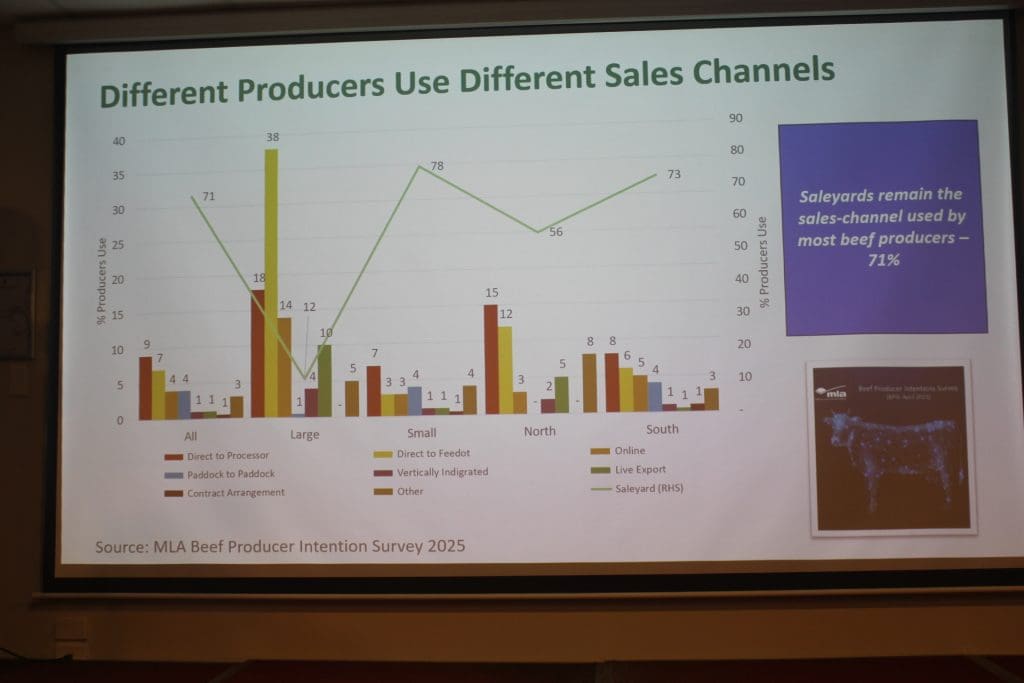
Ms Neath presented statistics drawn from the producer intentions survey (see image above) that showed 71pc of cattle producers are using saleyards in some form and this is higher among small producers – 78pc.
“So it shows how important the saleyard channel is for a lot of producers.”
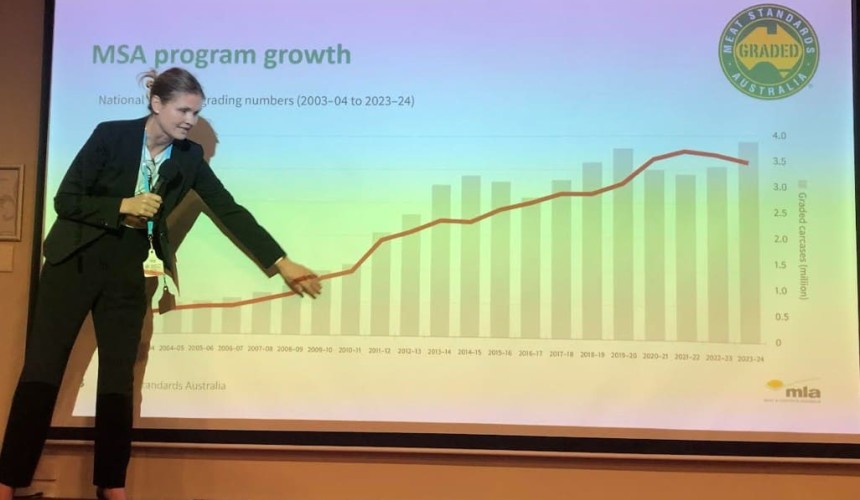
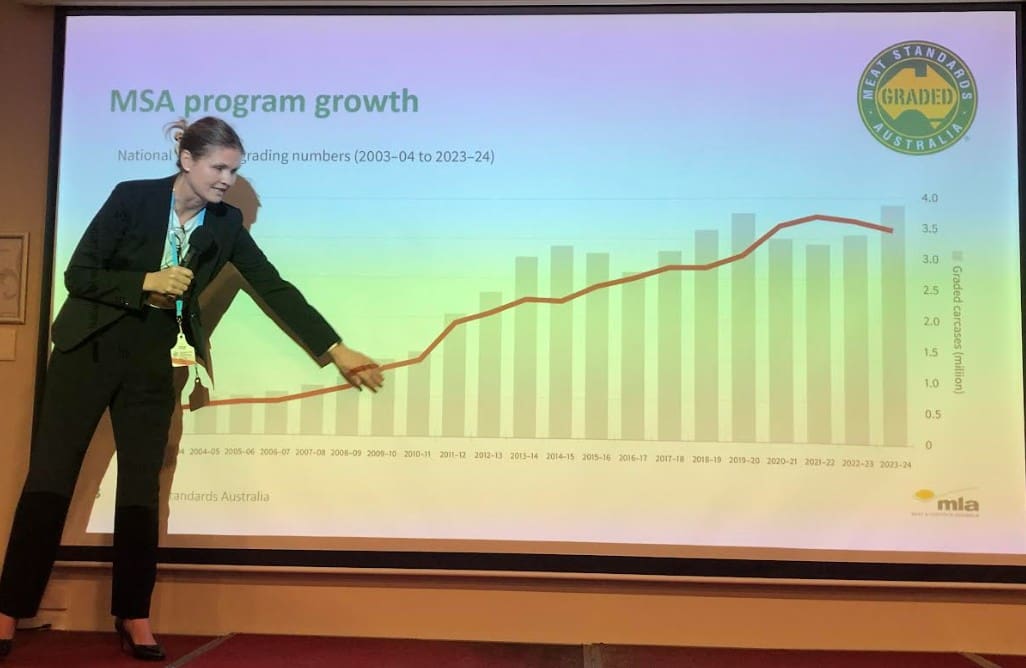
Ms Neath said although MSA is an optional grading system, but had grown its percentage of national slaughter to more than 50pc (51pc) or about 3.9 million beef carcases annually, up from about 20pc in 2010.
 “It shows the value the industry sees in MSA across the supply chain.
“We’re now seeing interest from our overseas importers and wholesalers in MSA.”
She said it was MSA’s goal is to enable all cattle to be eligible for an MSA pathway.
“Some cattle may fall out due to compliance but at least all cattle can be eligible to be MSA graded.”
She said the increased volumes of Australian beef exported to the United States with the decline in the US domestic production, US importers are looking for Australian cuts equivalent to USDA Prime.
“MSA has developed tools to support exporters explaining how their brand compares to Prime Choice Select and obviously that helps them provide that sales point of difference.”
Ms Neath said adhering to MSA standards in saleyards involved no mixing of mobs from saleyard to the processor — although mobs could be split for yarding in saleyards — to minimize stress and maintain glycogen levels in cattle.
“They do need to be kept separate because mixing is really going to impact the ultimate pH.”
A saleyard operator said the timeframe could easily be exceeded even if consigning stock direct to plants.
Important for saleyards to embrace MSA
AAM corporate services director Cye Travers, who initiated the original MSA saleyard pathway research, said it is vitally important for the saleyards industry that it embrace Meat Standards Australia.
“There has been a saleyard pathway there for a while, there are various reasons why it may not have worked.
“This project was about trying to make it work more efficiently for saleyards so that we can have more MSA cattle come through saleyards.”
He said it was set up to help saleyards gain more access to MSA markets in the future, but there was a need for more work to validate other pathways.
“I would encourage the industry and the board to get behind MSA and MLA to get that done.”
He thanked Meat & Livestock Australia, RLX and MSA for doing the MSA saleyard research. He also said there is another project underway about the impact of transit via long truck and rail transport.
“The big window of opportunity to improve that (the 51pc) is via saleyards and long transit out of the north. Where you’ve got two or three day transit periods.”
Ms Neath also outlined the myMSA benchmarking and myFeedback tools that enabled producers to compare their data to state and national data. Cattle breeders can also see the carcase data of their cattle, she said.
“There is also a compliance-to-grid tool.”
Ms Neath said the data collected by MSA is underutilized.
48 hour timeframe will be an issue for transporters
A livestock transporter at the conference said he saw the extension to a 48-hour timeframe as an issue and suggested the use of electrolytes.
“Most cattle could leave (the farm) at 9am in the morning on a Sunday to come for a sale on a Monday.
“That leaves us, by the time they are sold, a very short window to deliver stock for MSA compliance.”
He used the example of the Dubbo sale on Thursday, a lot of the cattle are trucked 700km, and most are trucked over the weekend because the processor can’t handle them sooner.
“I just think that 48-hour window needs some research.”
Ms Neath agreed with the transporter that it might not fit every situation.
“When we did that research, we also did 72 hours and one week and two weeks re-feeding, so more research is required.
“It probably needs more repetition in different scenarios to get a confidence that’s going to work … as long as it doesn’t impact eating quality it’s fine.”
Mr Mathers said to date less than one percent of cattle had been grade MSA under the previous 36-hour timeframe.
“The research has been done to extend that to 48 hours so you’ve got the whole of the next day to slaughter those cattle if they don’t leave the farm prior to 6pm the night before the sale.
“So that’s been a really big win, let’s not downplay that, the fact that we can kill them the whole day after a sale is a massive win for MSA (saleyard) pathways,” he said.
“Would it be better if it was longer? One hundred percent it would be from an MSA compliance point of view.”
He said one of the strengths of MSA is that nothing is passed, there are no pathways approved, unless it (the meat) has gone through a consumer taste panel that says there is no compromise to eating quality via the pathway.
“So the research that was done in this trial at the 72-hour mark and the seven day and 14 day with things like electrolytes, rehydration and feeding, those sort of things, it said that those pathways at this point, with that limited amount of data, couldn’t be validated.
“It doesn’t mean that there isn’t a way that we can reduce that compromise at some point with more research, but at the moment the 48 hours is where it is going to be and I still think that’s a big win for our industry.”