

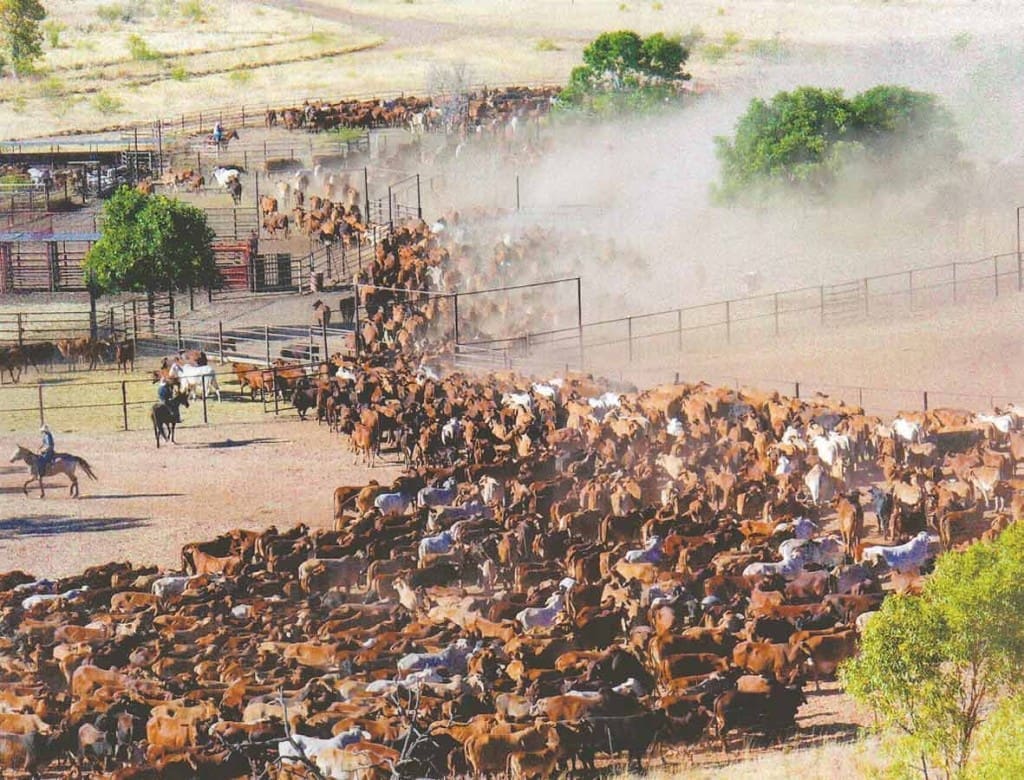
ACROSS the country, an extraordinary number of high-quality assets have been listed with hopes of achieving in excess of $50 million.
In this week’s property review, two of Australia’s leading rural property specialists explain the perfect storm bringing these holdings to the market.
Danny Thomas is a senior director with LAWD and widely regarded as one of the nation’s leading agribusiness transaction advisors.
He said if there was a theme running through the market at present, it was that there is an unprecedented number of large opportunities listed for sale, particularly above $50 million, across all states.
“In my career, I have never seen such an array of high-quality assets come to the market at the same time,” he said.
“Despite the volume, prices at the top end of the market are unlikely to fall, because it is coinciding with an uptick in the amount of available capital.”

Danny Thomas
Foreign investor influence Mr Thomas said prices may have adjusted at the lower end of the market, but the $50 million plus bracket appeared well-insulated.
“This is largely due to higher allocations being made to real property and natural resources by (mostly foreign) investors. In particular, foreign investors are motivated by several factors, including Australia’s low exchange rate, positive China exposure (Australia appears to be benefitting at this stage from the US/China trade war) and a world class carbon market.”
Mr Thomas said interest was coming from six or seven Canadian groups including PSP (Public Sector Pension Investment), Ontario Teachers’ Pension Plan, Fiera Comox and Manulife Wealth and Asset Management, along with new participants from the United States.
“The US has more available money for natural resource investments and many new funds that have raised their sights and decided to look at Australia for new investments.”
Mr Thomas said this was evident at the Global AgInvesting conference in New York held in April, which he (and a bunch of other Australian stakeholders) attended. Total attendance from across the world was about 700.
“While some investors have been late to the party, they are waking up to the ag space now. They have seen what the likes of the PSPs have been able to achieve in Australia and are keen to engage about where to invest and the different types of asset classes.”
At the New York conference and in separate meetings, Mr Thomas said it was apparent that several funds and private equity groups had started to embrace Australian agriculture as a seriously investable asset class.
A confirmation of this trend was the recent purchase of Aware Super-owned ProTen, one of Australia’s biggest chicken producers, for a purported $1.3 billion by KKR, one of the United States’ biggest private equity groups.
Mr Thomas said Australia is viewed as a safe place to invest and as a result, more money will be finding its way into agriculture.
 “Typically, foreign investors, who tend to run on a calendar year, spend the first half ruminating about what they might want to invest in. In the second half, there is an uptick in the number of transactions when they become motivated to deploy capital to ensure they have met their KPIs.”
He said fresh capital coming out of Europe and the United Kingdom had a slightly different mandate to traditional buyers.
“Groups who want to make an environmental and social impact are using newly-raised capital to acquire major investments for biodiversity and carbon projects. They are coming alongside and competing against traditional buyers – creating a deeper market.”
In this Friday’s Weekly Grill podcast, Danny Thomas tells host Kerry Lonergan, that while there is significantly less interest coming out of China, sophisticated Chinese money was still being invested in Australia via Singapore and other guises.
“Over the last five or six years, the rest of Asia (including Vietnam, Malaysia and Japan) has woken up and are keen to be exposed to Australian agriculture by way of partnerships, typically through investment groups.”
Domestic
On the domestic front, Mr Thomas said many established families were nearing the end of their journey, and it was time for someone else to take on those properties and steward them, going forward.
“Some producers held on to their assets longer than expected due to good seasonal conditions and commodity prices. They have built big businesses and are often now in their mid-70s or older and have no physical succession (no family to take the business over),” he said.
“They have reached a conclusion that now is time for financial succession. Fortunately, there is a deep market of buyers for large businesses that wasn’t evident 10 or 15 years ago.”
“There is more liquidity at the higher end of the market than there has ever been. Australian families backed by Australian banks doing deals above $50m demonstrates tremendous local confidence and there is a greater availability of private equity capital and new funds keen to invest.”
In September last year, the NASDAQ-listed and Cayman Island incorporated Agriculture & Natural Solutions Acquisition Corporation (ANSC), backed by US-based companies, Impact Ag Partners and asset management firm, Riverstone Holdings LLC, announced plans to purchase the Bell family’s Australian Food & Agriculture Co diversified portfolio, for around $700m. However, earlier this year, equity market volatility caused the deal to fall over.
Mr Thomas said it was a complex deal that doesn’t reflect the broader market sentiment and is confident that a transaction will occur, as the AFA assets were irreplaceable for quality and scale.
Mark Barber, Elders
Mark Barber oversees Farmland Agency and Agribusiness Investments at Elders, which recently tracked an increase in the number of its own deals valued at more than $20 million.

Mark Barber
Mr Barber attributed the rise to several drivers.
“Producers who are experiencing solid commodity prices coupled with good seasonal conditions across Northern Australia, Queensland, Western Australia and northern New South Wales believe it is a reasonable time to bring their assets to market.”
“Also, Australian agriculture is continuing to consolidate – with a large part of productivity gains coming from scale,” he said.
Mr Barber said typically, the larger the asset offered to the market, the smaller the buyer pool.
“There is a transaction risk splitting up a large portfolio. Selling it in one line is positive for Australian agriculture because it shows there is depth and liquidity in the market.”
Last year, Elders sold the entire Ray Scott portfolio to nine buyers as ten separate assets. Mr Barber said offering a portfolio in parts was sensible, particularly when there is strong interest from family farm operators.
He identified a rapid rise in property prices as another factor driving larger properties to the market.
“An asset worth $20 or $30 million five, six or seven years ago, is now worth around $40 or $50 million and over the next five years, the market is likely to experience a reasonably modest rise in capital growth.”
He said family farming operators were active, even in the +$50 million price bracket, while corporate and institutional buyers were dominating inquiry for assets worth $100 million and beyond.
“Prices, particularly at the top end of the market, are unlikely to be impacted by a higher volume of properties because there isn’t a rush and the assets coming to market are not commodity specific,” Mr Barber said.
“They are attracting reasonably strong demand and a recycling of capital – in other words, some funds are moving on and are being replaced by new entrants.”
Market maturity
Mr Barber said market maturity was also driving the large number of offerings above $50m.
“Ten or 15 years ago, there was an influx of institutional capital, with a significant proportion from offshore. Some of those funds are starting to tip out.”
“In the wake of significant property value increases, some investors are keen to sell down their assets and book the profit – that capital gain,” he said.
Mr Barber said the turnover of properties at the higher end of the market was giving new entrants confidence to invest in a market that is both liquid and more mature.
“There are large pools of capital in North America, Europe and Asia. Over the last ten years, a small number have invested in Australia. New entrants (pension and endowment funds) who have witnessed peers experience a full investment cycle are now showing interest in deploying some capital.”
He said most of the buyers were financial investors.
“While seeking a strong return, they are also happy to consider investments with regenerative or sustainability attributes.”
Like Danny Thomas, Mark Barber attended the GIA conference in New York and said first and foremost, investors were seeking financial returns.
“While prepared to look at properties offering a sustainability or regenerative overlay, they will not sacrifice returns,” he said.
Although there was some uncertainty back in April over tariffs, generally, Mr Barber said the mood at the conference was positive.
“The caution means investors are conducting greater due diligence and putting more effort into making sure the deal they are looking at can deliver under a range of scenarios.”
“Despite some caution, Australia stood out as being a safe haven. It is considered a stable, secure, low risk country to invest in, and a reliable supplier of agricultural products,” he said.