
A $6.4m grant announced by the Federal Government today, is hoping to consolidate the most commonly used “carbon calculator” for Australian farms.
 The grant was awarded to Agricultural Innovation Australia to support the ongoing development and coordination of emissions resoporting tools through its website until June 28. It will start with the GAF tool (Greenhouse Accounting Framework) then update to other standards the Government is currently working on.
GAF is a freely available tool that underpins many of carbon calculators, including from private companies like Ruminati and industry organisations Meat & Livestock Australia. It was originally developed by the University of Melbourne.
While the carbon footprint programs have largely been in used trials and pilots, the Government is likely to become reliant on its information, with mandatory emissions reporting for big companies phasing in over the next three years. AIA says it does not share information with the Government, it just gives producers the opportunity to share the information if they please.
But as Beef Central reported earlier this year, the reliance on the GAF tool for accounting has raised some concerns – with several inaccuracies pointed out by producers using it and a lack of coordination between service providers meaning different numbers are coming from the same inputs.
 The funding announced today was to address some of the coordination issues, with AIA essentially becoming the custodian of the online version of the tool – for 17 different commodities including beef on a website called the Emissions Accounting Platform. The tool will stay freely available and open sourced, meaning other companies can use and AIA has its own online carbon calculator.
Beef Central understands the ongoing development of the GAF tool is in the process of being transferred from the University of Melbourne to the Net Zero Emissions in Ag Cooperative Research Centre, who are planning to update the scientific side of the tool.
The Government says today’s grant is part of a $28.7 million package announced in the 2024-25 Budget, which is also funding the development of voluntary greenhouse gas emissions estimation and reporting standards for agriculture, fisheries and forestry industries.
It currently has an industry reference group set up to guide the new standards, including representatives from Cattle Australia, the National Farmers Federation, MLA, JBS and Rabobank. AIA says the GAF tool will eventually transfer to the new reporting standards.
 AIA CEO Sam Brown said that AIA’s cross-commodity calculation engine – the Environmental Accounting Platform (EAP) – will further build on the success of industry collaboration on emissions reporting to date.
“Significant engagement went into the development of the EAP, and this grant acknowledges collaborative efforts to reduce the fragmentation in on-farm GHG emissions calculation approaches that we have seen in other countries.”
“The grant will enable the market for emissions calculations in agriculture, by allowing existing providers and those entering the space to easily and securely connect to up-to-date, accurate calculators across 17 commodities.
“Producers, mixed enterprises and corporate farming entities will be able to access trusted emissions calculations through providers and tools utilising the EAP engine or code.”
Mr Brown said the awarding of the grant reinforces the importance of consistent, accurate and accessible environmental accounting tools for Australia’s rural industries and the need for collaborative, standardised approaches to support mixed enterprises.
“When designing the EAP, we were able to listen to producers, and develop a solution that can evolve to meet their needs, in particular those of mixed farming operations. AIA has already catalysed improvements to beef, sheep and grains calculators, and brought new commodities into the GAF model – something we will continue to do.
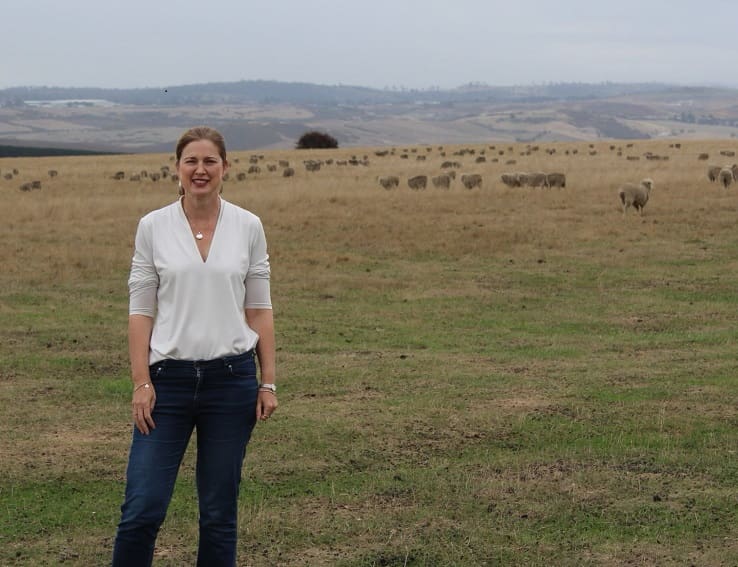
Julie Collins
“As a not-for-profit, AIA welcomes this grant as recognition of our unique cross-sectoral role, and of the efficiencies and productivity gains that can be achieved through effective engagement and collaboration.”
AIA will work closely with its consortium partner, the Zero Net Emissions from Agriculture (ZNE-Ag) CRC, which will provide the science to underpin greenhouse gas accounting against a consistent framework.
Minister for Agriculture, Fisheries and Forestry Julie Collins said trusted greenhouse gas calculations are becoming an essential part of doing business for producers.
“Supporting farmers to calculate their individual on-farm emissions can help them reduce their carbon footprint, save on operating costs, and improve their productivity,” Ms Collins said.
“This will help our farmers to diversify their income streams, and ensure they continue to remain internationally competitive in terms of emissions per unit of production.”