
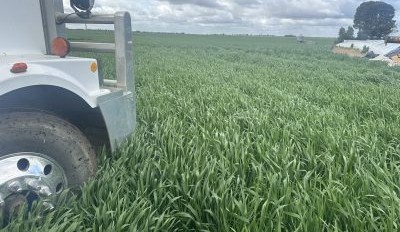
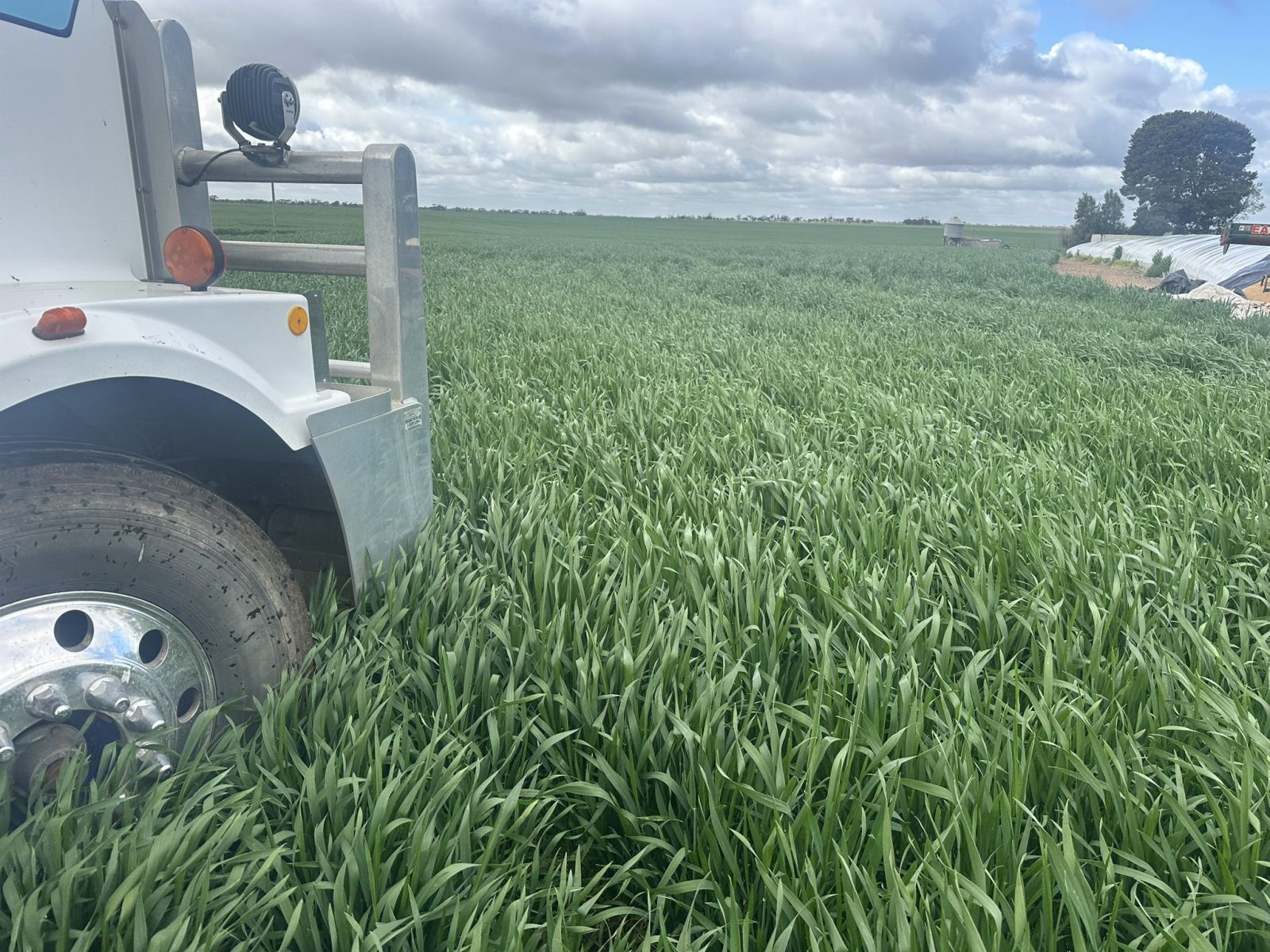
A wheat crop in the Swan Hill district, with a silo bag being emptied to go into vertical storage. Photo: Dion Costigan
PRICES for prompt and new-crop grain have softened to reflect sell-side pressure on the market as yield prospects consolidate.
While the southern crop remains heavily reliant on rain in September and October to yield well, heads on northern crops are filling as the start of harvest nears.
It has northern growers keen to sell current crop to make room for new crop, and in the south, growers with no or little canola, and concerned about low lentil prices, are making a start on forward sales of cereals to generate cashflow.
| Prompt Aug 21 | Prompt today | Jan Aug 21 | Jan today | |
| Downs barley | $315 | $308 | $315 | $305 |
| Downs SFW | $327 | $326 | $330 | $326 |
| Downs sorghum | $350 | $350 | NQ | Mar-Apr $320 |
| Mel barley | $330 | $325 | $328 | $325 |
| Mel ASW | $355 | $355 | $350 | $345 |
Table 1: Indicative prices in Australian dollars per tonne.
North bites the bullet
With a significant wheat and barley on-farm carry-out, and another big crop only weeks away from the header, growers are starting to shift current-crop into a limited number of consumer homes.
“Most of September is done, and most guys are filling a bit of their October requirement,” one trader said.
As a big Northern Hemisphere crop makes its way to market, trade sources say interest in accumulating for bulk export is limited.
 “The export market has pretty tight margins from up-country to port.”
Feedlots and other up-country consumers are expecting harvest pressure from next month, with subdued interest in APW-type wheat likely to push it into homes on the grainbelt.
“Growers are not going to travel far at harvest time with prices like this on offer.
“We could be buying SFW at harvest for $310/t.”
Despite the soft market for new-crop chickpeas in southern Qld and northern New South Wales, chickpeas are still expected to be the number-one cash sale for growers at harvest.
Cottonseed is trading at around $445-$450/t delivered Downs.
“It needs to be around $410-$420/t before it starts buying demand into the feedlots.”
Its expense relative to other inputs means some feedlots have halved its inclusion rate to around 5pc.
On the central and western Downs, barley looks like yielding at least 4.5t/ha, and up to 6t/ha where crops have had adequate moisture throughout the growing season.
Weather permitting, early barley crops in the in the Dawson-Callide and pockets of the western Downs could be in the bin in the next fortnight ahead of the southern Qld barley harvest gaining traction in mid-September.
Southern season shapes up
Rain in recent days, with more on the forecast, has growers in Victoria, South Australia and southern NSW starting to book small amounts of new-crop sales, despite the uninspiring prices on offer.
In Vic, registrations in the week to 9am today include: Dimboola 19mm; Horsham 15mm; Murrayville and Nhill 10mm, and Walpeup 12mm.
SA had similar amounts, with Eyre and Yorke peninsula registrations including: Coulta 15mm; Cummins 17mm; Lock 6mm; Minlaton 7mm and Warooka 15mm.
 While SA’s Murray-Mallee generally had 10mm at best, the Mid North and surrounding districts, and South East had registrations including: Auburn 22mm; Brinkworth and Clare 16mm; Farrell Flat 19mm; Keith 15mm; and Lameroo and Snowtown North 12mm.
In southern and south-central NSW, falls were very patchy and mostly light, and included: Cootamundra 13mm; Grenfell 11mm; Temora 9mm; Urana 13mm, and West Wyalong 8mm.
Pinion Advisory Andrew Brown said canola, priced in the high $700s/t delivered depot, is currently the forward sale of choice for those that canola in the ground.
However, the late break in the season means many growers reduced their canola area from normal, or decided to drop canola altogether for the season.
“Growers are just chipping away; the prices aren’t great at the moment.
“Some growers are looking to get cover.
“If they don’t have canola in, what are they going to use as cash flow?”
New-crop lentil prices delivered Wimmera packer are currently sitting at around $630/t for smaller types, and $650/t for Jumbos.
“If lentil prices have a five or six in front of them, especially a 5, a lot of growers will sit on them.”
While canola pricing is sitting at around decile 8-9, wheat is in decile 2-3, and barley is no better.
Mr Brown said multigrade wheat contracts at around $310/t delivered depot looked to be a reasonable option for growers wanting to price something forward.
“Barley’s already got a 2 in front of it.”
On the upside, rain is building prospects for decent yields.
“The rain has been perfect; we just need temperatures to stay in the low 20s or below because the crop’s still got a long way to go.
“The crop is 30 days behind where it normally is.”
Reid Stockfeeds commodity manager Justin Fay said while crops look good, they look as they normally do in early July.
“With crops being late, we’re coming into that susceptible frost period,” Mr Fay said.
If September delivers adequate rain, Mr Fay said some forward selling may be seen.
“If we get some decent spring rain, then growers will become more comfortable selling for new crop.
Mr Fay said current-crop barley has been coming to market.
“We were expecting it was going to be difficult to procure at this time of year but the market’s telling you that’s not the case; it’s below feed wheat.”
Even if September delivers some frosts which deplete grain yield potential, Vic, SA, and southern NSW crops have enough body to be cut for hay to replenish farmers’ stocks.
The split between what gets cut for hay and what goes through to grain will be decided in October, based on price and yield potential.
“The crop has now made hay, and it can be cut for that; the grain farmer has a lot to consider.”
Southern hay values are still high, but pellet supply is ratcheting back to meet the softer demand now that ewes and lambs are mostly back on pasture.
However, dairy and beef demand are still chomping through elevated amounts of prepared feed ahead of spring growth having sufficient body to support cattle.