
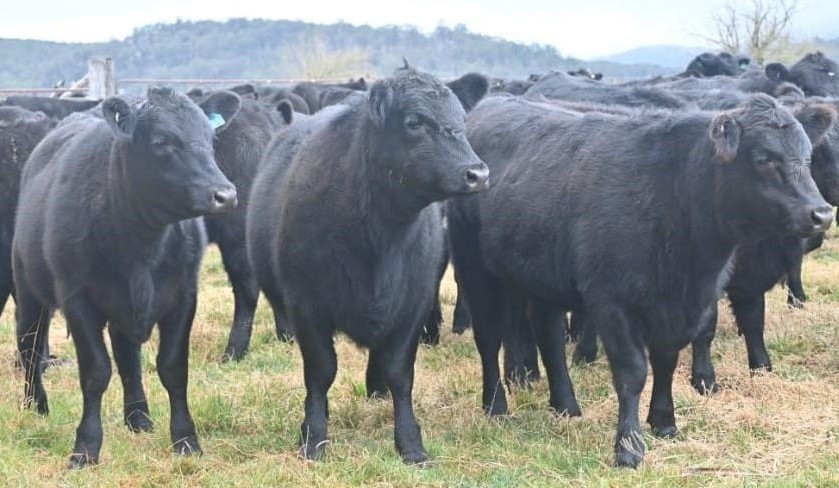
LOTFEEDERS will be asked to supply data on the extent of heifer feeding in future quarterly grainfed industry surveys, as part of bid to improve the accuracy and reliability of national herd size monitoring.
Up to now, formulae like the female slaughter ratio (the proportion of females represented in national adult cattle slaughter) together with ABS survey data have been the primary indictors of herd size movements.
Angus feeder heifers
However with the strident growth seen in grainfeeding activity over the past decade, it is now felt that additional metrics like heifer numbers on feed can add a lot to the industry’s understanding of herd size movements and trends.
The move was discussed during an MLA webinar held this morning following the release yesterday of the September half-yearly Cattle Industry Projections.
Yesterday’s report suggested Australia’s beef herd will remain stable at 31 million head by the end of 2025, however the herd size assessment process has changed over time, this morning webinar was told. There has in the past been some vigorous industry debate over the accuracy and reliability of herd size assessment.
MLA’s acting market information manager Erin Lukey said the dynamics of the national beef herd was very different now compared with where it was a decade or more ago.
“While we do take into account these long-term trends like female slaughter ratio and stock turnoff rates, we are now looking at them through a ‘shorter lens’, because female turnoff now is very different to female turnoff during prior times,” she said.
The core of the herd size assessment model remained as it has been for the last five years, using a University of Queensland peer-reviewed model system – although the assumptions that are fed into that have shifted, Ms Lukey said.
 “That’s where these conversations with industry are really important. The foundation is the same, but its just the weight that we put on some of these other data points that has shifted.
“But that topic (the real influence of female slaughter and stock turnoff) is definitely something we want to look into.”
MLA analyst Emily Tan told the webinar that herd composition looked a lot different today than it did ten years ago.
“Back in 2014, calves made up 23 percent of the herd, whereas by 2024, that figure has lifted to 31pc,” she said.
“This shift has been driven by more productive breeding cows and investments in genetics, which has lifted the number of replacement heifers available. This means producers today are able to maintain breeding capacity and continue to improve their herd performance.
The Beef Producer Intentions Survey certainly supported that trend, Ms Tan said. Thirty nine percent of beef producers in the most recent survey indicated that they planned to adjust their herd size (upwards), and 17pc said they were looking to move towards a more breeding-focussed system.
“A larger calf population brings a lot of opportunity, but certainly comes with its challenges,” she said. “Calves selected for faster growth will reach market weight earlier, but as they consumer more feed, this puts pressure on carrying capacity, which is particularly important for pasture-based systems.
Meanwhile the proportion of older cows and heifers in the herd has remain relatively stable, while the share of meat cattle has declined. This obviously reflects higher turnoff rates, shorter growth periods and greater use of feedlots.
“Grain-based rations are reducing the reliance on pasture, and in some cases can be used as a buffer during dry periods,” Mr Tan said.
The key for all producers was balance, she suggested – managing stocking rates to match feed resources, culling unproductive cows and turning off earlier.
“With more calves moving through the system, careful decisions around feed demand, turnoff timing and grazing pressure will be crucial, and shows what the herd is capable of, with a smaller and more productive breeding herd.
Another tool in the toolbox
During questiontime, a webinar participant asked about a recent ABS report suggesting the female slaughter ratio was now around 54pc.
“Herd composition has evidently changed a lot – does this mean we could judge a liquidation cycle by this factor?” the stakeholder asked.
Emily Tan said FSR was one of the tools used to see what producers’ herd decisions were.
“The FSR continues to be a good indicator, but as we get more data points, such as heifer numbers on feed, that will also provide another valuable point in getting to know what producers are thinking, in understanding whether the industry is going into liquidation or growth.”
“Producers now have more options – they don’t have to turn heifers off, they can put them on feed, which provides another tool in the toolbox in understanding what producers’ decisions are.”
Another webinar viewer suggested that a female slaughter ratio of 47pc or higher was no longer indicative of herd liquidation, asking where MLA saw the liquidation/growth cut-off now sitting.
“We cannot tell exactly when herd liquidation starts and finishes, but FSR, along with stock turnoff rate, is one of the tools we have to see what producers are thinking,” Ms Tan said.
But another new data points was the number of heifers on feed. In the United States, the industry gets access to heifers on feed data on a monthly basis, as part of the USDA Cattle on feed report.
“It’s another good tool to understand where producers’ minds are at, and essentially where their decisions are for the season,” Ms Tan said.
Another listener asked what proof there was that the national breeding herd today was in fact smaller.
“When we say the breeding herd is smaller, it is as a proportion of the overall cattle herd,” she said.
“What’s happened over the past ten years is that the herd size is actually the same, but we are seeing more calves. As a result, when the maths is done, it makes it look like the breeding herd is smaller.
“The point is we are currently producing more calves out of a breeding herd that’s the same size as what it was ten years ago. That’s an indication of how productive and efficient the herd now is, and the investment that’s been made to achieve it.”