

UNITED States burger giant McDonald’s has doubled down on its commitment to beef sustainability, announcing its participation in a US$200m initiative designed to demonstrate its “continued commitment to responsible beef sourcing and stewardship of natural resources.”
Overnight, the company’s US division announced its largest investment in regenerative agriculture to date, with the launch of the Grassland Resilience and Conservation Initiative, partnering with the US National Fish and Wildlife Foundation, the US Department of Agriculture’s Natural Resources Conservation Service as well as key McDonald’s US suppliers.
 The initiative will invest more than US$200 million over the next seven years to help promote and accelerate regenerative grazing practices, habitat restoration, water and wildlife conservation on cattle ranches spanning four million acres of US land across 38 states.
McDonald’s US is Australia’s single largest beef customer, accounting for about 80,000t of Australian frozen trimmings and manufacturing beef in a typical year. Volume this year will be higher still. The announcement made overnight makes no reference to offshore beef supply.
Through the Grassland Resilience and Conservation Initiative, participating US ranchers will have the opportunity to leverage tools and resources to help them improve wildlife habitats, conserve water, and enhance soil health, the company said in a statement.
 “McDonald’s US also believes that this initiative will help boost its US supply chain resilience, including by providing participating ranchers economic returns such as incentive payments,” it said.
McDonald’s US suppliers, including Cargill, Golden State Foods, Lopez Foods, OSI and Coca-Cola have elected to provide funds to NFWF alongside McDonald’s US. NFWF will independently award competitive grants to organisations that will assist participating ranchers in adopting practices that advance wildlife conservation and regenerative agriculture.
“As a brand that serves more than 90pc of Americans every year, we recognise the responsibility we have to help safeguard our food systems for long-term vitality,” said Cesar Piña, Chief Supply Chain Officer, North America.
“Through our support of this initiative, McDonald’s US is demonstrating the power of partnership between the public and private sectors and that feeding the population and stewarding our natural resources can coexist.”
Many ranchers took pride in serving as stewards of the land, taking care of their communities to help create a better and brighter future, the statement said.
Building off current ranch-level best practices, this initiative will provide new pathways and resources to help accelerate regenerative grazing for ranchers, like those who are invaluable to McDonald’s US supply chain. Selected partner organisations will work with ranchers to help improve grazing land management, protect and restore grasslands and other natural ecosystems, safeguard water, and upgrade ranch infrastructure such as fencing and water systems.
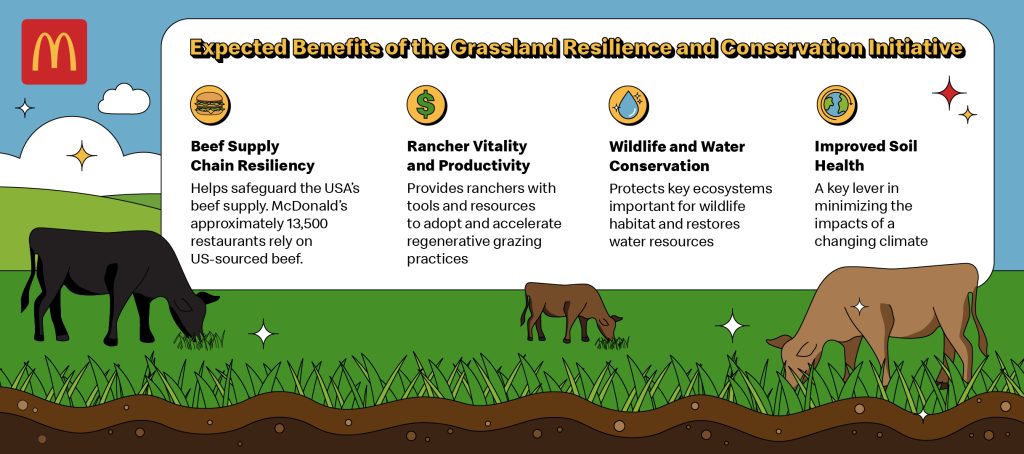
As part of this initiative, NFWF will manage and invest conservation funding to advance ranchers in their voluntary conservation efforts. NFWF is collaborating with its conservation partners across America’s grasslands to identify impactful landscape-scale projects that will generate the greatest possible benefits to both wildlife populations and the productivity of vital U.S. ranch lands. The first round of competitive grant-making will culminate in the announcement of awards, expected in January 2026.
“The benefits of grassland conservation are far-reaching,” said Jeff Trandahl, Executive Director and Chief Executive Officer at NFWF. “When cattle are managed to optimise multiple ecological and economic values, the land holds more water, grows better grass and supports more wildlife. Conservation practices voluntarily adopted by ranchers can improve the productivity of grasslands, increase ranching profitability and strengthen the vitality of rural communities across the US.”
Consultants Kateri and Carbon Yield will provide independent monitoring and quantification to the project looking for improvements in soil health.
Source: McDonald’s