
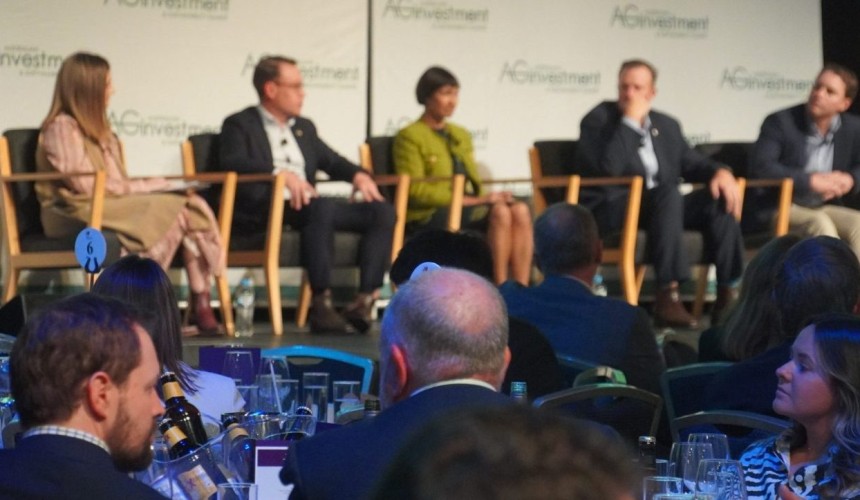
Audience members in front of the Ag Investment summit panel session in Brisbane
ENVIRONMENTAL, social and governance responsibilities, together with issues like trade barriers, access and relationships, will inevitably influence future Australian ag investment trends, a Brisbane Investment Summit heard recently.
Environmental, social, and governance (ESG) is shorthand for an investing principle that prioritises environmental issues, social issues, and corporate governance. Investing with ESG considerations is sometimes referred to as ‘Responsible investing’ or in more proactive cases, ‘Impact investing.’ The term is also frequently used interchangeably with corporate social responsibility and sustainability.
The Brisbane Ag Investment Summit convened by accountants Bentley’s last month heard that shifting global trade rules and challenges around tariffs, climate legislation and geopolitical tensions were among the challenges faced by agriculture, and those wishing to invest in the sector.
One of the panellists was Consolidated Pastoral Co chief executive Troy Setter, who recently took part in the Agriculture Round Table that fed into the recent Federal Government Productivity Roundtable. The discussions brought together about 60 stakeholders of all types, and attracted 180 submissions.
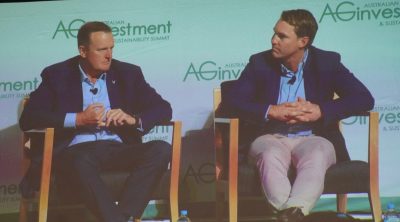
CPC’s Troy Setter and Warakirri Asset Management’s Steve Jarrott during the panel session
Mr Setter said while the discussions covered wide-ranging topics, the focus moved very quickly to the role of government in trying to maximise productivity and efficiency.
“It was exciting to hear that since 2000, of all Australian industry sectors, agriculture has had the highest level of productivity growth year-on-year,” he said.
“That comes off the back of R&D and extension, but as the most productive industry in Australia, has been 0.74pc per annum. Most industries over the same period are going backward, but we look great, in any comparison.”
Mr Setter said there was quite a bit of discussion, also, around the modernisation of extension and R&D.
“We need to keep investing in R&D – Australia has been a leader in R&D, and we’re pretty good at adoption, but we are real show-me, touch-me type adopters, as farmers,” he said.
Trade and market access was another hot topic at the roundtable.
“Since about 2000, Australia has had unrivalled reductions in tariffs into importing countries, and we’ve had great market access, meaning we’ve continued to grow market share,” Mr Setter said.
“But over a similar period of time from 2020 to 2022, our non-tariff trade barriers are now at 20pc. So what we have gained in direct market access, we’ve given up on non-tariff trade barriers. It exposed the fact that we are light-on for trade negotiators and country-to-country, BtoB, government-to-government and criss-crossing of those for trade negotiation.”
Cutting duplication
Dialogue around the role of government quickly turned to the need to cut duplication and red tape.
 “If you are a food or fibre producer you have state, federal and local red tape production issues. For us at CPC, to produce a steer and put it in a box for export, between local and government red tape, acts and compliance against best practise – all things we have to do – there are 327 requirements we need to meet,” he told the gathering.
“The duplication of bureaucracy in Australia is massive, and it was a big issue that came out of the Roundtable dialogue.”
“Sure, there were chats about labour shortages, the cost of labour and things like that, but it really came down to the need for removal of unnecessary duplication, and government services need to be developed with really good processes, efficiently – and no more legislation.”
Mr Setter said a lot of the groundwork had been done, through the productivity commission and numerous industry reviews by former ministers and department heads, “but actually, the energy now needs to go into implementing those recommendations,” he said.
After-shocks from tariffs, drive for diversification
Trade and Investment Queensland chief executive Justin McGowan touched on some of the global factors in play that are having direct impact on the domestic agriculture industry and investment confidence.
“With regard to world events, who would have thought that primary producers would know more about geo-politics and supply chain issues than many others?” he said.
“There’s often talk about informed consumers, but most of us in this room would have a broad understanding of issues like changing tariff barriers, the high cost of shipping (up 85pc since COVID) and other impacts on our global supply chains.”
Mr McGowan said with recent trade and access developments (a reference to US tariffs) the agricultural world was coming to thye conclusion that diversification was the answer.
“Almost minute by minute, there are adjustments and change,” he said. “India now has a 50pc tariff on its exports to the US; Brazil has a combined tariff of 76pc on beef; who would have thought it, but Switzerland has a 37pc tariff on goods into the US.”
“Unpicking that, beyond just regurgitating what’s in the news, what does all that mean? Is there an opportunity for the local agricultural economy?
“From TIQ’s point of view, its about de-mystifying that for our exporters, investors and investees, because keeping abreast of all this is challenging,” he said.
“But its not all doom and gloom. There are opportunities.”
“It’s now time, particularly in uncertain times, to make it very clear what your value proposition is.”
Need for flexibility, adaptability
Portfolio manager with Warakirri Asset Management, Steve Jarrott told the Brisbane summit that being able to evolve and adapt in the face of rapidly changing global circumstances had become critical for local agriculture businesses, and their investors.
Warakirri provides specialist investment vehicles for charities, superannuation and individual investors across Australian, global emerging market equities and Australian agriculture.
“There’s been a full range of impacts from tariffs and other trade access developments, depending on what product you’re working with, what markets you target, and who your competitors are in those markets. Things have been changing pretty quickly,” he said.
“Understanding your market and being able to diversify your market has become more important for producers and investors.”
Asked what sort of ‘conversations’ he was now having with Warakirri’s investors, Mr Jarrott said it was about setting up a strategy behind investments, exploring what investors are looking to achieve in different categories, and diversifying approaches to export and domestic markets to balance the risk side, and any potential ‘over-exposure’ to the US market and tariffs.
“Diversification, understanding the opportunities and the consumer base are key,” he said.
During a discussion around subsidies and how they impact on investment, Mr Jarrott said from the perspective of attracting offshore capital (and investment more broadly) into agriculture in Australia, that free-trade, free-market feature was important.
“Australian agriculture’s productivity and efficiency is all driven through the lack of subsidies, and that’s recognised by the global investment community,” he said.
Social considerations
In terms of the ‘social’ component of ‘ESG responsibility’, CPC’s Troy Setter provided an interesting case study on the company’s Indonesian operations, where the company is the largest importer of live cattle from Australia, supplying two large company feedyards.
“We need to look after the local village near out feedlots, where there are still pretty high levels of unemployment. There are 12,500 families that rely on our feedlot business for income – everything from truck drivers to farming staff. All of our corn is planted and harvested by hand, because it provides employment, and can be done at times when it is too wet for tractors to get onto a paddock,” he said.
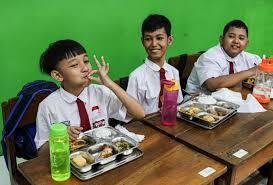
Indonesia’s School Food Program
CPC re-opened its dairy again this year to provide milk for the local community, as part of the Indonesian President’s School Food Program.
“There’s 300 million people in Indonesia – 90 million of which are children, huge numbers of whom suffer from malnutrition,” he said.
“Going from a standing start of 150 community co-op kitchens that started this year, we were already at 6000 by the end of August, and aim to get to 15,000-20,000. We are currently supplying 8000 Indonesian children each day with milk, from a standing start in just three months.”
“What has that done for us? We have really good permit access, as a result. And it’s not just the agriculture in Indonesia – if you want to be a clothing manufacturer or a miner, you have to have a positive impact on the local community.”
“The Indonesian government is doing things differently, and we are seeing this around the world. Rather than applying taxes to then go and fund community projects, businesses are encouraged by governments to have a positive, direct impact on their local community.
“Some governments doing this – like Indonesia – will actually direct where that effort goes. For CPC, we’ve negotiated a community milk supply program.”