

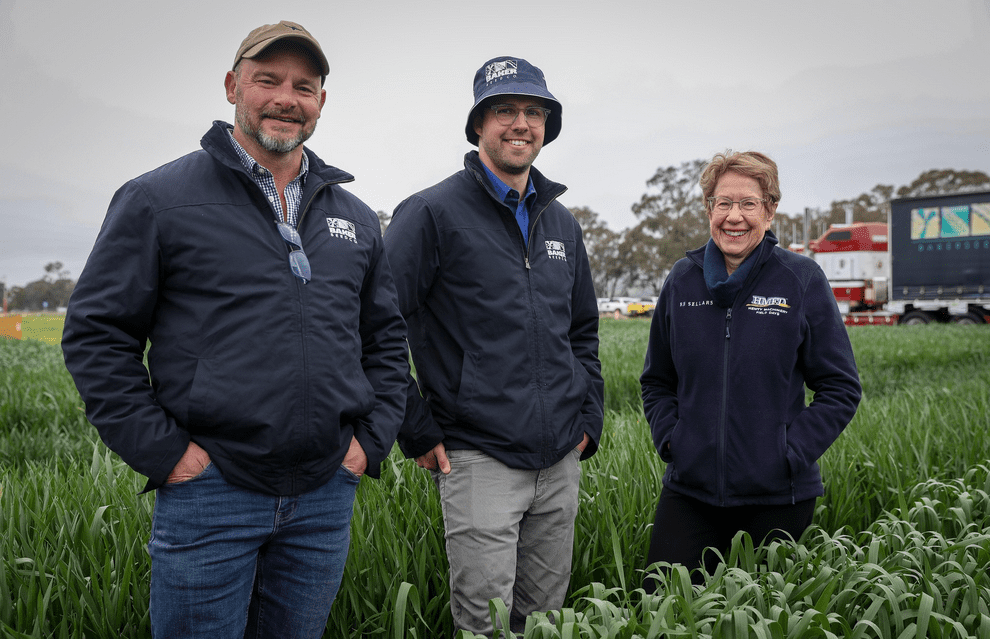
Baker Seed Co CEO Justin Daly and business development and sales manager Ed Harrod with NSW Governor Margaret Beazley at the company’s trial plots at the Henty Machinery Field Days held in southern NSW this week, where crops could do with another rain or two to maximise yield potential. Photo: HMFD
PLUMMETING chickpea and lentil prices are yet to produce a run of forward sales from growers on cereal prices, which have proved better than pulses at holding ground in the past week.
In the northern market, values for barley and SFW-type wheat have firmed as consumers try to cover a limited number of prompt positions.
In the south, growers are anxiously waiting for rain to avoid screenings issues in crops now running to head.
Consumer demand remains limited as those with animals to feed sit back and wait for harvest pressure to drive prices down.
| Prompt Sep 18 | Prompt today | Jan Sep 18 | Jan today | |
| Downs barley | $305 | $325 | $300 | $305 |
| Downs SFW | $320 | $325 | $315 | $325 |
| Downs sorghum | $336 | $335 | Mar-Apr $313 | $310 |
| Mel barley | $315 | $315 | $310 | $310 |
| Mel ASW | $347 | $342 | $340 | $322 |
Table 1: Indicative prices in Australian dollars per tonne
North
Weak chickpea prices have so far failed to spark volume forward sales of wheat and barley in the northern region.
An indicative gross margin for growers in north-west New South Wales puts wheat at a yield of 4t/ha and $260/t on farm for a gross margin of $1040, against chickpeas at 1.5t/ha and $560/t for a gross margin of $840/t.
 “Chickpeas are dropping every day,” one trader said.
The delivered Downs price for new-crop chickpeas has fallen from around $600/t on Monday to $560/t today, and is at least $200/t lower than prices seen this time last year, when Indian demand made chickpeas the crop of choice for sale off the header.
The trader said premiums are around this week for prompt wheat and barley, a function of the soft finish northern cereals are experiencing.
The Central Queensland harvest is slowly gathering pace, and Prime Hard parcels are being bid at $375/t delivered Brisbane.
Norco trader David Henderson said wheat growers were hopeful that protein would be high enough to catch premium milling grades, and were therefore unlikely to forward sell.
H2 and above wheat has better potential to work into early season cargoes than lower-protein grades, which are facing fierce competition from Northern Hemisphere suppliers in the global market.
“If you’re not excited by the SFW price, you might want to wait until you see what you get,” Mr Henderson said of the grower.
Consumer demand from prompt deliveries is thin, although some smaller operations appear to be caught short by the soft finish.
“The only people looking now are the people who thought harvest was going to be earlier.”
In northern NSW, Broun & Co director Charles Coventry said growers see current cereal prices as “marginal to unprofitable”.
“They’re pretty soft, and pretty ugly; they are hoping for yields to compensate.”
Concerns abound that the soft finish for Qld and northern NSW cereals will turn into a wet finish, as forecast by the Bureau of Meteorology in its seasonal outlook to November.
That could result in widespread downgrading and sub-APW protein levels.
Mr Coventry said growers with canola were likely to make it the cash sale of choice this harvest, provided its prices hold ground.
He said consumer demand for cereals was limited.
“They’re all buying just enough to get to harvest; they all feel very comfortable.”
Like chickpeas, faba beans were in hot demand from exporters this time last year, but this year are trading at least 20 percent below where they were this time last year.
“Faba beans are $400 at best on farm; they’ve fallen out of bed.”
Mr Coventry said those with livestock to finish could well hang on to their faba beans to value-add through livestock.
“The economics of feeding grain to animals is very good.
“It’s barley and barley and faba beans they’ll be using.”
Need for rain escalates in south
Crops in Vic, SA, and southern NSW need a good drink in the next 10 days or so to preserve what for most is an average yield outlook at best.
With the exception of south-west NSW, crops are looking good, but a hot and dry start to October could wipe a chunk of yield potential from crops.
Lentil prices have tumbled to levels where growers are looking at some cash sales of cereals as relatively more profitable, particularly if they don’t have canola to sell off the header.
 “I feel like canola’s going to be a sell, lentils are going to be a hold, and wheat and barley could be either,” one trader said.
BoM’s eight-day forecast points to 10mm or more for crops in the Wimmera and SA’s South East next week, but only single-digit falls for the Vic and SA Mallee and Mid North and surrounds.
“The crop’s still got great potential, but it’s been getting 4-5mm, not the 20mm it needs,” another trader said.
New lentil growers are expected to meet the market with cash sales of their pulse rather than their cereals, even at $590/t delivered port, which is well below the $800/t established growers liked to see.
In the Wimmera particularly, prospects look promising for malting barley, provided spring does not turn hot and dry, while crops in the Mallee are already out in head.
The depressed export malt market, and China’s preference for FAQ over malting barley out of Australia, means bulk barley exports are looking lean in the early part of the shipping year, which starts next month.
Western Australia, which could produce its biggest barley crop ever if its season gets a kind finish, is expected to be an aggressive exporter in the near term.
“On the east coast, we’re going to play second fiddle to WA.
“Their freight spread is US$6-7/t better to China.
“We haven’t got grower liquidity, and we’re trading at a premium to WA.”