
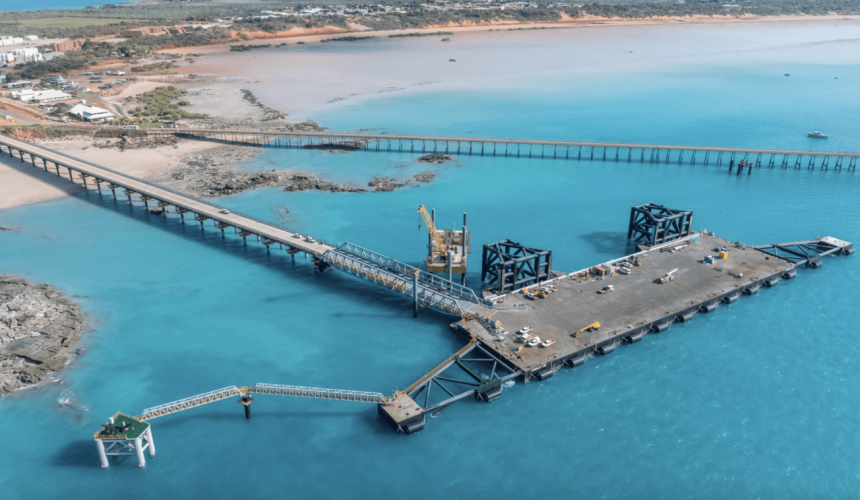
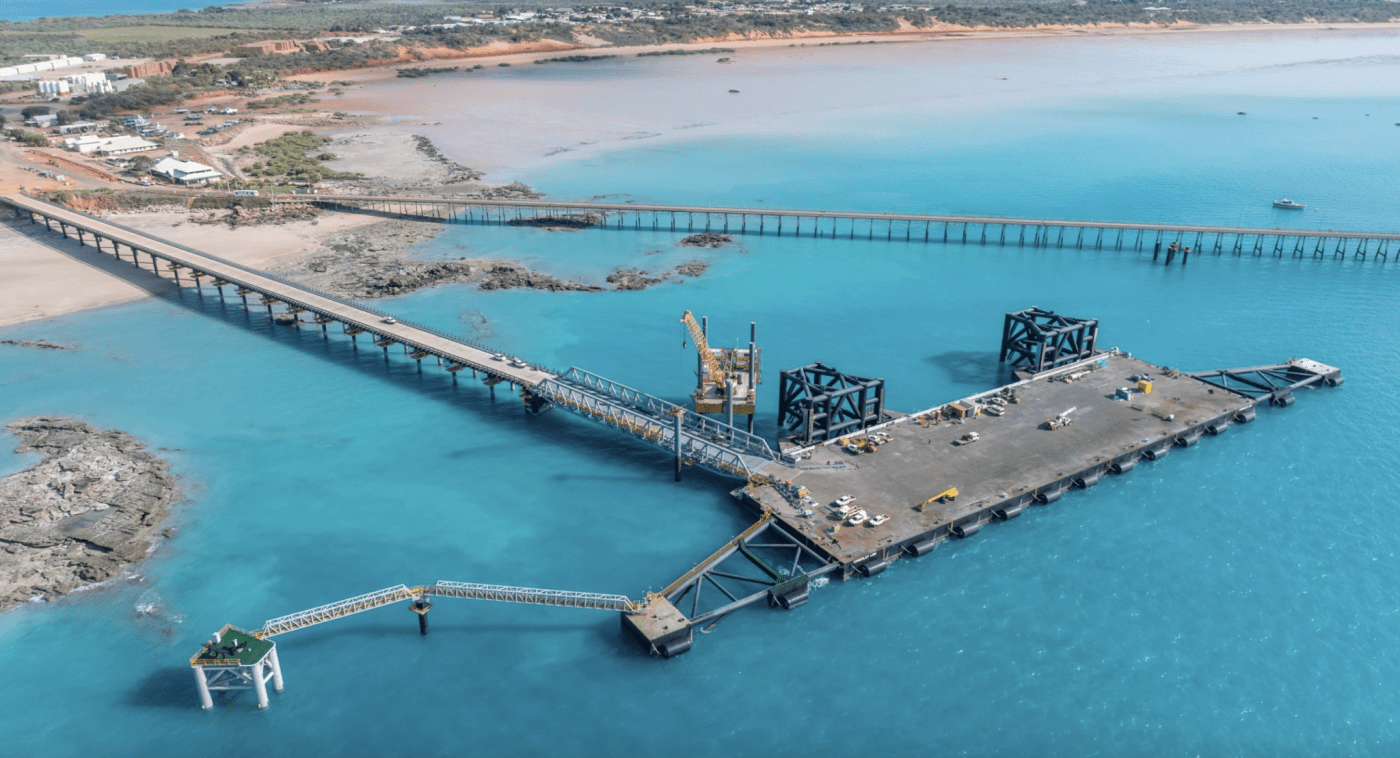
The newly opened 24/7 tide-independent floating wharf at Broome. The Kimberley Port has become Australia’s second largest cattle export port in 2025.
Australian cattle exports to Indonesia have surpassed 402,264 head for the calendar year-to-date, marking the highest January to September export volume since the high-turnoff, severe-drought year of 2019.
With import permits for the final three months of 2025 now understood to have been released, exports to Indonesia are also expected to pick up pace toward the end of the year as Indonesian importers begin filling feedlots ahead of Ramadan/Lebaran in February/March 2026.
Overall 572,360 cattle have been exported from Australia so far in 2025.
 That volume has included 77,279 cattle to Vietnam, 85 percent of which were slaughter weight cattle, the balance being feeder and breeding stock. The volume to Vietnam is 28 percent below the same period last year.
21,522 dairy heifers have also been exported to China so far this year, well back on the 52,599 head exported in 2024, which in turn compares to much higher numbers of 78,723 and 140,651 head exported in 2023 and 2022 respectively.
The latest figures underline the busier year northern exporters have had. A total of 325,467 cattle were shipped from Darwin through until the end of September, 72,720 head higher than the same period of last year.
An increase in export activity from Townsville during September, which saw more than 12,000 feeder cattle exported to Indonesia, has taken total export numbers from the NQ port this year to 56,432 head, still well below the 124,000 head exported in the same period of 2024.
Broome rises as second largest cattle export port in 2025
2025 has also been a year of stronger export activity from northern WA, with 72,574 head shipped for the year to date from Broome, matching the entire volume of cattle shipped from the port in the 2024 calendar year.
About 65 percent of that volume has comprised feeder cattle shipments to Indonesia, 25 percent were feeder, breeder and slaughter cattle to Vietnam and 10 percent were feeder cattle to the Philippines.
That volume ranks the Port of Broome as Australia’s second largest cattle export port in 2025, ahead of Townsville, Portland (49,913 head – with 15,000 head to Mexico and 5000 to Turkey supplementing dairy heifer export volumes amid China’s decline) and Fremantle 49,682 head.
September also saw a new significant investment launched at the port in the form in a state-of-the-art floating wharf, engineered to operate 24/7 despite Broome’s extreme tidal variations (up to a 10m tidal spectrum). The floating wharf design provides a fixed height relative to visiting vessels throughout the entire duration of cargo operations, thereby removing tidal constraints, and facilitating rapid vessel turnarounds.
The Kimberley Marine Support Base Pty Ltd’s Marine Offloading Terminal was officially opened by the Minister for Ports Stephen Dawson MLC on 12 September 2025.
“Our floating wharf at KMSB is designed for ‘non-tide dependant’ operations – removing the bottlenecks that have long-plagued supply chains within the region. For resources projects, food and fibre exporters, cruise ship lines, and government alike, this is about certainty, efficiency, and continued regional development across diversified industries,” Founder and Managing Director Andrew Natta said.
He said the KMSB will boost productivity, safety and reduce costs for established Kimberley businesses in the agricultural and resources sectors, while also allowing cruise ships to come alongside for passengers to visit Broome without the need to wait for appropriate tides.
The facility would also enable the growth of new sectors – such as proposed critical minerals and renewable energy developments – by providing the necessary infrastructure for handling specialised cargo like wind turbines, solar systems and commercial battery imports.
The substantial infrastructure includes an 11,500 tonne, 9,250 square metre structure with a 255-metre berth line, between northern and southern dolphins, as well as a 400-metre bi-directional causeway and an 85-metre linkspan bridge. Ultimately, KMSB is designed to support vessels up to 348 metres LOA.
16,474 cattle have also been exported from the northern WA port of Wyndham for the year to date.