
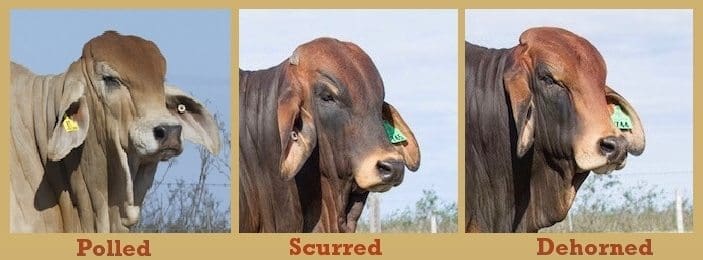
FOR decades, any discussion around breeding for polledness has inevitably attracted comments or observations from some producers stating that horned cattle have ‘more bone’ and are ‘more productive’ than their polled counterparts.
These comments often go further – particularly on social media, where producers readily state polledness causes ‘cattle herds to go backwards’ as well as ‘reducing carcase yield and overall value.’
While it is easy to make these statements, the science doesn’t support any of the claims. Put simply, horns and bone are different structures, governed by different genes, and removing horns has no measurable effect on skeletal integrity, carcase value or productivity.
A paper published this year in the journal Biology (Xu et al., 2025 – The Development of Horns in Bovidae and the Genetic Mechanisms Underpinning This Process) summarised the latest understanding of horn development across cattle, sheep and goats.
 The evidence presented in this research demonstrates that horns are specialised skin appendages, not extensions of the skeleton. Horns are formed from neural crest cells in the skin above the skull, creating a small bony core surrounded by connective tissue and covered by a keratin sheath. In total, horns account for less than 0.5 percent of liveweight – typically less than a kilogram in adult cattle.
The genes that control horn growth, identified within the paper as RXFP2, FOXL2, HOXD1, TWIST1, and ZEB2, act locally in skin and skull tissues. They have no role in long-bone or vertebral development.
Polledness is a mutation that occurs in a regulatory region on chromosome 1 that turns off horn bud formation in the embryo. This paper confirms that horns and bone are biologically and genetically separate: one does not influence the other.
The comments around the amount of bone animals have is also worth noting. Several decades or research focussing on carcase composition, commencing in the 1960s with work be scientists such as Professor Rex Butterfield and Dr Norman May from the University of Sydney, through to work done in the CRC for Beef Cattle, established the ratio of carcase composition in beef cattle.
These ratios are consistent across breeds and horn status. The muscle-to-bone ratio averages 4:1, meaning that bone is a relatively fixed proportion of bodyweight, regardless of the presence of horns.
Removing horns or selecting for polledness has no measurable impact on the carcase composition or dressing percentage of cattle.
Live animal composition
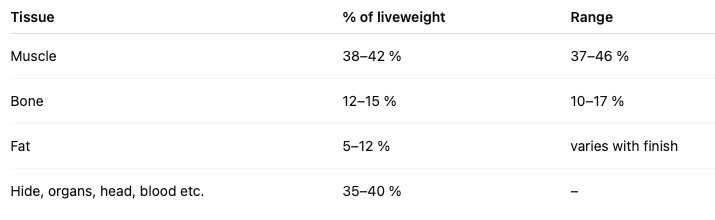
Source: Butterfield & May. 1966
Why select for bone?
Underlying these comments and criticisms, there is an often-overlooked question: Why would cattle producers want to increase the amount of bone in their cattle?
From a production standpoint, there is no advantage in having more bone. While bone contributes to liveweight, it doesn’t advantage the level of saleable meat yield. The reality is that bone is a non-edible weight that adds cost to transport and reduces saleable kilograms per carcase.
The structural strength needed to support growth and longevity is achieved through bone quality, not quantity, and there is no evidence that polled cattle have weaker skeletal integrity or are less robust in the paddock.
Historical selection patterns
The belief that horned cattle are ‘better boned’ has probably developed through historical selection patterns, not biology. Of the major breeds in Australia, except for the naturally polled Angus, horned cattle have dominated structured breeding and performance testing for decades.
Many of the foundation sires that built breed progress in growth, fertility and carcase traits were horned, simply because polled populations were smaller or newer.
By contrast, early polled herds were often selected primarily for horn status rather than comprehensive performance across multiple traits and have had fewer generations of genetic improvement. This has created a perception that horned animals are inherently more robust or better performing, when in fact, they have simply benefited from more selection pressure over time.
As polled populations expand and undergo the same rigorous selection, their performance can be equal to, or in cases where selection is clearly focussed on a balance of traits, better than some traditional horned lines.
While breeding for naturally polled cattle has clear welfare and management advantages (as discussed in this earlier article), it is crucial to avoid making this the only focus. Selecting solely for horn status without equal emphasis on fertility, growth, structure or efficiency risks slowing herd improvement.
Producers need to clearly focus on their breeding objectives and select sires that are best suited to those objectives. Polledness is a desirable outcome for herds, however this is a trait that must be kept in balance.
In the short-term using high-merit horned sires may be a practical solution for some producers, provided there is a focus on total genetic merit rather than horn status alone.
More broadly across the industry, there are numerous breeds with both horned and polled cattle. There is a clear opportunity for these breeds to increase their levels of performance recording.
In growing the data sets within breeds, it will become easier for bother seedstock breeders and their clients to identify animals with higher genetic merit alongside their horned status. Without robust performance data, visual impressions and anecdote dominate the discussion.
Objective measurement is the only way to identify the genetically superior cattle, regardless of horn type.
Extra bone doesn’t increase productivity or profitability
As the 2025 bull selling season draws to a close, there is already discussion about why horned and polled bulls have sold differently. While it is easy to look for simple explanations, the evidence suggests these differences have more to do with breeding history, selection intensity and market familiarity than the presence or absence of horns.
Extra bone doesn’t increase productivity or profitability, and the apparent gap between horned and polled cattle is a greater reflection of how long and how hard populations have been under selection pressure rather than on any physiological limitation.
Producers need to remember that horns are skin-derived appendages, not indicators of skeletal strength or carcase yield. The genes that control horn growth act independently of those influencing bone and muscle development.
Horns add handling risk but no commercial benefit. Carcase value and overall profitability is derived from fertility, growth and muscle, not from what’s on the head.
- Read Al Rayner’s previous Weekly Genetics Review discussion about breeding for polledness, published last month.

Alastair Rayner
Alastair Rayner is Principal of RaynerAg and an Extension & Engagement Consultant with the Agricultural Business Research Institute (ABRI). He has over 28 years’ experience advising beef producers and graziers across Australia. Alastair can be contacted here or through his website: www.raynerag.com.au
You are correct in the assessment that most breeds have been bred as predominantly horned for longer and that selection pressure on these horned herds have created a superior animal. The problem lies in the promotion of inferior polled genetics that haven't had the same levels of selection over long periods and as such we are seeing a wide variety of the crossed progeny hitting markets, some good, some not so. Adoption of straight polled herds amongst breeds that have developed through stringent selection in horned populations, can if using carefully selected genetics, be a big improvement. But unfortunately we are seeing the wide spread use of inferior polled genetics, which has produced lighter framed, tight skinned, less fat coverage, temperament issues, fertility problems, structural changes( ie: narrow pins, narrow hips, flat ribbed, etc.). Media hype and articles suggesting the exclusion of horned cattle from markets do nothing to improve the adoption/adaptation of polled genetics into the beef populations, only to influence readers away from quality horned genetics that can and do supply quality article in the current beef system.
perfectly said. cheers Matthew Della Gola
the problem with the rush to polled genetics through using supposed mutations within the breed and or bringing outside genetics from other breeds is that some were substandard and ultimately affected the constitution of many prominent horned breeds. throw in single trait selections and its pretty obvious to see where some breeders have lost their way. can we also not forget the angus breed isnt completely polled. cheers Matthew Della Gola
<strong>Care to elaborate on your claim that the Angus breed is not completely polled, Matthew? Editor</strong>
if you type into Google.
"is the angus breed completely polled" you will find your response. it's was at one point and it may still be buried on the angus australia website.
we have had horned baldy calves from horned or hetro hereford bulls over angus. we have had one angus calf born with scurs. the genetics were from registered angus cattle. granted it should be less and less within the breed the gene still exists. cheers Matthew Della Gola.