


Australian consumers taste test Angus and Wagyu Angus cross cattle using the MSA protocol.
The Middle East is seen as a growth area for Australian beef with the United Arab Emirates (UAE) and Saudi Arabia markets having both been consistently among Australia’s top 20 most valuable beef export markets.
To better understand what type of beef Middle Eastern consumers prefer and how that compares to Australian tastebuds, researchers had 360 untrained participants from the UAE and 360 Australians evaluate 1,260 grilled samples of Aussie beef.
Consumers evaluated the tenderness, juiciness, flavour and overall liking of beef cuts including bolar blade, rump centre, eye rump side, outside flat, rump cap, striploin from purebred Angus and Wagyu Angus cross cattle using the Meat Standard Australia (MSA) protocol.
The study highlighted the similarities in consumer preferences as the highest scores for both countries were predominantly observed in the rump cap muscle, whereas the lowest scores were associated with the outside flat muscle.
MSA applicable to Middle Eastern consumers
“Currently, the MSA is the most reliable and advanced red meat grading scheme in the world, having been used in 13 countries,” Dr Peter McGilchrist one of the report authors said.

Dr Peter McGilchrist, Professor of Meat Science at the University of New England (UNE).
“However, Middle Eastern consumers primarily consume lean domestic beef, and traditional local dishes which often involve slow cooking. Whereas the MSA recommended cooking methods are grill, roast, stirfry, thinslice, slowcook, shabu shabu (a Japanese style hotpot) and yakiniku (a Japanese style grill).”
Traditionally high fat meat has not been preferred in the Middle East however there has been a steady rise in high-quality beef to that market, which is why the researchers wanted to use MSA to assess if the acceptance of high-quality beef was equal to that of domestic consumers
“We asked the question – how do Middle Eastern consumers perceive premium beef, compared to domestic Australian consumers, when the 25mm steaks are prepared using grilling methods?” Mr McGilchrist said.
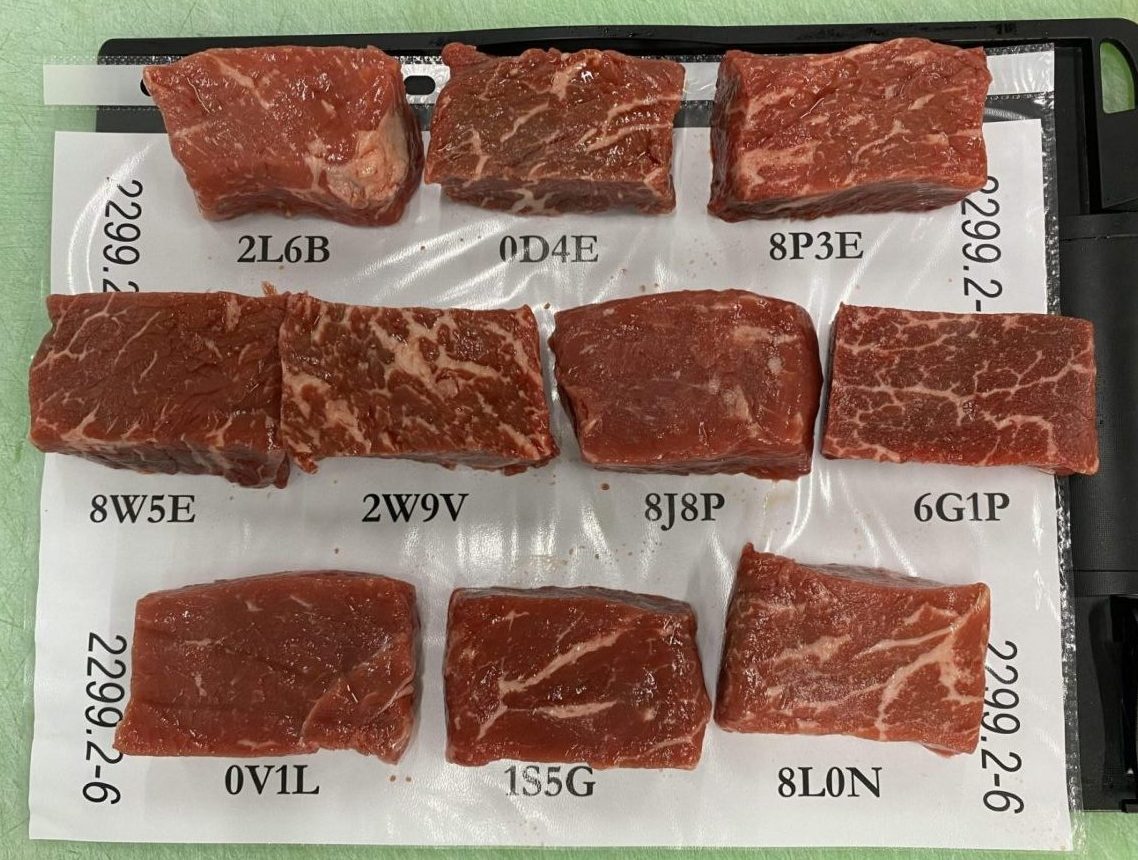
Consumer taste testing samples.
The study reaffirmed the applicability of the MSA model for Middle Eastern consumers while also highlighting areas for refinement, particularly for certain muscle types like the rump cap, which exhibited superior eating quality.
Importantly, the study showed that the ranking of cuts didn’t change between countries.
This means that the samples ranked the best and worst by Australians maintained their positions as best and worst by the Middle Eastern consumers.
The study also assisted Australian beef exporters in gaining a deeper understanding of Middle Eastern consumers’ preferences within the premium quality beef segment.
“Understanding the factors influencing food acceptance and choices across various cultures, as well as identifying opportunities for successful product development that resonates globally across diverse cultures, is essential for thriving in increasingly varied and competitive markets,” David Packer, MSA Program Manager at MLA said.
“The ability for Australian brand owners to use the Eating Quality Graded (EQG) cipher on the carton label rather than a dentition, is powerful for marketing meat on quality not how many teeth it did or didn’t have.
“Not only will this important data enhance the future MSA predictions of beef, but it compliments the continued business development work that the MLA are conducting alongside brand owners in international markets.
“This further aids in differentiating Australian red meat around the world and supports the importance of educating customers around understanding eating quality and buying Australian beef beyond traditional specifications.”
If its so comprehensively tested then the MLA should publish fields for Age, Sex, Weight, Breed, Farm, Feeding Regime, Location, Butcher, Wholesaler.. etc instead of publishing almost nothing with the forementioned of course kept as ( ) Blankety ( ) Blanks ( )
Part 2 Producers should be able to obtain their own individual EQC on their prime cattle with the assistance of the MLA and Wholesalers/Butchers for a reasonable fee.
Part 3 Consumers should be able to score and contribute their own individual EQC rating (feedback) with the assistance of the MLA and Wholesalers/Butchers
Imagine the day that a Producer might be able to say prior to and at his/her Point of Sale the recent EQC feedback rating of 2025 Farm Bred Steers tested was "Excellent"
<strong>Appreciate the creative thinking, Mick, but this opens up an enormous can of worms. Consumers can absolutely stuff a perfectly acceptable piece of meat in the cooking process. We'd hate to think that would become part of any extended 'feedback' model. Editor </strong>
Things the MLA wont publish or don't know ?
How other Breeds compare to Wagyu/Angus in a Middle East steak tasting study.
Were the Wagyu / Angus steaks from a heifer, bull or steer?
How old were the cattle ? calf, vealer, 1, 2 year old?
What did the cattle weigh, in kg?
Where were they bred ? and their District and State?
Can they trace any point of sale information including the Breeder, the Agent, or the Buyer?
All the above information is required from the Breeder by the Agent at point of sale and appears to be totally lost or absolutely pointless if the Breeder cant receive any real feedback.
Who were the Butchers/Wholesalers ?
It is 2025 the Age of DNA, Artificial Intelligence, Blockchain, Super Computing and yet the MLA don't seem able to record or retrieve any basic point of sale information other than the breed and Country of Origin Australia and the eventual cut of meat eg 25mm Angus (or Wagyu) Rump Steak.
Summary: Does the MLA really have any idea of what sex, weight, age, these beef steak cuts exactly were (and the location of their farm ) that made up the 1,260 grilled samples of Aussie beef consumed and if not, why not ?
<strong>As with any MSA consumer taste test trial conducted over the past 25 years, Mick (more than 800,000 tests have been conducted involving 114,000 consumers) there will be detailed production and origin records behind the samples used in the Middle East study, covering age, gender, breed type, feeding regime, chiller assessment and MSA grading data, aging etc etc etc. It could hardly be more comprehensive. Editor </strong>