
TWO large grainfed beef supply chains – one based in Queensland and the other in NSW – have abandoned their use of Meat Standards Australia grading, throwing up questions about whether after 27 years the program is still fit for purpose, or is in need of some revision.
Neither company was prepared to speak on the record about their reasons – in fact one ignored Beef Central’s persistent phone calls, text messages and emails over the past fortnight – but the other was happy to offer some off-the-record background.
Certainly, there has been a belief evident in some industry circles that ‘simply grainfeeding’ reduces the need to MSA grade to underpin consistency of tenderness in beef carcases. That comes despite the fact that MSA in its original form was squarely targeted at grainfed beef.
Click on image for a larger view
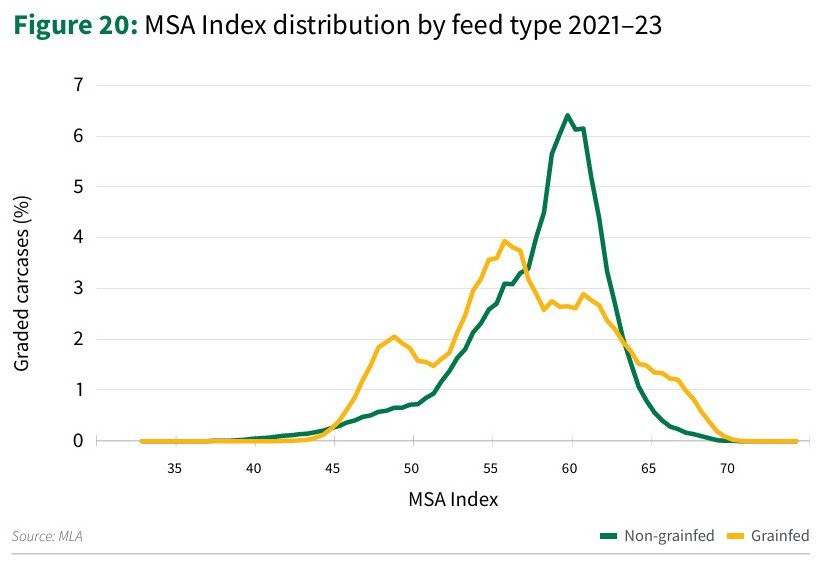
Views like that are not supported by this graph from MLA’s biennial ABEIQ report, plotting all grainfed cattle (yellow line) graded between 2021-23 which clearly shows MSA grainfed index scores in a dramatically wide range from about 45 to 70. The multiple ‘humps’ in the grainfed line reflect HGP status. The MSA index performance has lifted a full index point since 2011, with drought years clearly having a negative impact.
In Queensland, one of Australia’s largest grainfed beef processors no longer MSA grades its carcases. The company involved started MSA grading all its grainfed cattle (with the exception of its Wagyu programs) in 2018, after a large commercial trial.
““The trial results were compelling, for our new business model,” a company spokesman said at the time.
“We see MSA as further enhancing and supporting our customer-focussed objective, up and down the supply chain. Even though 100-day grainfed cattle tend to be reasonably consistent in carcase weight and fatness, it does not necessarily mean that eating quality (as measured by MSA index) is going to be exactly the same in every carcase,” he said.
“We fundamentally believe that MSA grading will add further value to our customer experience around the world. It effectively enables us to better ensure that the right customer is getting the right product, every time. It means we can deliver a more consistent eating experience in every market we service,” the spokesman said back in 2018.
Second departure
In the past three months, another large grainfed supply chain – this time located in southern Australia – has pulled out of MSA grading. That decision applied to only one of the company’s higher marbling score (2+ and 3+), breed-specific, no HGP programs, all YP or YG age cipher, with all other grain and grassfed brand programs continuing to apply MSA grading.
We’ve estimated that when combined, the two large brand departures may account for about 7-8pc of typical national MSA grading numbers. The departures are not immediately evident in MSA grading throughput statistics, because in fact, other operators have lifted their grading numbers over the same period, partly masking their absence.
A spokesman for the brand program that has most recently pulled out of MSA agreed to discuss the move with Beef Central, on condition of anonymity.
He said his company’s decision was made because many overseas customers were content to trade quality Australian grainfed meat based on a simple set of parameters including marbling score, age/maturity, carcase weight and meat and fat colour.
“The simple fact is that with the better grainfed cattle producing higher marbling scores, of certain breeds, and perhaps managed under no-HGP programs, much of the tenderness inconsistency issue is eliminated – without the need for MSA,” he said.
“Grading for MSA adds cost to our business and can slow down production through sortation, chiller management and other requirements,” he said.
The adoption of some of the new objective carcase measurement technologies was also a factor in his company’s decision.
“We’ve collected enough data over the past ten years to satisfy ourselves that this particular product does not suffer in terms of quality or consistency, by removing MSA,” the spokesman said.
The contact denied a suggestion that removing MSA had anything to do with the fact that it was presently ‘incredibly easy’ to sell quality Australian meat on the world market, due to deep shortages in the US, Europe and elsewhere.
MSA a victim of its own success?
Beef Central approached respected independent meat scientist and consultant Dr Alex Ball for his take on the reasons behind processor departures from MSA.

Dr Alex Ball (standing) with taste panellists involved in a Wagyu branded beef competition
We asked Dr Ball whether at the upper end of the beef quality scale, marbling score was becoming a defacto beef grading system.
“Absolutely,” he said, “particularly for those higher quality brand programs.”
Marbling score was one of the key drivers of that competitive position. For example a really good Australian Angus grainfed product going into the US or the Middle East region would compete against universally-known and understood USDA Prime graded beef.
“USDA Prime is marketed predominantly on marbling score, so in the international market space, how does an Australian exporter compete against that? The EQG cypher was established to help compete in the international market, but it does takes time for acceptance.”
“The challenge is that marbling score only represents about one third of the influence around tenderness and eating quality consistency. But nowdays, consumers buying a four or five star product are accepting that they are ‘probably’ going to get acceptable tenderness, and are definitely going to get juiciness in what they buy.”
“What’s the trait that’s really driving those parameters of flavour, juiciness and overall liking? Marbling has a fair influence on that,” Dr Ball said.
“Get into a program where a product is grainfed, its Angus or a superior eating quality breed, and its got no HGP, then it’s much more likely to eat pretty well, all the time – when competing in the US against a US Certified Angus Beef option, graded Prime, with a marbling score 4+.”
He stressed, however, that for other segments – Certified Grassfed or shortfed domestic cattle fed perhaps 70-100 days – MSA still played a very important role in delivering consistent tenderness. It remained ‘absolutely fundamental’ for any product (grain or grass) producing marbling scores below 2, he suggested.
“However, for the right cattle (ie superior marbling performance), the competitive value of having MSA grading is less and therefore each company will make a value judgement on MSA grading provides and what costs are incurred.”
Dr Ball made the observation that for newer Australian beef brands entering the market, it was still ‘almost essential’ to embrace MSA to remain competitive.
“But for those well-established higher-quality brands that have a strong domestic and international footprint, it may become less valuable as other drivers of brand value emerge such as sustainability, welfare and provenance.
“Go to any good steak restaurant or even better quality pub in Australia or overseas, and you rarely see MSA mentioned. On the menu, it’s all about brand, marbling score and/or breed,” he said. However, having MSA is a bit like ‘Intel’ it just ensures that product that’s inferior doesn’t enter the marketplace, particularly for grilling cuts.
Has MSA’s value proposition changed?
These recent developments pose the question: Is MSA still fit for purpose, at the upper end of the grainfed quality and marbling spectrum?
Underpinning a lot of this discussion is the national industry’s long-term move towards more grainfed finishing systems, and higher quality.
“Once its established that a product is sold under a grainfed cipher, we know it is going to be good meat colour from the start (grainfed cipher requires maximum meat colour of 3), we know it is going to meet the minimum requirements for fat cover, we know it is going to be within an acceptable carcase weight range. And once the product gets to a marbling score of 4 or higher, it is a pretty robust product, eating quality and consistency wise,” Dr Ball said.
As he saw it, the real challenge to the MSA system was that as overall eating quality continued to improve (MSA eating quality index scores have continued to increase since the program started in 1998 – see graph below), both in upper end of the Wagyu and Angus space, the value proposition becomes less clear.
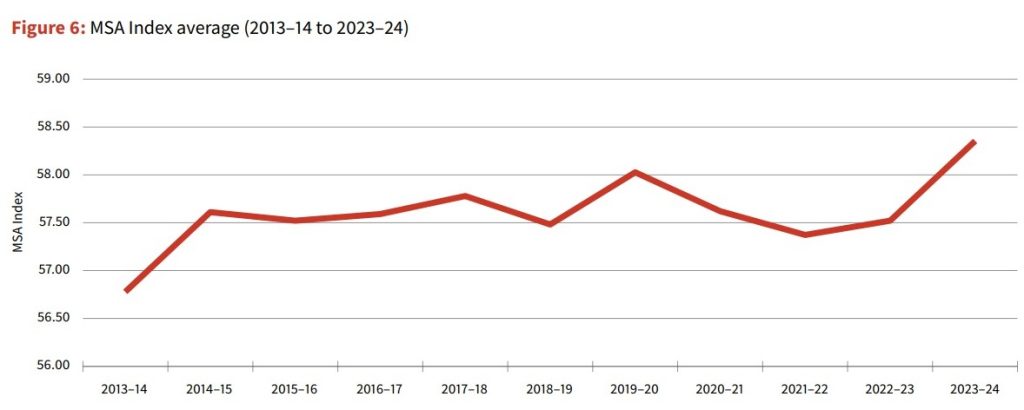
“The changes being seen in MSA index scores over time through events like the Beef 2024 and Beef 2021 National Beef Carcase Competitions clearly show that we are changing the quality profile of the Australian beef herd very quickly,” Dr Ball said.
“Basically, MSA was originally designed to take the rubbish out of the market (the bottom end of the bell curve), and it has done that incredibly well. But was it really designed to categorise that top-end product that wasn’t there 30 years ago? Potentially not,” he said.
“It’s fair to say that within the expanding Australian Wagyu segment, there have been plenty of brands that have yet to embrace MSA, because they are completely focussed on being a marbling play – tenderness is almost a given. But equally, there are highly-marbled beef brands that remain very much in support of MSA.”
But to some extent, MSA was becoming a victim of its own success.
“The real challenge for the Australian beef industry, as we continue to increase quality and consistency and start to really differentiate that top-end product, is whether we have the tools and technologies to enable us to really reposition our premium product in the international market” he said.
Testing for fatty acid profiles was offered as an example – currently being explored by the Wagyu industry, but equally relevant to other marbling breed types.
“In addition, we see the significant investment that processors are making in objective measurement technologies to ensure that the accuracy of prediction of eating quality is enhanced and we expect that new technologies will continue to emerge,” Dr Ball said.
Currently, the MSA fixed model is based on a 30pc weighting in eating quality scores on tenderness, 30pc on flavour, 30pc on overall liking and 10pc on juiciness.
“But we know from branded beef competitions that once you move above that marbling score 6+, and particularly in the score 8-9+ range, which exceptional Angus products and Wagyu cross are now hitting – tenderness considerations are less relevant, and flavour and overall likeability are more important,” Dr Ball said.
AusMeat marbling to align with USDA
For those higher quality export brand programs not using MSA, they often used AusMeat marbling scores (instead of marbling measured under MSA grading) to seek equivalency with USDA grading levels.
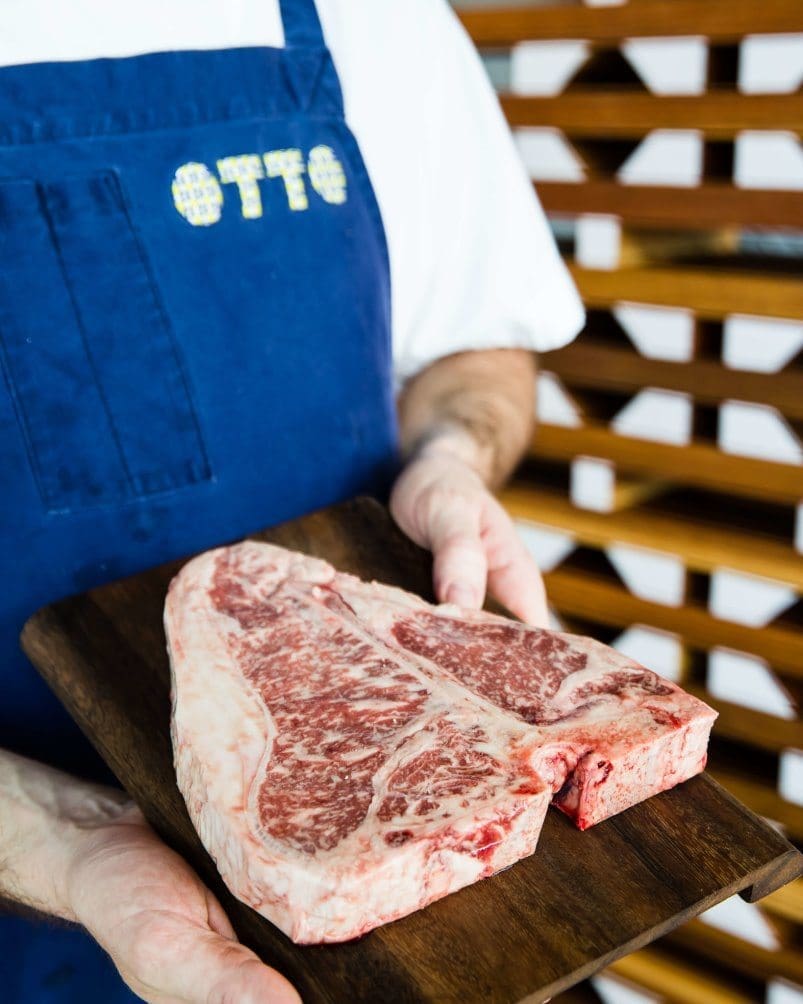
Highly marbled Rangers Valley bistecca being prepared for service at Sydney’s Otto restaurant
Depending on carcase weight, USDA Choice grade roughly equates to AusMeat marbling score 2, with USDA Prime aligning with marbling scores +3-4 and higher.
In simple terms, it’s not that hard for a customer in Chicago or San Francisco to order an Australian grainfed product that closely equates to USDA Prime or Choice – perhaps specifying straightbred Angus, carcase weights 320-400kg, fat cover +8mm.
“That would deliver very, very close to a USDA Prime graded product,” Dr Ball said.
From the bigger picture perspective, as more and more Australian cattle go through grain-finishing systems, the national herd is going to continue to evolve towards eating quality genetics, Dr Ball believes.
“And the challenge is that the top end of that grainfed product range is largely not being graded for MSA, meaning we are probably not seeing the real genetic shift that’s happening,” he said.
“The value proposition on doing MSA grading on a Fullblood Wagyu animal fed for 400 days is probably difficult to quantify,” Dr Ball said.
“Perhaps the program needs a re-set – particularly at that top end of the marbling score range, if it is to remain relevant. Currently, our ability to differentiate above a Wagyu marbling score of 9+ is low. That is an industry challenge that will have to looked at as we move to IMF as the gold standard measure of marbling.”
“And it’s similar for British-breed brands out of Whyalla, Rangers Valley and elsewhere that are consistently hitting marbling scores 6+. Are the current parameters we have in the MSA model fit for those top-end brands?” he asked.
“Australia can produce a premium product which is at the extreme top end of the USDA Prime grading range, but our ability to differentiate that requires new science to help us do it.”
“We raised the question during the Beef 2024 national carcase competition last year. As we start to see MSA grading index scores at the top end of the 67s and 68s, is that really the ceiling point, or do we need the science to think about where the program needs to be in the future?”
Averaging or VBM?
If the beef industry was to truly chase the ideal of Value-Based Marketing, the top end of the performance range needed the ability to differentiate itself further –otherwise it simply gets averaged-out, Dr Ball warned.
He said for those brands that had discontinued MSA grading, they were making commercially-relevant decisions for their own business practises, and how they want to position their brands in the marketplace.
“There’s nothing inherently wrong with that, but the beef industry does need tools like MSA and the MSA index to continue to drive change,” he said.
MSA was developed to GUARANTEE the eating quality of beef and it did this better than any other system in the world. It went even further than guaranteeing tenderness, it could guarantee premium tenderness for those seeking a higher quality, and for those seeking the ultimate in eating quality it could guarantee supreme tenderness which carried a gold label. Yet here we are largely leaving the consumer to try and pick this brand or that brand, when we could lead the world in absolutely guaranteeing the tenderness of our beef to both our Australian and overseas consumers by adding the MSA category.
Meets MSA specifications, fails company specifications. See it all the time.
A great article and interesting interview with Alex Ball. With all of the investment to produce 6+ product it is important that we maintain the ability to differentiate and most importantly reward this product. Sounds like we might finally be ready for VBM even if only at this top end for start. Like all good grading systems they need to evolve & it sounds like it is time for a reset with MSA.
It once again appears the processing sector play by their own rules while producers are forced to adhere to an ever growing stream of compliance.
<strong>MSA is not a mandatory system for anybody in the supply chain, Mike. Those who choose to participate do so. Editor </strong>
editor, you are correct in saying that msa isnt mandatory. the problem is if you don't send your livestock away with a msa form you automatically receive a lower price. so the term voluntary is misleading. I think the frustration mike is alluding to is that msa ontop of our mountain of other regulatory requirements is becoming very frustrating/ tiresome and seems to be forever growing without simplifying/ reducing. let me be clear msa didn't add more value to producers. we just got paid less if we didn't use msa. cheers Matthew Della Gola
Eating quality - are there other factors involved?
I have a question for Dr Alex Ball.
Would it be fair to say that Wagyu, Jersey and even Friesian are all amongst the highest eating quality cattle breeds?
If so, is meat fineness, thin skin and lesser bone all predictors of good eating quality?
<strong>Worth noting that in Japan's grading system, some emphasis is placed on the fineness/coarseness of meat texture. Carcases are graded into five levels, with woven fabric textures sometimes used to illustrate the differences. Level 1 is 'hessian', level 2 is 'linen', level 3 is 'cotton', 4 is 'satin' and 5 is 'silk'. MSA explored the characteristic of meat texture decades ago, but could find no correlation with degree of tenderness in Australian carcases. Editor </strong>
Hello Rob,
The variation between breeds in eating quality is in many cases larger than the differences between breeds. Obviously, some breeds have strengths in some key components of eating quality, but not all elements. Industry is full of anecdotal elements that are linked to eating quality. Muscle structure does have an impact on eating quality. I have not seen any reputable scientific evidence of skin type, hair type etc on eating quality, despite often being told that they are important.
If you are interested the recent addition of 'Lawrie's Meat Science' 9th edition has some excellent reviews. You do have the purchase the book though.
Regards
Alex
Appreciate your reply Alex.
I will be having a look at Lawrie’s Meat Science, 9th Edition. Thank you.
I’m interested in Phenotypic indicators of eating quality.
While industry has observed so many techniques to improve eating quality in the last 40 years, eg. LSS, maximum in-transit time, rehydration, electrical stimulation, no HGP, hump height, PH, indicus content, marbling and age at slaughter, there is still meat on shelves that doesn’t stack up on tenderness.
On the phenotype side of selection, the last 40 years have seen industry demand changes such as moderate to heavy bone, big increases in EMA, butt profile and increased live weight.
It would be great to know if these increases in bone, muscle and hide thickness are detrimental to eating quality?
The observation from Alex...."Industry is full of anecdotal elements that are linked to eating quality"... is correct, as are many of the anecdotes which ignore scientific evidence related to the beef industry.
Any decision to depart from MSA grading might be attributed to laziness or cost-saving however from both producer and consumer perspectives, it's disappointing. There is plenty of tough-as-boots, grain-fed, high MBS beef bought by unwitting consumers in this country.