
CQU experiments have identified pigeon peas as a promising inclusion in supplementary feed for northern Australian cattle.
CROPPING as an adjunct to northern Australian beef cattle enterprises has potential to create an additional income stream, and get cattle to target weights faster.
That was the message from CQUniversity’s Simon Quigley during his presentation in the Agriculture diversification in Northern Australia session at TropAg, held in Brisbane earlier this month.
Professor Quigley spoke on the topic of Integrated crop-livestock systems to support new feeds and feeding strategies for cattle in Northern Australia.
“Agronomic expertise now exists across the north, so really, it’s the best chance that we’ve had for a long time to make this work in northern Australia,” Prof Quigley said.
After “many attempts over the last 50 years”, Prof Quigley said cropping has expanded significantly in recent years, and pulses, cotton, and cereals all had potential for incorporation into northern Australian beef cattle enterprises.
“The pulse grains look really good to us because there’s multiple feed uses as a grazing crop or a grain crop in supplements, or in feedlot rations, or in commercial weaner mixes.”
Local feed demand
Prof Quigley said more cropping can be expected to generate co-products to displace what is brought in from southern Qld or overseas to satisfy’s North Queensland’s existing animal feed demand, and growing locally is now a solid option.
“This is all cattle feed, whether it’s coming out of a mill or a gin or a crushing plant, or whether it’s crop residues that are left in the field.”

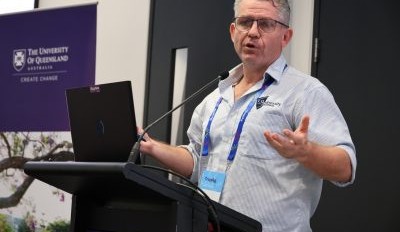
CQU’s Professor Simon Quigley presents at TropAg 2025.
While chickpeas were worth around $900/t on farm at planting time, they got down to around $500/t in early November, just above where they would price into the stockfeed market.
“Anything with a four on it is cattle feed,” Prof Quigley said of the chickpea complex.
North Qld recently exported its first chickpea cargo, and is an established exporter of containerised sorghum and mungbeans.
While human-consumption markets can offer premium pricing, broadacre crops may well stack up as local cattle feed.
“These feed mills… are looking for cheaper, locally grown alternative feedstuffs that can replace what they’re…trucking in from south-east Queensland, which has added so many hundreds of dollars a tonne on to soybean meal and things like that.
“They’re importing and shipping up to Richmond, for example, to make a weaner ration that they then sell to producers.”
Imported product, namely soybean and copra meal, and palm kernel cake, are available, but are impacted by “lumpy supply”.
“We’re looking for alternative feed sources for cattle, protein and energy that can be generated locally to feed our cattle [and] reduce the costs of getting them into the cattle.
“This is where the forage crops, cereal grains, pulse grains that can be generated in northern Australian cropping systems might fill those gaps.”
Slow uptake on mixed farming
The three-day TropAg program looked at tropical agriculture globally, and Prof Quigley noted that mixed farming in tropical Australia was a rarity.
“Up until now, there’s been limited integration of crop and cattle systems in northern Australia compared to other tropical regions.”
They include South-east Asia and the Pacific, where CQU has worked with the Australian Centre for International Agriculture Research on numerous projects, as well as Central and South America.
“That is the opportunity for northern Australia, where the tyranny of distance and isolation adds extra cost to a beef cattle enterprise.”
Prof Quigley said integrated cropping and cattle systems present a risk-management opportunity that a cattle-only enterprise does not.
That comes through options to graze and/or harvest the crop, with harvested tonnage able to be stored on-farm for cattle feed, sold for cash, or kept for seed.
“It’s all dependent on market prices and climatic conditions [and] how that’s impacting the development of that crop.”
Chance to fill feed gap
Prof Quigley said targeted nutrition had the ability to stamp out periods of weight loss in the annual feed cycle.
“We’re talking about targeting heifers, so reaching a critical mating weight.”
“Heifers are the key ones — hitting our critical mating weight for heifers at the right time of the season so that they have a calf and reconceive for the second calf.
“Digestibility and protein content of the standing pasture declines significantly during the dry season, which can be for six or seven months of the year; that’s the feed gap that we’re trying to address, that dry-season feed gap.”
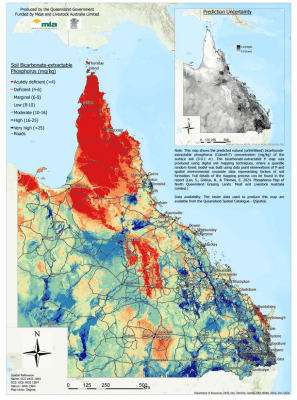
Figure 1: Acute phosphorus deficiency, as shown in red, is rife in Far North Qld, and research is looking to identify feed supplements that can counter this, as well as providing starch and protein for cattle diets.
Prof Quigley said supplementary feed can also help producers counter phosphorous-deficient soils which limit the nutritional value of native pasture.
“Phosphorus supplements or high-in-phosphorus feeds are recommended for cattle in large areas of northern Australia.”
Feedlot developments are afoot in northern Australia and Central Queensland, and Prof Quigley said they provide further impetus to accelerate achievement of target weights for live export and feedlots as well as slaughter.
“If you’re thinking of slaughtering these animals direct off pasture, you’re talking about a three-and-a-half to four-year lag period.
“That’s a long time for your return on investment, and you’re carrying animals that are relatively unproductive for a long time.”
“These are all targets for potential supplementation.”
Experiments point to pulses
Experiments conducted by CQU used nine different feeds and involved roughly 90 head of cattle with the aim of identifying crops that could provide crude protein, starch, and phosphorus.
Prof Quigley said experiments involving a range of pulses showed “very good 20-24 hours’ peak digestion in the rumen”.
“We moved ahead with mungbean as an established crop in northern Australia, and pigeon pea as an emerging crop.”
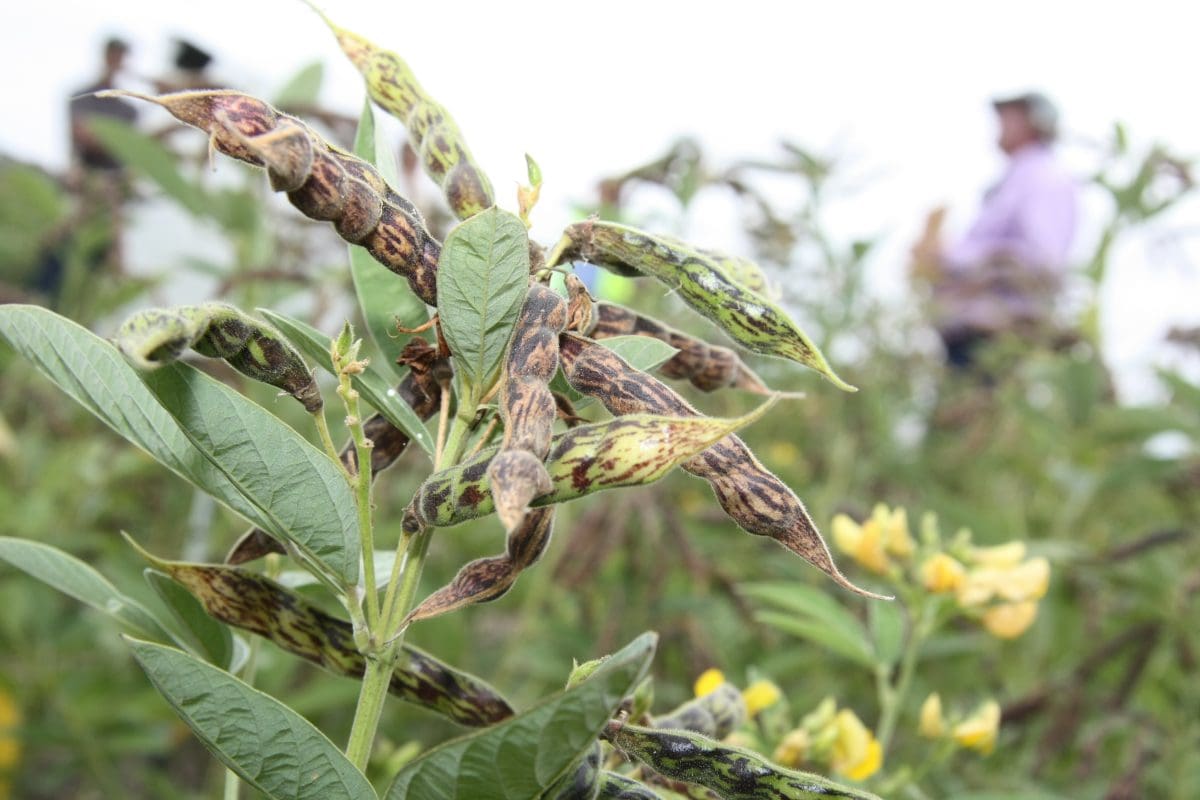
Pigeon pea has been grown as a trap crop for cotton, and is suited to semi-arid areas, with potential for grazing, or for harvesting, with the option of the pulse being fed to cattle.
“The key variable for us is liveweight gain.”
He said pulse grains promoted “very good growth rates”.
“If we convert that to an equivalent nitrogen basis, you can see they actually look better than the soybean meal…and that’s because of the extra starch that’s going in with that same level of feed intake.
“It’s that combination of starch and protein you get with a pulse grain that you probably don’t get with a soybean meal or protein meal.”
Prof Quigley acknowledged soybean meal as the “gold-standard protein source”.
At the opposite end of the scale is dry-season Mitchell grass, with low digestibility, and the propensity to sit in the rumen for a long time prior to digestion.
Prof Quigley broke it down to the use of pigeon pea as a supplement for the animal’s first dry season, which could help it achieve its target weight much earlier than it would have have without the supplement.
“That’s an extreme high input system, but you can see that’s just one strategic use of a pulse grain there.
“You can see in any dry season [or] wet season, there’s multiple times you could use these things to hit these targets, and you’re reducing those times by about 12 months.
“For example, hitting mating weight a year earlier is giving you another calf in the lifetime of that animal.
“From our work there’s certainly a range of options emerging from northern cropping systems.”
Prof Quigley stressed that more testing under controlled conditions was required.