
AUSTRALIA’S grain feeding capacity has continued its year-long surge, with September quarter capacity exceeding 1.7 million head for the first time.
The quarterly feedlot survey stats released today by the Australian Lot Feeders Association and Meat & Livestock Australia show feedlot capacity climbing by another 2.5 percent compared to the June quarter, reaching a new high of 1.749 million head.
That result is in line with Beef Central’s recent Feedlot Expansion report series (click here to access).
This growth reflects ongoing confidence and investment in the sector, with Queensland and New South Wales yards leading the charge. Queensland feedlots are now edging closer to the one million head capacity milestone, with September capacity reported at 971,857 head. NSW recorded a significant 7pc increase to 527,000 head.
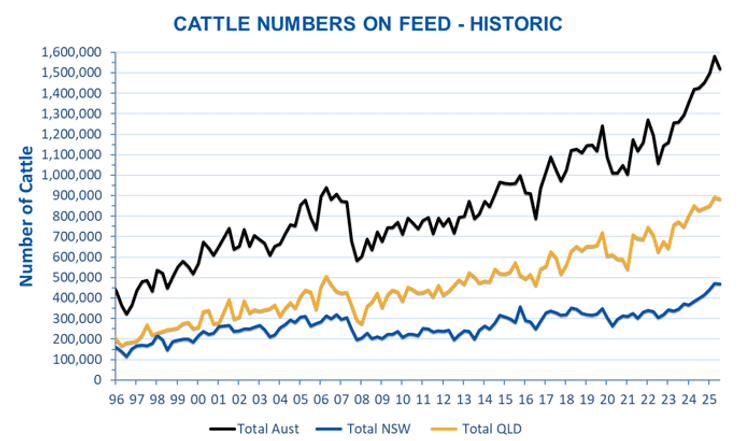
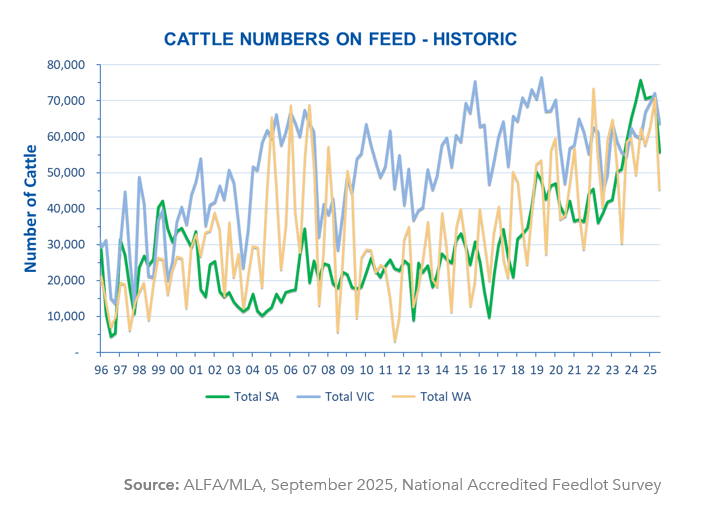
Numbers on feed last quarter eased by 3.9pc to 1,518,289 head, as feedlots regulated throughput, yet remain 7pc higher than the same period last year. Most of the decline in numbers on feed since the June quarter was seen in South Australia (-16,000 head) and Western Australia (-25,000 head), following normal seasonal cycles.
Feedlot utilisation sat at 87pc at the end of September, well above the ten-year average of 81pc, highlighting the sector’s sustained efficiency.
Note due to their differences in size, Qld and NSW numbers on feed are presented in the first graph below, and Vic, SA and WA in the graph below it. Note the high degree of seasonal volatility in feeding in WA (yellow line).
Mid-fed feeding programs continue to grow
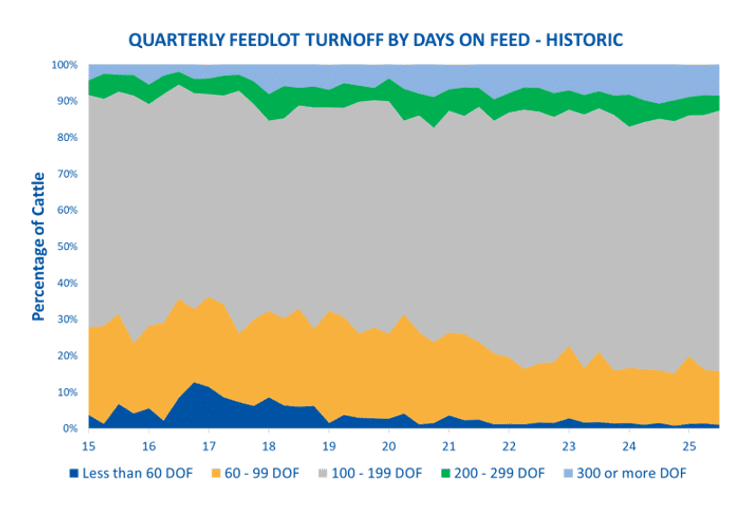
The biggest days-on-feed category growth was seen in the 100-199 days group (grey part of graph below), which took some share from the longer-fed categories 200-299 days (green) and +300 days (light blue, essentially, Wagyu). The 60-99 day category (yellow) continued its long-term decline. However that reflects overall growth in feeding, relative to domestic-fed cattle.
ALFA President Grant Garey said current expansion was a clear signal of the industry’s resilience and commitment to meeting global demand.
“The continued growth in feedlot capacity is not just a number, it’s a reflection of the confidence lotfeeders have in the grain fed production system,” Mr Garey said.
“Despite the challenges of rising input costs and market volatility, operators are investing in infrastructure and technology to ensure we can deliver consistent, high-quality beef to both domestic and international customers,” he said.
“This level of investment underpins the sector’s long-term sustainability and its critical role in the Australian beef supply chain.”
Turnoff last quarter also hit a record, with 962,436 grainfed cattle processed during the quarter. Strong lifts in Queensland (+5pc) and NSW (+22pc) drove this result, underscoring the sector’s ability to meet demand even as feedlots moderated cattle placements following last quarter’s record utilisation of 93pc.
Exports of grainfed beef surged to a record 121,157 tonnes, up 7pc on the previous quarter and accounting for 29pc of total beef exports. China led the way with 40,625t (+3pc), representing 34pc of grainfed exports, while shipments to Japan and Korea both rose by 8pc. Growth was also recorded across diversified markets beyond the top three destinations.
MLA senior market information analyst Erin Lukey said the export performance reinforced the global appetite for Australian grainfed beef.
“Grain fed exports remain essential in Australia’s beef trade, and this quarter’s record volumes highlight the strength of demand across key markets,” Ms Lukey said.
“China continues to be a major driver, but what’s equally important is the growth we’re seeing in Japan, Korea and emerging destinations. This diversification is critical for long-term industry resilience.
“Even with feeder steer prices lifting 18% during the quarter, easing grain prices have provided some relief, helping lot feeders maintain competitiveness in a challenging cost environment.”