
CHINA’S recent announcement of beef import restrictions will reshape global beef markets for years to come, Elders senior markets analyst Richard Koch suggests.
Trade flows are already being distorted as Chinese beef prices lift to drag beef exports off other markets as Chinese importers rush to position themselves ahead of restrictions.
 As restrictions bite, the net effect will be up to 100,000t of Australian beef and 600,000t of Brazilian beef looking for a new home outside China sometime later in 2026, Mr Koch suggests in this report.
While Australian exporters should be able to pivot away from the Chinese market, it won’t be without consequence. Without doubt the major impact will be the secondary ramifications of increased Brazilian beef exports in export markets other than China.
Growth in Brazilian exports to China has largely shielded Australia from the impact of rising Brazilian production in recent years. These restrictions will accelerate Brazilian efforts to open alternative markets and diversify its beef exports and will expose Australia to the full force of competition from rising Brazilian beef production and exports.
The timing of the impacts of Chinese restrictions will be determined by, when and if, major exporters adopt quota management systems.
Brazil is considering implementing a quota management system that would restrict monthly exports to 80,000t, resulting in Brazil having to find new alternative export markets for up to 60,000 tonnes of beef each month. Discussions are underway in Australia about the merits and the possibility of a self-imposed quota management system.
Background
To protect its domestic beef industry, the Chinese Government will restrict beef imports to 2.7 million tonnes in 2026, roughly in line with the record 2.87mt it imported in 2024. Restrictions will be applied through country-specific quotas with exports above country specific quotas levied at a prohibitive 55 per cent tariff.
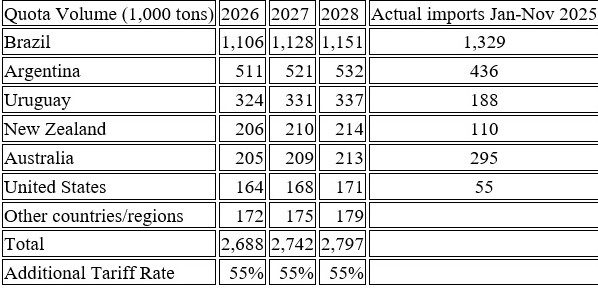
Source: Chinese Ministry of Commerce.
Major exporters to China, Brazil and Australia, have been granted quotas well below their 2025 shipment levels.
Direct impact on Australian exporters
Based on where things stand currently, (US beef exporters not having access to China) it is likely that Australia’s export volumes to China will be affected – by up to 100,000t. Some of this volume would need to find another market which would make the impact the difference in export returns from China vs returns from the next best market.
The industry is currently discussing options to impose a self-imposed quota management system to ensure the industry optimises exports to China in terms of timing and value.
Secondary impact of increased Brazilian export competition in non-Chinese markets
Increased Chinese imports of Brazilian beef have largely shielded Australian exporters from the impact of the dramatic rise in Brazilian beef production and exports.
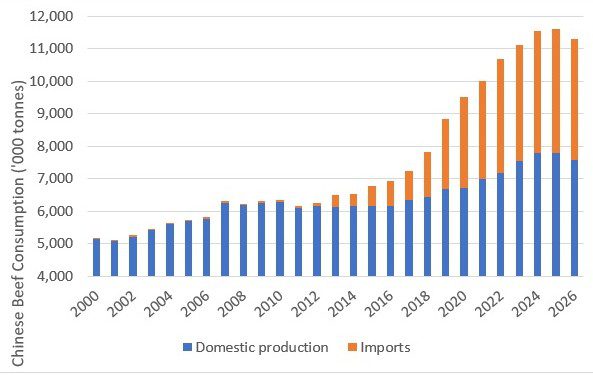
This chart shows the sources of Chinese beef consumption. Source: USDA
Chinese restrictions on Brazilian beef import volumes will accelerate Brazilian efforts to access alternative markets and diversify its beef exports.
The Brazilian Association of Meat Exporting Industries (ABIEC) expects the US, the second-biggest market for Brazil’s beef last year after China, to buy 400,000t in 2026, up from 270,000t in 2025.
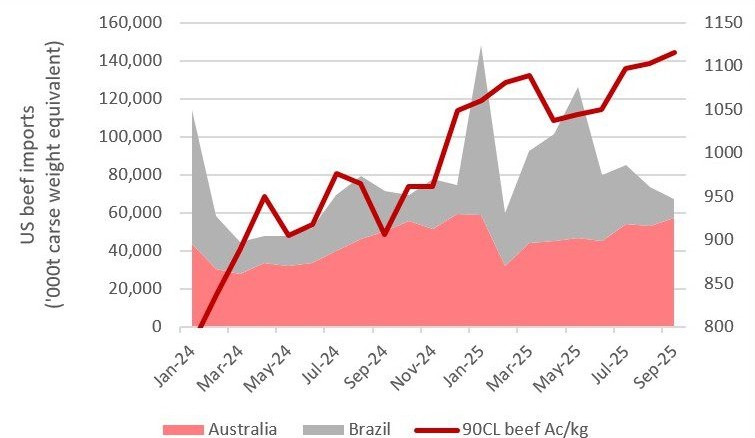
Expect Brazilian export volumes to the US to match the heavy export volumes in March-May 2025 prior to Trump increasing the tariff on Brazilian beef to 76.3pc (later 66.3pc).
During this period in 2025, when Australian faced increased competition from Brazilian beef imports, US imported lean manufacturing beef prices were A$9-9.50/kg compared to around $12/kg currently.
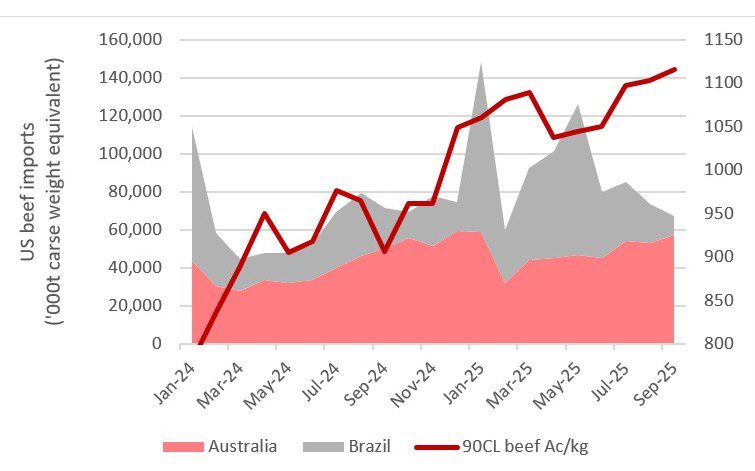
This chart shows US beef imports from Australia and Brazil vs the 90CL beef price in Ac/kg. Source: USDA
Productivity gains drive the rise in Brazilian beef production and exports
Since 2021, Brazilian beef production has increased by 2.6 million tonnes – the size of Australia’s entire annual production.
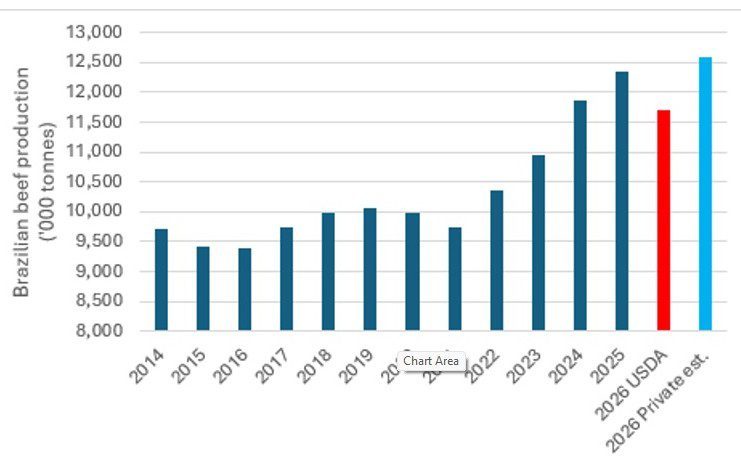
This chart shows Brazilian beef production 2014-2026. Source: USDA
Productivity gains and expansion in lotfeeding in Brazil are allowing it to expand beef production while herd rebuilding. Brazil is fattening cattle faster and slaughtering them younger and their cows are becoming more productive.
The outlook for global beef prices in the medium term will hinge on whether Brazil can avoid a production downturn.
The USDA expects Brazilian production to fall 5.3pc to 11.7mt carcase weight equivalent this year. However, USDA’s estimates diverge markedly from Brazilian private analysts who suggest Brazilian beef output could rise (due to productivity gains) again, to around 12.6mt in 2026, reducing the decline in beef production across the top six producers in 2026 to just 0.2pc.
What can the Australian beef and cattle industry expect? Read the full article here.