
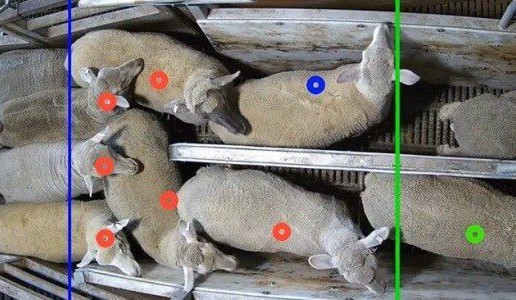
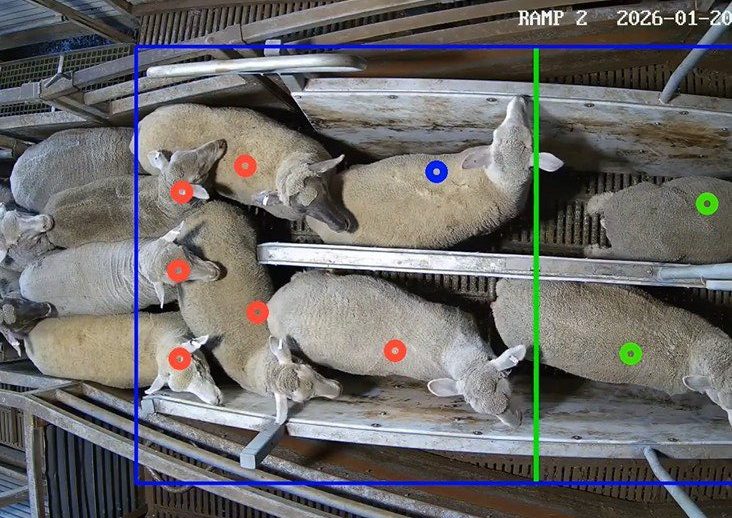
The system individually identifies and ‘tags’ each lamb and counts them as they pass a certain point in the race, also compensating for animals that turn back so that they are not counted twice. The orange dotted lambs in this image haven’t been counted, the green dot lambs have been counted and the blue dot lamb is a ‘turnback’ that has already been counted.
TALLYING sheep and lambs with cameras linked to a system with artificial intelligence capabilities is proving faster and more accurate than traditional visual counting or electronic ear tag scanning for Western Australian livestock processor V&V Walsh.
Discrepancies in sheep counts have been a persistent source of frustration between farmers, truck drivers, stock agents and meat processors.
And with some lambs commanding more than $300 per head, the costs of miscounts can run into the thousands of dollars for either buyer or seller.
Major WA livestock processor V&V Walsh is solving that problem with artificial intelligence at its Bunbury processing facility, which is now counting sheep so accurately it has become the processor’s primary counting source.
V&V Walsh has teamed up with Brisbane-based AI Vision specialist, BlueSync, to install and operate AI-linked cameras which accurately identify and record each animal as they come off the truck, providing a total at completion of unloading.
The system individually identifies and ‘tags’ each lamb and counts them as they pass a certain point in the race, also compensating for animals that turn back so that they are not counted twice.
The AI count is then matched against the farmers’ count (via a waybill), and if the counts correlate, the sheep pass through to the lairage. The consignment is physically recounted if there is a discrepancy.
V&V Walsh general manager Brent Dancer said while accurately counting hundreds and thousands of sheep as they rushed through an open gateway up to four sheep at a time, at various speeds and altitudes, was an agricultural art-form, count discrepancies occurred and could lead to disputes. Adopting a scientific approach is solving that problem.
“We ran a comprehensive on-the-ground assurance process ahead of deploying BlueSync’s AI sheep counter in our Bunbury operations, and there is no doubt it faster and more accurate,” Mr Dancer said.
“And if there is a discrepancy, there is a video recording of each consignment as it comes off the truck, meaning we can audit the count at any time.
“This provides both parties with confidence in the count and reduces the risk of counting irritations occurring in the supplier-processor relationship,” he said.
“It’s just another example of using technology to iron out problem areas so the farmer can get on with the job of growing their sheep and lambs and we can focus on processing them efficiently and obtaining the highest value for the carcase or cuts.”
Up to 5000 sheep and lambs per day are unloaded at the V&V Walsh site, and any expansion in numbers can be accommodated through additional AI-linked cameras.
Mr Dancer said there had been examples where the farmer’s count was less than the AI count.
“And when the AI count on that consignment of lambs was greater, we paid the higher amount,” he said.
“It is important to be able to operate an accurate counting system while the RFID-based roll out works through its challenges.”
BlueSync technical director Anthony Browne said it was important all divisions of the abattoir worked together to ensure a trouble-free implementation and operations.
“Installing an AI system to count sheep requires practical implementation, such as getting the correct lighting and ensuring the application compliments and assists existing operations to improve efficiency and the end result is excellent in terms of accuracy,” he said.
The installation of the system was supported by funding from AMPC and DPIRD.
System is suitable for all livestock
Mr Browne said the BlueSync system did not use facial recognition, but similar to similar to the ‘painting’ of targets by army infantry for aircraft attack, it tracks an object (sheep) frame by frame once identified, with dots staying with an animal once ‘tagged.’
“(It) locks on essentially.
“It tracks the direction, so it can do a minus if the sheep goes back the other way,” he said.
“The dot stays with the sheep once identified.
“It is tracked anywhere in the region of interest, which is the green box,” Mr Browne said.
“The model is trained for sheep so it doesn’t count dogs or people.
“It can be trained for any species or object.”
Mr Browne said the model had to be trained for all types of sheep, Dorper, Merino, black sheep, black head white body etc., and for different lighting such as morning sun and night time conditions.
Mr Browne said the accuracy of the BlueSync system versus RFID tag scanning would be because read rates from RFID readers through the race can average around 80-100pc.
He said this is mostly due to RFID read range and tag orientation, and speed of sheep through the race.
“This makes it unreliable as a count.
“AI counting is more accurate due to NOREADS from RFID, but at a saleyard for instance, with single lane readers, sheep single file after being drafted, the RFID is very accurate if sheep are tagged,” Mr Browne said.
“Our goal and our brief was to be as accurate or better than a human.
“If installed correctly and flow of sheep is constant we have achieved this,” he said.
Mr Browne said while manual counting can be very accurate, AI counting comes into its own with large lots that can be three or 400 sheep.
“The concentration and focus required to count that many is quite large and with unskilled labour becoming more prevalent in the industry the AI count definitely checks the checker,” he said.
“RFID would be last in the list.”
Mr Browne said the BlueSync system is being used commercially at two sites: WAMMCO International in Katanning, WA and V&V Walsh.
“They are also achieving 100pc counts.
“They both connect back to the plant livestock receivals systems and give four counts: expected quantity, manual count, AI count and RFID count.”
He said WAMMCO has used the system in a 2-way and a 3-way laneway with counter and RFID. At Walsh’s it is installed on three 2-way laneways with counter and RFID. It was being used at the ALC Colac site, but the project was shelved with the change of owners.
Mr Browne said the difference between the BlueSync system to others is it records the RFID from the reader, the AI counts and sends them back to the abattoir livestock receivals systems or uploads direct to the NLIS database, so they have all the data and footage available instantly.
“It is not cloud-based, it is all on premise on their servers so not reliant on internet connection or off site processing.”
Mr Browne said the system can be used for cattle, goats and pigs.
“We have done trials at JBS Dinmore on beef as they had trouble with Angus cows at night.
“We’ve done successful trials at JBS Diamond Valley Pork and Swickers bacon factory for pigs where we looked at detecting welfare issues, animal health and things like speed.”