
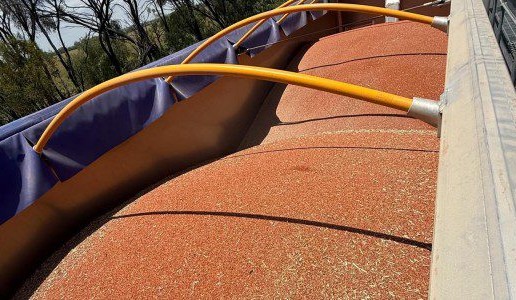
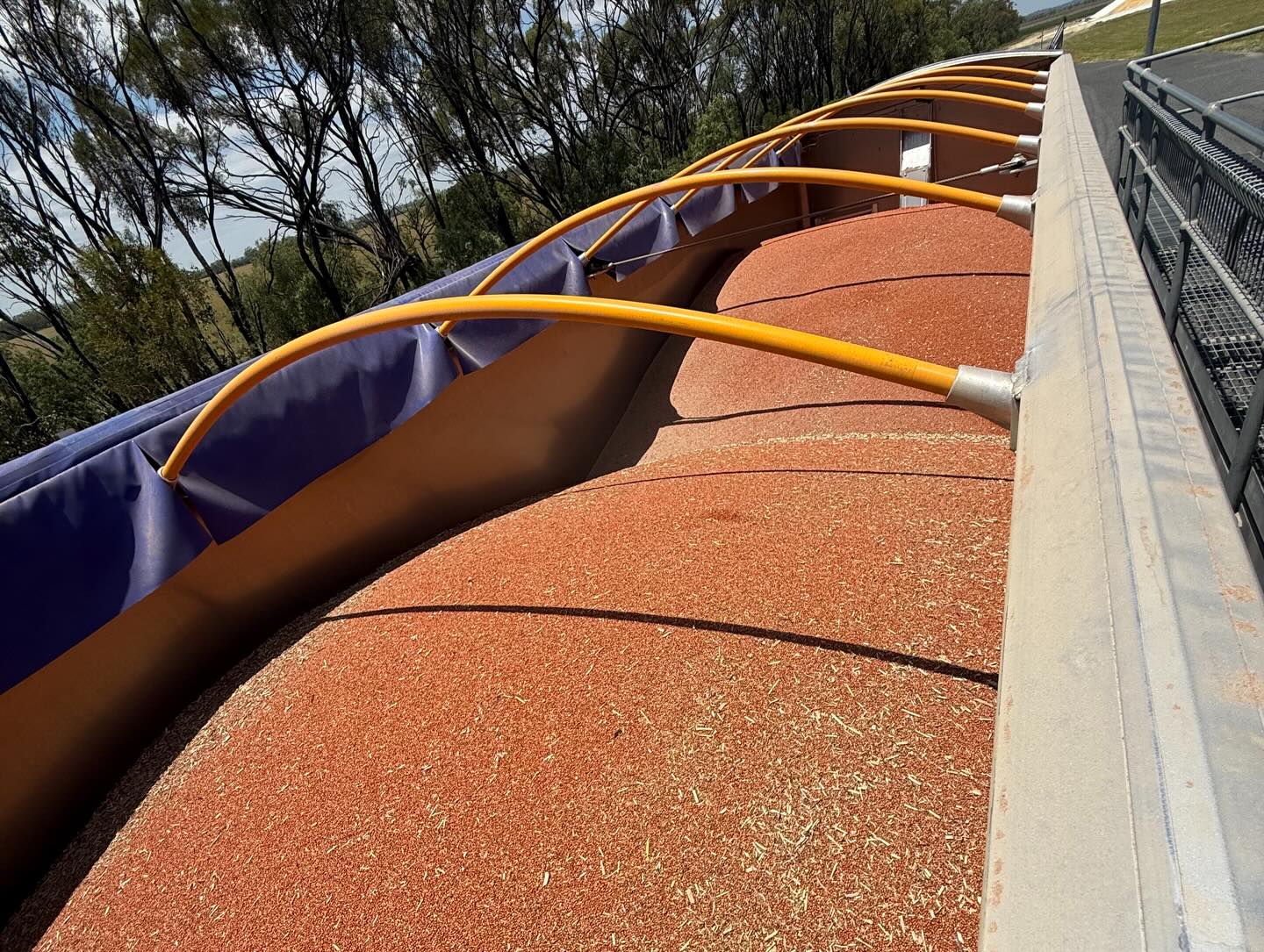
CHS Broadbent’s Jondaryan depot received its first new-crop sorghum delivery this week. Photo: CHS Broadbent
SALES of wheat and barley have slowed even further in the past week as dry conditions reduce grower interest in selling, and the stronger Australian dollar weighs on the export appeal of both cereals and sorghum.
Northern wheat and barley has firmed to catch business from growers who are mostly full steam ahead, or even finished, on their sorghum harvests.
In the south, wheat and barley prices have dropped $5-$12 per tonne in the past week on sluggish demand from export and domestic customers close to port.
| Jan 22 | Today | |
| Downs barley | $333 | $336 |
| Downs SFW | $333 | $340 |
| Downs sorghum | $338 | $318 |
| Mel barley | $340 | $328 |
| Mel ASW | $350 | $345 |
Table 1: Indicative prices in Australian dollars per tonne.
AUD weighs on north’s sorghum
The sorghum harvest is in full swing in southern Queensland and northern New South Wales, with accumulation for new-crop shipments taking place in Brisbane.
Container packers on the Downs are also busy with new-crop sorghum in a prompt market which is quoted as $20/t lower this week, largely to reflect the stronger Australian dollar.
However, the March-April market has shown signs of rebounding, looking like $330/t for Downs delivery.
“You can’t get slots to deliver sorghum at some sites,” one trader said.
The situation is expected to be short lived, and reflects big dryland yields of 6-9t/ha from early planted crops, with the occasional crop clocking 10t/ha or more.
However, later-planted crops are likely to yield considerably less to show the effects of a mostly dry summer.
“With the dry weather, growers are sitting on their white grain, which is not like sorghum that has only one path, and that’s to export.”
The stronger AUD is improving the attractiveness of imported soymeal, particularly for consumers closer to Brisbane than Newcastle, which is the north’s only large-scale canola-crushing site.
Soymeal is quoted today at around $680/t ex store Brisbane, $4/t cheaper than yesterday, simply because of the dollar.
Weaker soymeal values are also weighing on canola meal.
Urea to top dress cotton is currently in demand, which is providing some incentive for growers to sell a load of sorghum for delivery to the Port of Brisbane to backload with fertiliser.
“Currency’s killing us at the moment,” Sunrise Commodities managing director Scott Merson said with regard to grain exporting.
“The dollar at 70.9 US cents is a big problem for the sorghum grower.”
Many feedlots have extended their barley and/or wheat coverage out to April, with ongoing dry weather likely to push more cattle into feedlots.
“The Darling Downs feeders are quite well covered because they were smart enough to buy when prices were relatively low at harvest, whether ex farm or out of the system,” Delta Grain Marketing general manager Mick Parry said.
South feels the heat
Southern growers remain largely disengaged from selling wheat and barley into the cash market.
“There’s not a lot of cashflow decisions being made at the moment,” Mr Parry said of the southern as well as the northern market bar sorghum, and chickpeas being sold to fill the last export hatches for now.
Some fiercely hot weather over the past week means growers have no need to think about spraying weeds, which will not germinate in these dry conditions.
“There’s no shortage of grain, but what’s being made available makes it feel balanced or short at times,” Pinion Advisory broker Brad Knight said.
The low-yielding 2025-26 wheat and barley harvest in the southern half of NSW means the Griffith-Hanwood market is trading at a few dollars above where the delivered port markets say it should be, with ASW-type wheat at around $325/t.
“It’s pretty quiet,” Mr Parry said.
“The grower is looking at the long-range forecast, and is in an absolute heatwave.”
He said growers were largely still living on harvest sales, and may carry what remains unpriced through to the new financial year starting July 1.
Storing grain or faba beans on farm can also become a drought hedge in what for most are brutally dry conditions.
“It’s a little bit different in the far north of NSW, but from Walgett to Coonamble and south, they’ve only had 50mm since August last year.”
If winter-crop planting is limited by lack of moisture, growers will want to hold grain for 2026-27 cashflow, and to feed to their own livestock.
“It’s normal to have a hot dry summer, but we’ve got to be careful here; growers are not going to want to sell faba beans and barley and low-quality wheat.”
Mr Parry said growers could well be holding out for rallies in US grain futures often seen once markets start to trade Northern Hemisphere new-crop conditions,
“The charts look like maybe we’ve seen season lows.”