
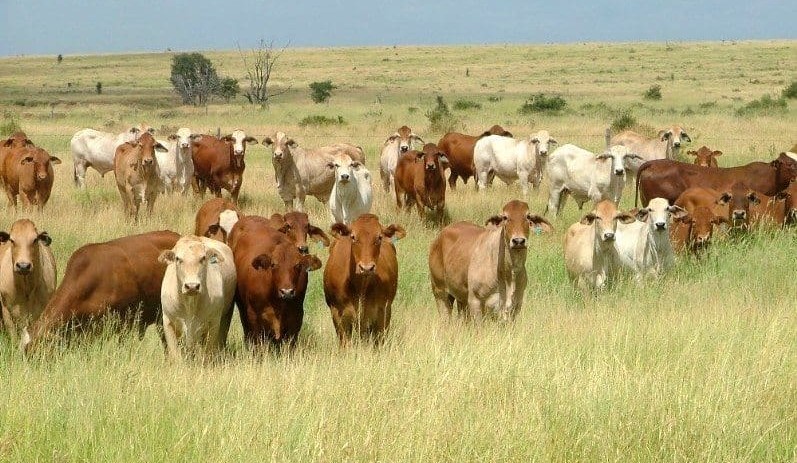
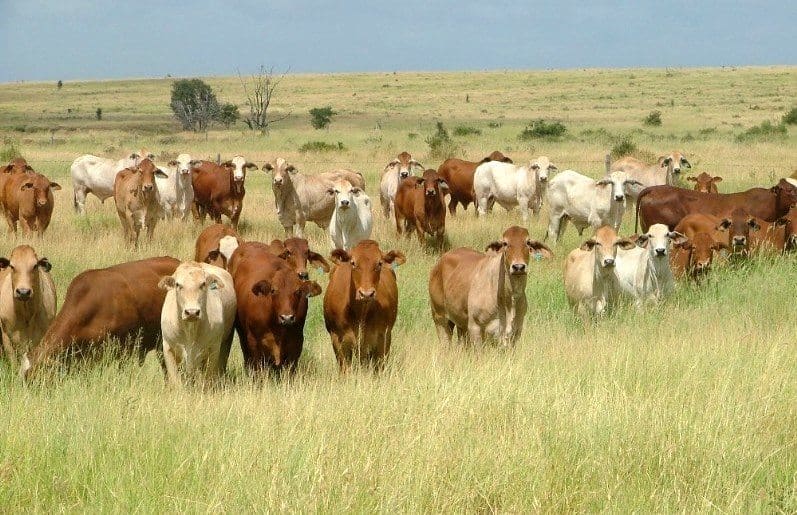
AS one of the Northern cattle industry’s most valuable pastures comes into the crosshairs of environmental groups and politicians, Andy Hayes reflects on how buffel grass has revolutionised his family’s property.
While the grass has become a big part of the grazing industry, there is a push to list it as a weed of national significance – which could be a big limitation for landholders.
Mr Hayes grew up on Undoolya Station, which surrounds Alice Springs on two sides. He said buffel was a big part of his upbringing.
“Our grandfather used to make us pick buffel seeds with one of those jumbo-sized garbage bags, just to spread it.
“You can imagine how much interest a kid has in doing that, it would take us all day to fill a sandwich bag,” he jokingly told The Week in Beef podcast.
While the buffel was introduced before Mr Hayes was born, he said various events have spread it further across his lifetime. One was a big rain event in the early 1970s after dry-times in ‘60s and another was in 2000 after he took over The Garden station in 1996 – which is now home.
“The previous owner said buffel would never be able to grow at The Garden because it was too hilly. But it grows,” he said.
Running cattle for longer
Mr Hayes said the spread of buffel grass has revolutionised the pastoral industry in Central Australia.
“Buffel is the best thing that has happened to our country, it is probably the best thing that has happened to a lot of other country,” he said.
“You get a lot of family places that are a husband and wife team around the Alice area and buffel has been a gamechanger.”
Mr Hayes said there were a lot of benefits.
“It means you can carry cattle longer, you are not putting anymore cattle on because you still need to water them,” he said.
“It is slowing erosion down, it is not so important these days to put ponding banks or contour banks in because the buffel is holding the ground together.”
Has it been good for the environment?
While buffel has been celebrated by grazing companies across Northern Australia, it has come under intense scrutiny by environmental and traditional owner groups in recent years.
The opponents to buffel say it is taking out other native pastures and making bushfires more intense and harder to control.
There has been much debate about the exact origins of buffel grass in Australia, however, dust and erosion control were the main reasons it was introduced to many areas.
In Alice Springs, it is believed the airport was a big spreader as it was planted to stabilise dust around the runway and improve visibility for planes.
Asked whether he thought buffel grass had improved the environment around Alice Springs, Mr Hayes said it was a problem when unmanaged.
“It has opened up a lot of country, it has made a lot of harder places more viable. But it has become a problem in the locked-up areas, the conservations and the Indigenous areas that are not leased out or anything,” he said.
“But for us who use it as a tool, our cattle thrive on it and it is a good thing.”
Buffel pays the bills
Governments are now starting to legislate buffel grass. The Northern Territory recently released its buffel grass management plan, which essentially listed the grass as a weed when it is not on a cattle station.
Western Australia has it listed as a weed and there is currently a proposal to list it as a weed of national significance – which could restrict its use on cattle stations.
Mr Hayes said it was important to recognise the economic importance of buffel grass before bringing in new regulations.
“Buffel makes this area, it is what pays a lot of the bills. They want us to be to food bowl for South-East Asia, it would have a major effect on that.”
To list buffel grass as a weed of national significance would be one of the most ridiculous decisions ever, and would highlight just how little the educated bureaucrats really know, stuff all. It's in the same category as wanting farmers to farm kangaroos, what stupid decisions we have to deal with!!! Buffel grass has been a part of what has made the cattle industry what it is today. We would be stuffed without it in many places so let's highlight its great benefits.
Buffel grass has been a part of our ecosystem in Qld for many years and there is no doubt it has modified some. It has been the go to grass for cleared Gidgee and Brigalow country since I don't remember when. This call for it to be declared a weed of national significance results in a few headlines and gives some green-leaning persons a warm fuzzy feeling, but all their campaign might do is pour money into a bottomless pit. Buffel adapts very well to various conditions, stock do well on it and is here to stay. Who has successfully eradicated it from a domestic garden? Hands up.
There is not much point declaring Buffel as a weed of national significance or a weed of any significance because it would be impossible to control any way. Better to ignore the ratbags pushing a ridiculous idea and keep going with what is a very important pasture grass. Lucerne is not native either, when will they get their claws into it?
without Buffel grass the Australian Beef Industry would not be what it is today. Do what you want in non cattle areas but leave it alone in the bush.
GOOD INFORMATION ON BUFFEL GRASS
The benefits obviously vastly outweigh the negative. You’ll wake up when you have nothing to eat. If you can’t see a food crisis coming in Australia you’re blind. Governments should be doing everything to lower the cost of food production and support agriculture and the people on the land where the wealth of the whole country originates.
The proposal to list it as a weed of national significance is nothing short of ridiculous. We have weeds of National significance like Prickly Acacia, rubber vine and Noogoora Burr, but very little is done about eliminating them, so why start with one that is already covering a large area of northern and central Australia, is a very useful pasture plant and is already past controlling. Just bureaucrats doing what bureaucrats do.
well said mate and it doesn't burn any worse than spinifex does
what a great read I am not a farmer but any plant that can help livestock survive and do well in such a harsh environment has to be good/ I say grow more Buffel Grass/ all the best Colin Hogarth