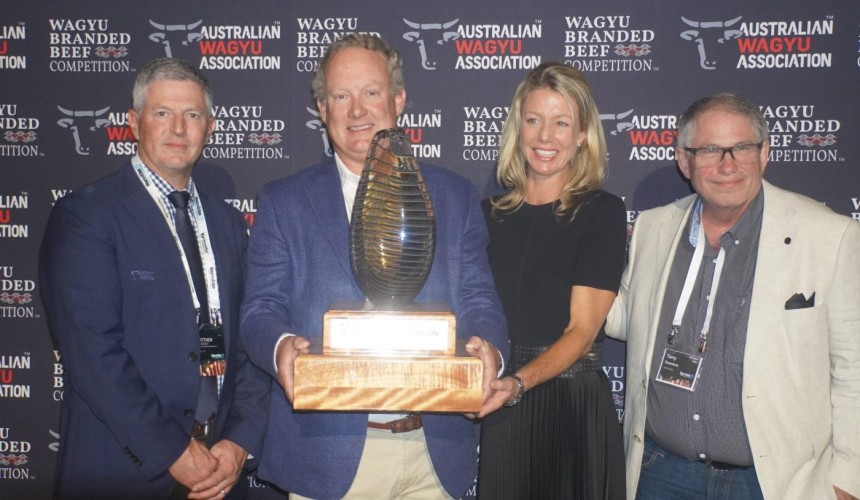
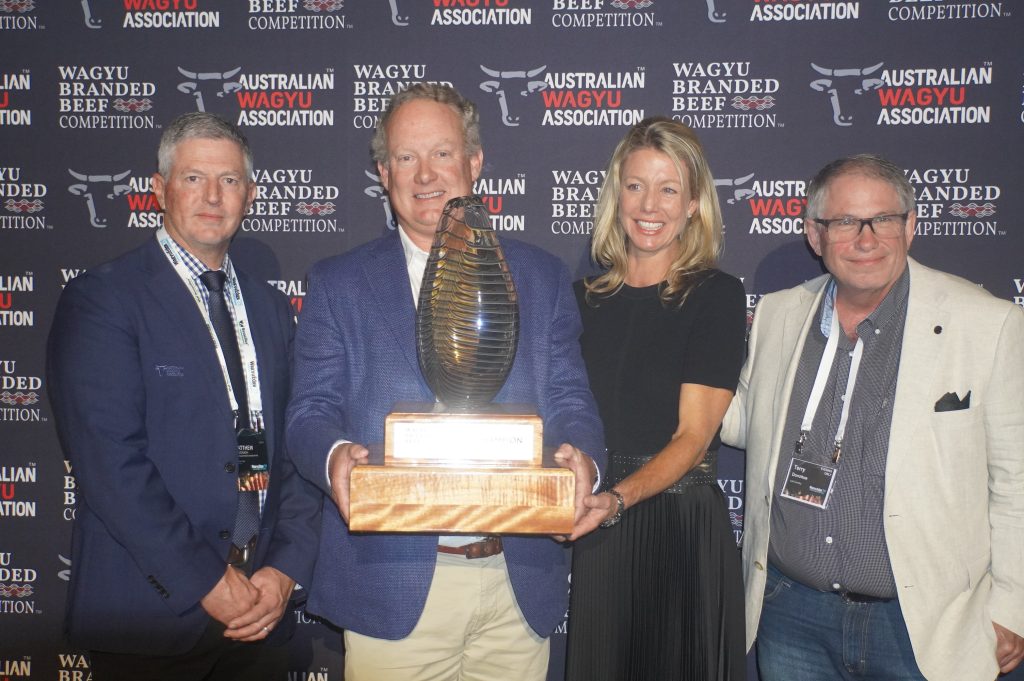
Grand championship winners Martin and Martine Donohue from Marble King Wagyu in Victoria, being congratulated by sponsor Terry Donohue (no relation) from Ariat, right, and AWA chief executive Matt McDonagh
A RELATIVELY new entrant to the ranks of Wagyu supply chains upstaged some of the country’s biggest and best known producers to claim the major honours at the Australian Wagyu Association’s annual Branded Beef Competition announced overnight.
The awards took place during the opening stages of the AWA’s WagyuEdge conference being held this week in Brisbane. The branded beef competition provides brand owners and cattle producers with the opportunity to showcase their product, benchmark against competitors and gain valuable feedback to continuously improve their brands.
Judging took place late last year across three days, involving 60 judges in closely managed blind taste testing (see earlier report).
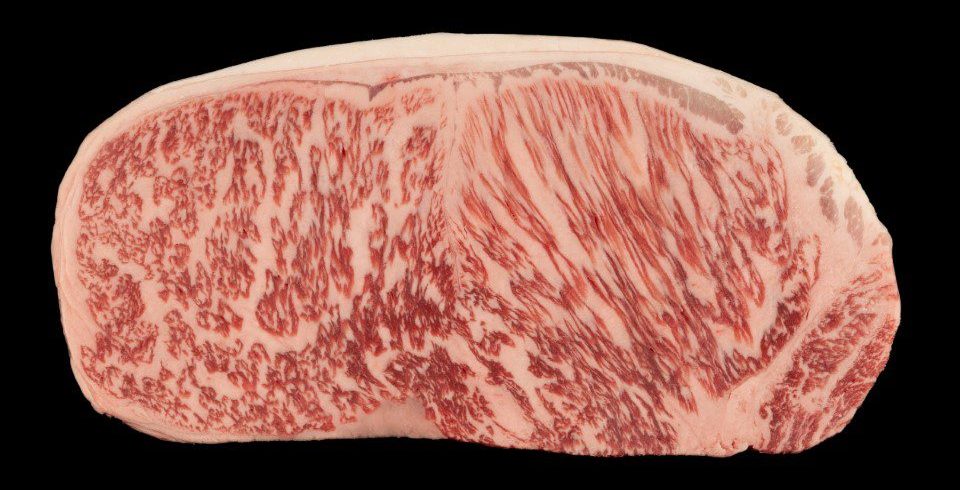
Grand champion’s eye muscle photo, take during judging – digitally-measured IMF was 54.2pc. Click on image for a larger view
Topping results among the 84 entries this year was a Fullblood Wagyu sample representing Martin and Martine Donohue’s Marble King Wagyu business based out of the Acheron Valley in Victoria. A summary of all five class winners appears below.
The Donohues’ Penstock Pastoral Group only entered the Wagyu industry four years ago, shifting out of sheep and conventional cattle, but is on track to grow Fullblood cow numbers from around 1000 today to closer to 2000 over coming years. The cattle run in the high-rainfall Yarra Ranges region northeast of Melbourne.
Currently 90pc of cattle fed into the Marble King program are bred by the Donohues themselves, with a few bought steers to manage low production periods, but ultimately the aim is to become self-sufficient in feeders.
The Fullblood cattle are fed anywhere from 450-600 days at the ICM Peechelba Beef feedlot near Wangaratta, owned by Martine’s father, Doug Shears.
Peechalba, led by general manager Brianna Daly and operations manager Scott Douglas, has undergone major changes over the past five years including extensive use of permanent shed structures. The yard has fed Wagyu and Wagyu crosses for close to 30 years.
Processing of the Marble King Fullbloods takes place at the Central Agri Group’s export licensed beef plant at Trafalgar in the Gippsland. Carcases are hitting marbling scores of 9 and 9+ with consistency, using the MasterBeef grading camera, and the best of them are hitting the equivalent of BMS scores 12 and 13.
 This year’s AWA branded beef grand championship winner was a BMS 12 striploin, showing a digital marbling percentage of 54.2pc.
Being a smaller brand program, Marble King is looking to target the European Union and UK export markets, with some sales into Malaysia, Singapore and domestic customers. Brisbane’s on-trend Phat Cow steakhouse restaurant, which has one of the best Wagyu menu offerings in the country, features the Marble King brand.
“We think the EU and UK are probably a little under-serviced, in terms of high end Wagyu,” Mr Donohue told Beef Central last night.
“The Central Agri Group plant is not China accredited, but that’s fine with us – we’re not interested in that market at the moment,” he said.
“A lot of new Wagyu breeders have gone down the F1, F2 or Purerbred route, but we’ve decided we want to stick true-to-form with Fullblood cattle only, and are trying to adopt more traditional Japanese style feeding and management,” Mr Donohue said.
Fullblood genetics have come primarily from Joe Grose’s 3D Genetics, with emphasis on carcase data on marbling performance and eye muscle area, as well as good weightgain potential in the feedlot to optimise efficient feed conversion.
“One of the biggest profit drivers is the carcase yield we can get, so we have tried to combine all traits that add up to efficient, profitable Wagyu production,” he said.
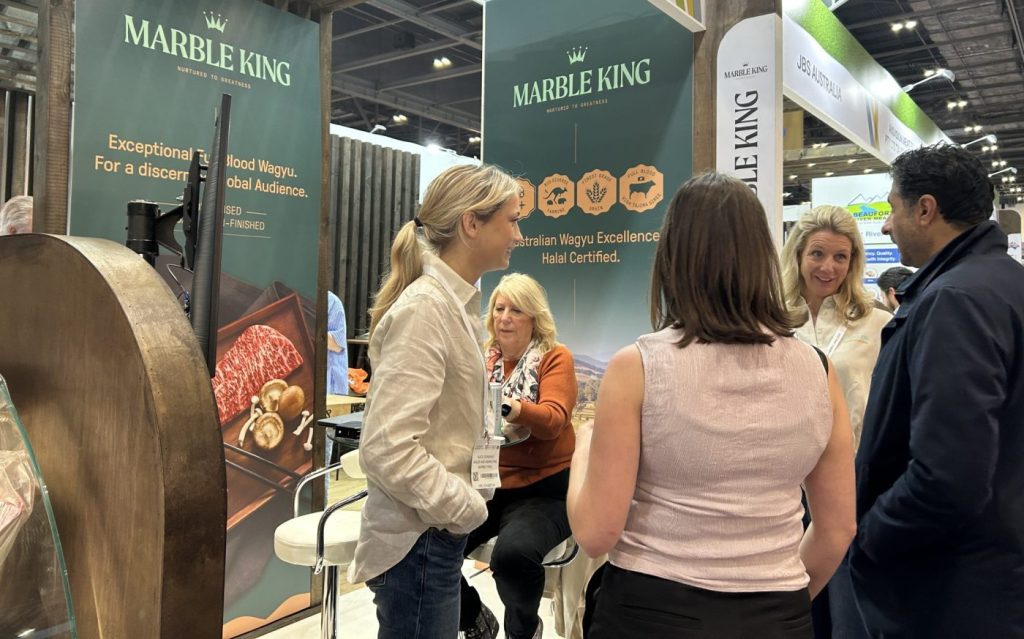
Pictured above, Martine Donohue and daughter Alice engage with customers on the Marble King stand at the recent UK food trade show – the Wagyu brand’s first big marketing exposure in an international market.
“Wagyu in the UK has up to now been promoted mostly as F1s or locally-produced grassfed, so the trade show visitors sampling our Fullblood product were blown away,” Martine Donohue said. “Some rated it better than the A5 Japanese product in the same show, saying it had a cleaner mouth-feel.”
Overall reserve grand champion in this year’s Wagyu branded beef competition was another Fullblood class entry, bred and exhibited by Scott de Bruin’s Mayura Station on South Australia’s Limestone Coast. The entry displayed IMF of 61.8pc and an eye muscle area of 113sq cm.
Other class winners
Exceptional marbling was evident across all five competition categories this year, with digitally-measured intra-muscular fat levels peaking at an incredible 69.2 percent in the Fullblood class (Stone Axe Pastoral entry); 66.9pc in the Purebred F4 and higher class (Mort & Co entry); 64.9pc in the Crossbred F1-F3 class (Mort & Co The Phoenix entry); and 63pc in the Open F1 class (Andrews Meats Tajima entry).
Here’s a quick summary of other class winners:
Purebred class:
Topping the Purebred class was a striploin sample from Mort & Co’s Master Selection brand, fed for 390 days at the company’s Grassdale feedlot near Dalby and processed at the nearby Stanbroke Beef plant. The entry displayed an eye muscle area of 112cm and digital marbling percentage of 66.9pc, the third highest among all 84 entries. The calf was bred by Muirhead Pastoral Co.
Crossbred class – F1-F3:
Mort & Co also claimed the crossbred Wagyu class with a sample drawn from the company’s The Phoenix brand, fed 393 days at Grassdale and processed at Stanbroke. Digital marbling was 64.9c and eye muscle area 98.4sq cm. The calf was bred by Kevin Brennan
Open F1 class:
JBS Australia’s Andrews Meat Industries topped the division with a sample from the company’s Tajima Wagyu, bred by Morella Agriculture. Fed at JBS Prime City and processed at JBS Riverina near Yanco, the entry was fed about 400 days, exiting at 24-26 months. Eye muscle area was one of the largest in the competition at 117sq cm, and IMF was 63pc.
“It’s an exciting moment for all the producers who feed into our Wagyu programs and for our team seeing Tajima, our most beloved Wagyu brand, rise to the top at such a renowned competition,” said Jeremy Stuart, General Manager of Export at Andrews Meat Industries.
“Last night’s win just highlights again how crucial a collaborative and robust team is to the production of award-winning premium wagyu that Australia is renowned for,” he said. Tajima Wagyu is supplied to premium venues domestically and internationally.
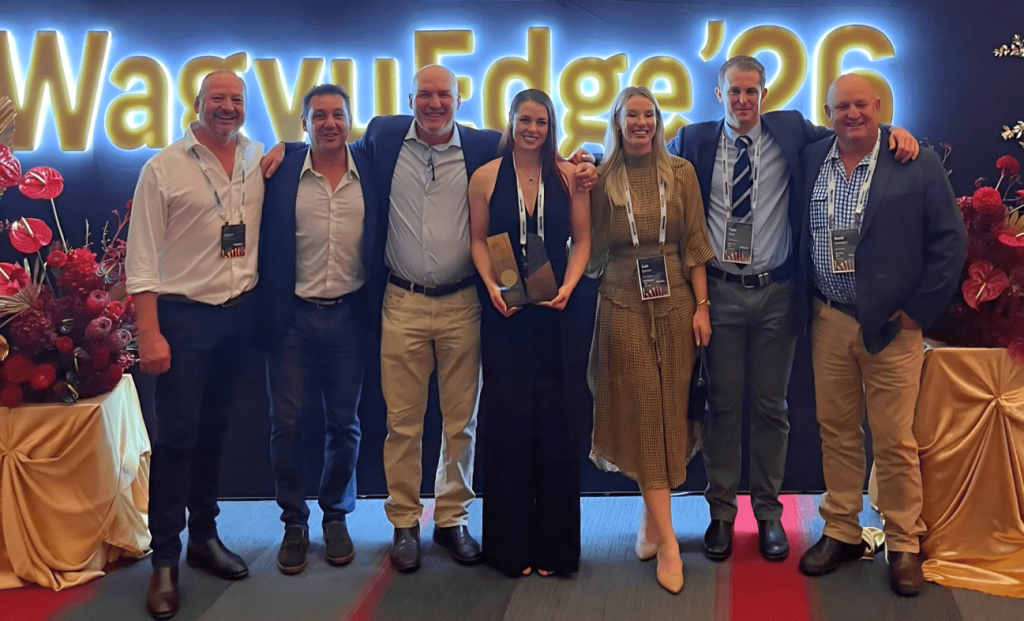
Andrews Meats and JBS teams celebrate last night’s win in the crossbred class, from left Jeremy Stuart, Nick Zanapalis, Will McCrohon, Breanna Harrigan, Cait Barton, Tom Stier and Scott Minnikin.
Commercial Wagyu marbling scores 5-7:
Queensland Stockyard claimed first place with a sample of the company’s Stockyard Silver brand, fed 400 days before processing at John Dee. Bred by Rogers Livestock on the New England, the calf produced an IMF percentage of 30pc and eye muscle areas of 95sq cm.
Congratulations on your award. Can l buy your product? Thanks.