The New South Wales Government has annonuced a $7 million investment to review and rebuild the state’s cattle tick program.
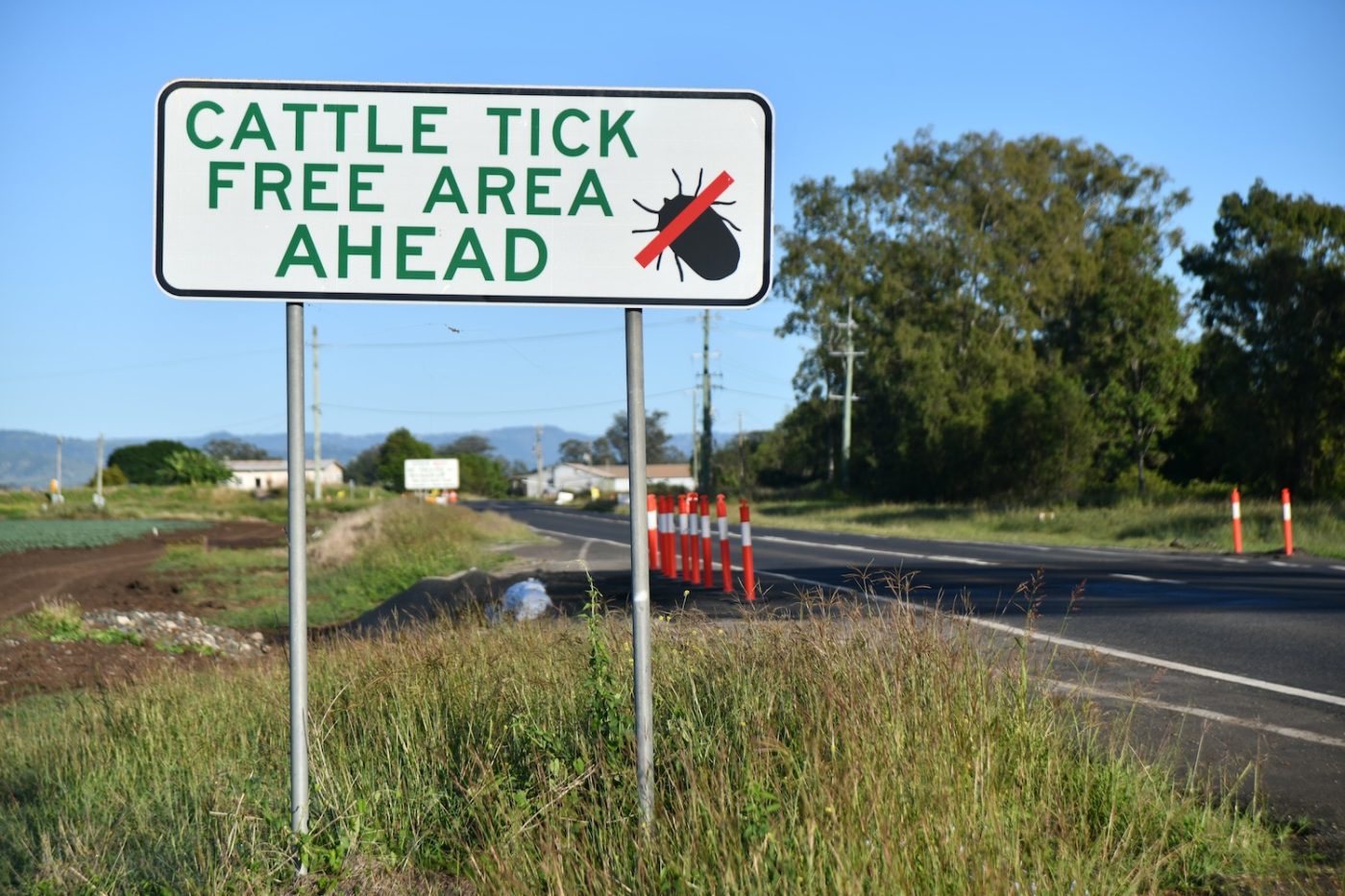
Signage for the Cattle Tick Free Area Ahead for the Lockyer Valley at Gatton, Queensland. Australia. Beef and dairy cattle transported to these areas must be treated for ticks.
Last year the Minister for Agriculture appointed Dr Katherine Clift to the role of Independent Biosecurity Commissioner and requested her first priority be to identify opportunities to improve the management of cattle tick in NSW.
This followed feedback from stakeholders that the state’s cattle tick program had been run down under the former National Liberal Government and required a new approach to protecting the state’s livestock operations along the border with Queensland where it is an established pest.
In developing her report, Dr Clift undertook work with stakeholders in the beef and dairy industries and far north coast communities, reviewed the existing program, and has made 14 recommendations to improve the program to deliver more effective biosecurity outcomes.
The Minister for Agriculture has determined there is an urgent need to improve the existing program to protect the state’s northern beef and dairy sector.
Work will start immediately to get the program back on track by boosting the program’s annual budget by 60 percent to implement the Commissioner’s recommendations.
The Minns Government commitment to the following foundational actions for renewing and rebuilding the state’s important Cattle Tick Program includes the following:
- Commitment to eradication as the objective driving all program decisions and regulatory actions and deliver the first Cattle Tick Eradication Action Plan by 30 September 2026.
- Deliver more support to farmers to better understand the options available to them for prevention and management of infestations and collaborate on improving the program.
- Boost the program‘s access to veterinary resources and skills by transferring the Cattle Tick team to operate under the NSW Chief Veterinary Officer, ensuring its animal health focus, and boosting technical and compliance support from across DPIRD and Local Land Services.
- Prioritising and expanding research and development focusing on chemical resistance and alternatives, diagnostics, emerging control tools, and monitoring technology.
This is part of the Minns Labor Government’s commitment to protecting the state’s primary industries and boost the economic growth of the sector and follows an historic $1.05 billion investment in the state’s biosecurity budget.
The new NSW Cattle Tick Plan will be developed in collaboration with stakeholders and will be aligned with the state’s recently updated biosecurity response frameworks, and will clearly articulate program objectives, outcomes, strategies, and performance measures.
Minister for Agriculture Tara Moriarty said it was important to get the tick control program back on track for beef and dairy farmers whose livestock are endangered by cattle tick spreading from Queensland.
Cattle program gets tick of approval
NSW Farmers has thanked the NSW Government for listening to producers and unveiling a $7 million funding boost and eradication-focused direction for the NSW Cattle Tick Program.NSW Farmers Biosecurity Committee chair Tony Hegarty said farmers had engaged constructively with the NSW Independent Biosecurity Commissioner’s review process, and it was important that the NSW Government respond quickly to the findings and recommendations.
 “We acknowledge the Commissioner’s engagement with farmers during the review, including producers who took the time to share on-ground realities from the border region,” Mr Hegarty said.
“We also thank Minister Tara Moriarty for a timely response to the report, and for backing the findings with an initial $7 million funding commitment.
“While this is an important down payment on rebuilding capability, we will be seeking further detail on how the $7 million will be allocated, including what it means in practice for surveillance, treatment support, compliance capacity and producer engagement.”
Mr Hegarty said NSW Farmers particularly welcomed the government’s commitment to eradication – including the commitment to deliver the first Cattle Tick Eradication Action Plan by 30 September 2026 – and the focus on strengthening technical capability and collaboration.
“We welcome the clear shift back to eradication rather than long-term management. Producers have been calling for a program that is properly set up and resourced to stop cattle tick crossing the border and threatening livelihoods,” he said.
“We also welcome the commitment to strengthen resourcing through DPIRD and Local Land Services, and to ensure the program has strong veterinary oversight and capability.
“Importantly, the government has committed to developing the new tick plan in collaboration with stakeholders. We look forward to ensuring producers’ voices are a critical input into that plan – because the settings have to work in the real world, not just on paper.”
Mr Hegarty said the ongoing challenge of cattle tick and tick fever could not be left to individual landholders to manage alone.
“Producers can’t manage tick infestation on their own. Government must continue to have a key role in addressing this challenge because it is putting a brake on cattle producers and significantly affecting their livelihoods,” Mr Hegarty said.
“As this action plan is developed, NSW Farmers will continue advocating for a program that is transparent and practical – including better public access to information on outbreaks and tick fever risk, strong on-ground resourcing, and clear processes that support rapid response and protect neighbouring properties.”
NSW Farmers also urged the NSW Government to ensure cross-border coordination matches the intent of eradication.
“Cattle ticks don’t stop at the border. We strongly encourage the Minister to ensure the Queensland Government works with NSW so the eradication objective is achievable, and so northern NSW producers aren’t left carrying an unfair burden,” Mr Hegarty said.
Sources: NSW Government, NSW Farmers
the 20 million of tax money wasted on Alboz fuel saveing ads would have been better distributed on this project.
Given the truck full of ticky cattle that rolled over in the 50k zone in Injune last week there needs to be serious changes and inspection of cattle traveling in CLEAN zones or DPI should foot the full cleanup cost
It is disappointing that the bulk of the plan aims to shore up the bureaucratic infrastructure that has been allowed to languish. Benefits resulting from the $8million investment will be slow to materialise.
At least two immediate measures can improve animal welfare and reduce stock losses:
a. Promote the vaccination of newborn calves in northern NSW against tick fever. Address the widespread misconception that this "blooding" is not a vaccine. There are inactivated ("dead") and live vaccines. This one is live, therefore adult vaccinated cattle usually have to be treated afterwards. Young calves seldom need treatment, because they have some maternal (colostral) immune protection.
b. Bring back the TickGardPLUS cattle tick vaccine and vaccinate a 100km buffer zone on the NSW northern border. The vaccine is long out of patent. If the Cubans can produce it successfully and reduce their reliance on chemicals by 80%, surely we can produce the vaccine at the schmick facility at EMAI?
Once again, no mention of the role that the National Livestock Identification Scheme has in tracing cattle movements, including inspections of tick status before movement.
If NLIS is being compromised, why?