
HOW effective has $45 million in government funds been and how can the next round of support provide more impact?
That’s a question currently being asked by the Federal Department of Agriculture regarding the Carbon Farming Outreach Program.
The Carbon Farming Outreach Program supports Australian farmers and land managers to make informed decisions to manage emissions and store carbon.
In July this year, the Department of Climate Change, Energy, the Environment and Water transferred management of the program to DAFF, separating the funding and management components of the program.
But how informed are the nations’ livestock advisors, and how confident are livestock producers when it comes to practice change to reduce emissions or initiate carbon farming?
 That’s what the latest DAFF-managed project is seeking to find out. Invested through MLA, the department aims to develop a commodity-specific gap analysis for the knowledge of livestock producers, land managers, and advisors regarding carbon farming and emission reduction.
DAFF deputy secretary of policy Matt Lowe said the grants had been developed following consultation on the Agriculture and Land Sector Plan.
“From our conversations with farmers, a lot of people were telling us they wanted more information on how to reduce emissions, particularly across different commodities,” Mr Lowe said.
“There’s no one way to reduce emissions, and what works on a cattle property isn’t necessarily going to work in horticulture or broadacre cropping.
“What these grants will do is find where that industry-specific knowledge is missing, so that appropriate information can be developed in an appropriate format and included in a knowledge bank that farmers can easily access.
Producers can help shape emissions funding priorities in ag
Primary producer input is vital to this gap analysis. Through the survey accessible below, producers are invited to share their experiences, challenges and needs to identify adoption barriers and guide future advisory services for emissions reduction in the red meat industry.
 This is an important opportunity as a primary producer to provide feedback and input.
In participating in the survey producers can help to identify barriers to low-emission farming and shape the direction of future funding around training and advisory services.
In recognition of the time contribution, the names of all producer respondents who complete the survey will be placed into a draw to win one of four $100 gift cards, courtesy of MLA. Entries close 26 October.
Click this link to access the Producers and land managers survey, or use this QR code.
Advisors can support smarter emissions advice for producers
Under a separate survey process, feedback from extension officers and livestock advisors will shape practical support for producers navigating the transition to low-emissions farming.
Their insights will directly inform future funding, training, and advisory services across the red meat sector.
This survey is designed for extension officers and livestock advisers. It seeks your insights on:
- Your current knowledge of emissions and carbon farming,
- The information producers need to make informed decisions,
- Barriers to adoption and opportunities for improvement.
 Feedback will directly inform future funding, training, and advisory services across the red meat sector. Extension officers’ and livestock advisors‘ knowledge and experience are an essential part of shaping practical, effective support for producers, as they navigate the transition to low-emissions farming.
In recognition of the time contribution, the names of respondents who complete the survey will go into a draw to win a $100 gift card. Entries close 26 October.
Extension officers and livestock advisers can complete the survey here: advisors and extension providers, or use this QR code.
With newly-released commitments to reduce Australia’s emission by 62-70pc by 2035, DAFF is eager to ensure investment is most effectively placed and optimal adoption outcomes can be realised. These surveys are the industry’s opportunity to help direct investment priorities.
Significant investment to date
The Federal Government has invested significantly over the past five years in programs supporting research, development and extension for the livestock sector through programs such as CFOP training and advice, Methane Emissions Reduction in Livestock (MERiL), Securing Raw Materials program and Entrepreneurs’ Program.
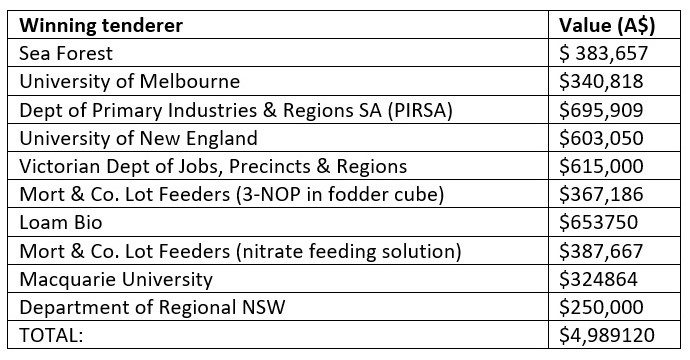
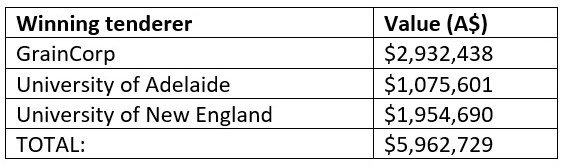
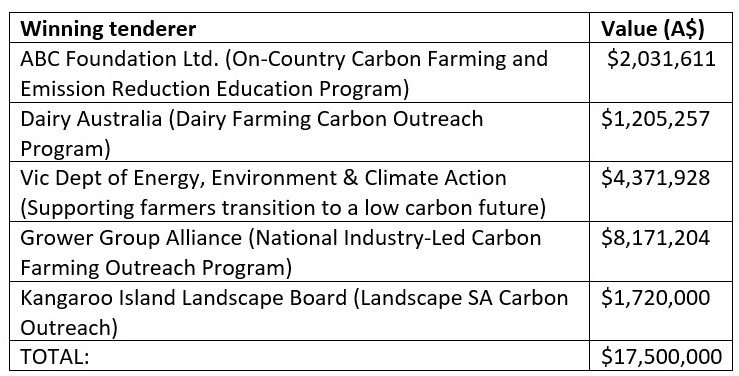
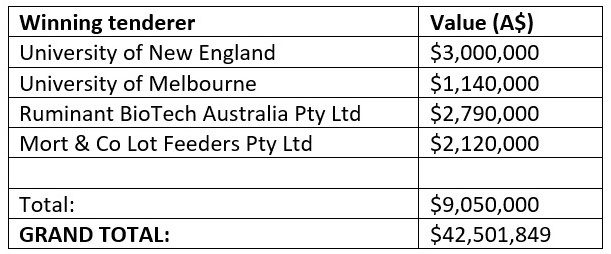
Investment stages are set out in the table below:
MERiL – Stage 1 (Research Grants) Date: 17 Feb 2022
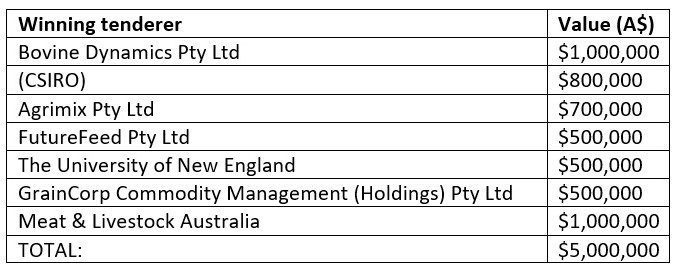
MERiL – Stage 2 (R&D grants) Date 23 October 2022
MERiL – Stage 3 Round 1 (Validation & demonstration) Date 16 Mar 2023
CFOP – Outreach (train-the-trainer) grants Date: 13 Dec 2023
MERiL – Stage 3 Round 2 (Validation & demonstration) Date: 9 Aug 2024
On 25 August, Agricultural Innovation Australia (AIA) was awarded a $6.4 million grant to help improve the consistency of farm level greenhouse gas emissions calculators.
The grant is part of a $28.7m package announced in the 2024-25 Budget, which is also funding the development of voluntary greenhouse gas emissions estimation and reporting standards for agriculture, fisheries and forestry industries, leaving a further $17m likely to be announced in the coming year.
This survey feedback will be highly influential in determining what areas of knowledge and capability remain a hurdle to emission reduction in the livestock sector.
Good morning
Are there any producer driven programs.
The universities tend to get too ganualar and often not fit for purpose.
Can I establish a group of qualified farmers to help get programs understood then on the ground.
Thank you
Mal peters
Good question:
Who/what business entity is receiving a share of $45m in government subsidies?
Consultants, new setups, ag companies with influence whilst genuine land managers keep managing the land and the environment.
Government funding must be transparent to disclose where this money goes!
<strong>The bottom of the article contains a comprehensive list of the recipients, Val. To summarise, it includes six universities; CSIRO; State agriculture, environment and climate departments; agtech and feed additive developers working in the carbon space; individual beef producers; and producer groups like the Grower Group Alliance - a national industry-led carbon farming outreach program that got by far the biggest slice of the pie: $8.17 million. It could hardly be more transparent. Editor </strong>