
AUSTRALIA’S beef industry needed to arrest its declining lean meat yield performance with increased selection pressure, University of New England meat scientist Professor Peter McGilchrist told the Southern Beef and Lamb School in Wagga Wagga recently.
In a wide-ranging presentation, Prof McGilchrist compared the genetic trends in eating quality traits in Australia’s beef herd and sheep flock.
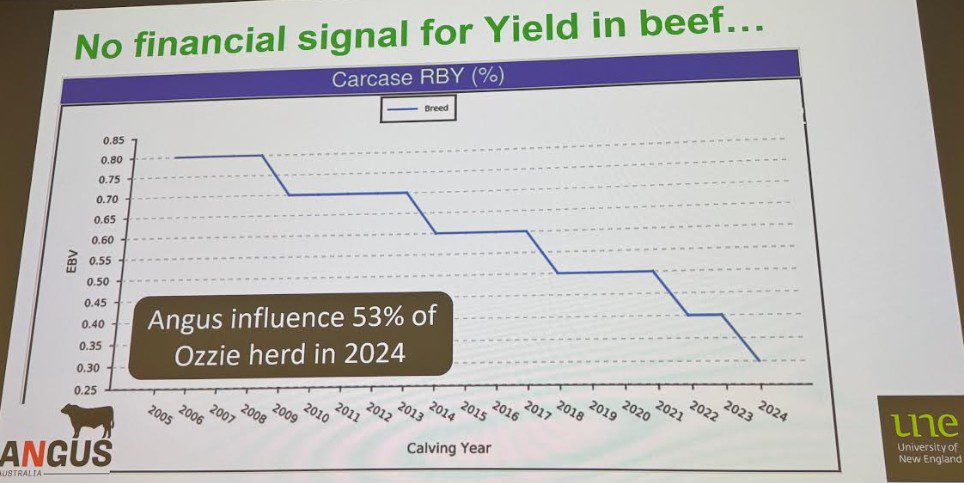
He said the genetic trend in lean meat yield over the last 20 years in the Angus herd is negative, back 0.5 percent, and Angus made up 53pc of maternal herd in 2024.
“We harvested 8.4 million head in 2024-25, they averaged 307kg of carcase weight and so I agree with you that the amount that we are exporting is still going up because carcase weights are going up, but yield is the percentage of that carcase weight that we can put in a box to sell.”

UNE meat scientist Prof Peter McGilchrist
Prof McGilchrist said multiplying 53pc of cattle harvested by a 307kg carcase weight, and reducing that total by 0.5pc equated to “6.8 million kilograms of beef we didn’t put in a box because we’ve taken the foot off the pedal on yield in the beef industry.”
“That’s a fair bit, nearly 7000 tonnes of beef that we haven’t realised any value on because we’ve reduced selection pressure on yield.”
“So we need to arrest this decline fast because we are actually losing money and we can have our cake and eat it to … if you want something you can simply select for it.”
But Prof McGilchrist said the beef industry had done an amazing job increasing intramuscular fat or marbling, with Angus as the predominant breed lifting IMF by more than 2pc.
“And this comes back to you guys as producers, market signals drive change and we’ve had a market signal for meat quality.”
He said the increase in IMF had been achieved despite carcase weight taking almost a quarter of the weight (24pc) in the Angus Breeding Index ($A) and Angus Breeding Low Feed Cost Index ($AL).
“So we’ve had for years massive selection pressure through indexes on yield and which way have we gone? The opposite direction,” he said.
“So I give producers credit that they are actually selecting for things that make them money, which is reproduction, growth rate and quality, so well done.
“However, we are losing cash by not having higher yields – so no payment equals no selection essentially – even though in the indexes we’ve got huge weighting on yield, which is quite interesting.”
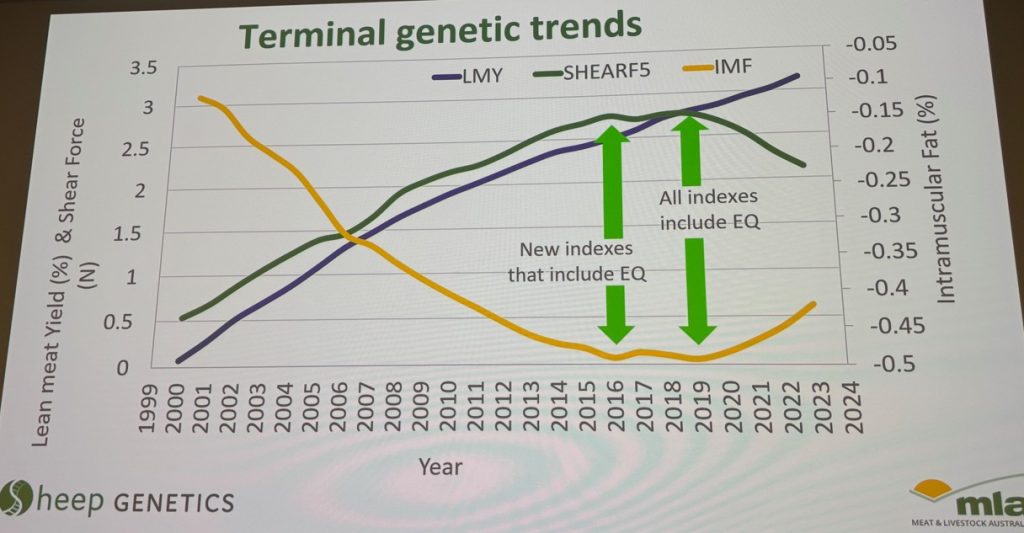
Prof McGilchrist showed how eating quality indexes in sheep had turned around the trends of increasing shear force (decreasing tenderness) and decreasing IMF, while also increasing lean meat yield.
“It’s absolutely a great story for our industry and it shows what happens when you give producers information, what can happen in the direction we go.”
The value of lean meat yield or more muscle on farm was in faster weight gain, greater efficiency of production to approach carbon neutrality and a higher dressing percentage, he said.
“It takes six times more grass or feed to deposit a kilo of fat compared to a muscle. So if you’ve got a six to one ratio – 6kg of dry matter is equal to 1kg of growth grown and they are laying down muscle, as soon as you start laying down fat totally, that’s 36kg of feed they have to eat to lay down 1kg of fat.
No value in ‘over-fattening’
He said there was no value in ‘over-fattening’ sheep or cattle.
“We’ve got to get them to the right fatness and then quit it as soon as we can. Overfat sheep costs us a lot in efficiency,” he said.
“So yield not only makes money at the processor end, but it is costing you dollars by laying down too much fat on farm.
“Sheep producers get it, well done, but we absolutely need to measure yield in the beef industry and also select for it …. we just need a little bit more meat all the time.”
Prof McGilchrist outlined the value of objective measurement to find and select the animals who have high IMF and LMY, despite the negative genetic correlation, to maximise eating quality in sheep and cattle.
How is lean meat yield calculated? Why 53%? We know our reported carcase yield for beef here are much lower than in the US due to grading and standard trim differences. Is this, effectively 'poor data', corrupting the signal?
Keep with the purebred Angus culture and the decline will continue.
Crossbreeding has been proven to produce balanced carcases, including improved retail beef yield and maintaining marbling. Crossbreeding has been integral to the phenomenal rise in the productivity in the chicken, pork and lamb industry but still many beef producers prefer the ostrich approach.
yes Micheal what you have expressed is the most profitable beef production it combines carcass yelld and feed efficiency with all MSA
qualities. cheers.
Prof McGilchrist's observations are are relevant to profitability throughout the production chain however the importance of eating quality, partly achieved through selection for marbling, tenderness and docility cannot be underestimated if beef is to remain a premium protein source.
The emphasis on yield in the production of prime lamb appears to have backfired to the extent that consumers cooking traditional roasts are now experiencing poor eating experiences, primarily attributed to a void of intramuscular fat and discernable toughness, especially in the "shedding" breeds.