
IT IS not uncommon for some producers to overestimate the ongoing performance gained from a bull purchase decision made years previously.
It is true that genetics offers permanent and cumulative improvements to a beef herd, however it is also important to remember that genetic improvement is not a one-off.
4WD analogy
An easy way to consider the impact of genetic improvement could be to compare herd progress towards a breeding goal in the same way we might consider comparing the performance of two generations of Toyota HiLux – the first being the current 2026 series, while the second is a 2006 model.
Both vehicles are made by the same manufacturer and are ostensibly very similar in what they offer. However, there are some dramatic differences in performance.
 As an illustration, driving from my home to Tamworth and back in my HiLux is a round trip of 1192km. My operating environment is the road network with its speed restrictions, the risk of hitting a roo and the cost of diesel. In a current model HiLux, that round trip would take around 13hours (averaging 91km/hour). And in fuel cost it would be about $188.
Comparing this to a 2006 model HiLux, the trip would take an hour and half longer (averaging 83 /km hour) and the fuel cost would be $299 or $42 more than the newer model.
On the face of it, some people may argue that this isn’t too great a difference, and in the scheme of things acceptable. The goal of traveling to Tamworth and back has been achieved, and while it may have been a little longer and cost a little more, it’s not a huge cost.
Accumulated cost
However, if that was a journey made once a week (or 52 times a year) it’s a very different story. At the end of 52 round trips, the current model vehicle would have clocked up 681 hours driving, used 5580 litres of diesel for a total fuel cost of $9765. The 2006 HiLux would have taken 751 driving hours, using 6817 litres of diesel and cost $11,930 in fuel.
In real terms, the difference between the two is 70 hours of driving (3 days difference); 1237 litres of diesel and a costs difference of $2165.
So while it is possible to say that both the current model and the much earlier model did achieve a set goal, the cost and resources used by the older model, as well as the time associated with achieving this goal is clearly inefficient.
Herd inefficiency
This is the case with many beef herds across the country. There are herds that invested in superior genetics some years ago, using the leading sires at the time. However, those genetics are now surpassed by the current generation.
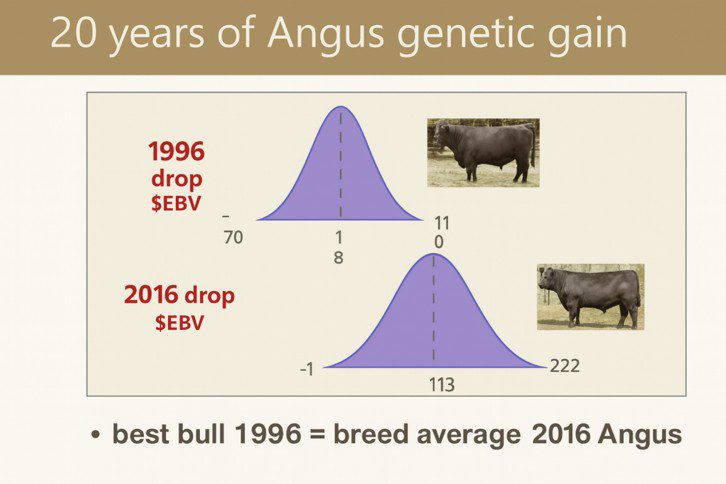
This is very clear for most breeds, with perhaps the most striking example presented by Dr David Johnson at last year’s Northern Genetics Field Day held at Spyglass Research Station near Charters Towers in North Queensland.
During his presentation, Dr Johnson highlighted the huge progress that the Angus breed has made over the past 20 years.
The slide below shows that the average Angus born in 2016 had a similar $EBV performance to what had been the Top 1pc of the breed in 1996. This shift is often underestimated, particularly because of the incremental shits that occur through genetic improvement.
Source: Dr Davide Johnson AGBU
Small gains are cumulative. In practice this means that producers who focus on and record performance, continue to use sires with high accuracy genetic information, and place high selection pressure on their replacements do move their herds towards more productive and profitable outcomes.
It is just as important to recognise that genetic progress is not limited to growth and days to turnoff, although these remain highly visible and commercially significant drivers.
In the same way that newer vehicles have not just become faster but also incorporate features that make travel easier, safer and more efficient, modern cattle genetics now include information on traits that were either poorly described or largely unavailable two decades ago.
In the same way that newer vehicles have not just become faster but also incorporate features that make travel easier, safer and more efficient, modern cattle genetics now include information on traits that were either poorly described or largely unavailable two decades ago.
Today, bull breeders and commercial beef producers have access to selection tools around eating quality, feed efficiency, structural soundness, temperament and maternal performance. These traits influence not just how quickly cattle reach market, but how consistently they meet market specifications and how efficiently they are managed along the way.
Like the example used around the Tamworth road journey, in breeding no single genetic trait accounts for the entire difference that can be measured. It is the cumulative effect of marginal gains across multiple performance areas that ultimately determines enterprise efficiency, cost of production and market compliance.
Herds relying heavily on sires that are representative of past genetic benchmarks may still reach their production goals, just as the older HiLux still reaches Tamworth, but they do so using more time, more feed and at a greater cost per kilogram produced. The commercial challenge is not whether older genetics still function, but what it costs to keep operating behind the performance level now available.

Alastair Rayner
Alastair Rayner is Principal of RaynerAg. He has over 28 years’ experience advising beef producers and graziers across Australia. Alastair can be contacted here or through his website: www.raynerag.com.au
Your analogy with the Hilux may ring true for efficiency, but have you factored in one of, if not the most important underlying factor in beef production and of any industry - "LONGEVITY". Yes your Hilux is faster and more fuel efficient, but will it last, cost to maintain $?. When we were part of breedplan, we were told that over time figures increase because of the number of animals recorded, not because they are better. A 250kg 200 day weaning weight in 2006( ?), may be assessed at +10 for his 200 day growth, in 2026 a 220 kg 200 day weight will be presented from the same herd as +30, because of the numbers of animals recorded over time( this is what was told me by ABRI staff at that time). What breeders need to look at, is not the figures but the actual 200, 400, 600, mature and carcasse weights and qualities, yes the figures are deemed to be representative of this, but depending on whether your herd shares genetics, has been recording for any length of time are factors that DO have an effect on what your animals figures are. We have all seen inferior animals with a set of bloated figures. One thing that I have noticed, particularly in the past 10 years, across all breeds, is the gradual diminishing of a cows milking abilities and the overall breeds milking figures, perhaps this is due to imported genetics and the enamored chase for growth, coupled with stud breeders, not just here but around the world trying to add early growth by substituting milk with grain and in doing so, the gradual demise of the females milking ability and the selection focused on growth alone. That, then brings me back to the most effective tool in a breeders armor( whether stud or commercial), and that is efficiency. If you can get your early growth from a cows milking ability, then the feeder doesn't have to spend as much on grain to make up for the lack of growth. A lot of older genetics have superior milking genes, because back then, feeding was inefficient.
Three separate issues are being conflated here.
Firstly this issue of longevity. Structural soundness, fertility retention and cow survival are economically relevant traits, but they are heritable and selectable. Modern breeding objectives increasingly include fertility, mature cow weight and functional traits alongside growth and carcase performance. Longevity is not inherently linked to “older” genetics.
Secondly, EBVs and genetic trend. Increasing numbers of recorded animals improve EBV accuracy. They don't inflate breed averages. EBVs are expressed relative to a defined base period. When breed averages rise over time, that reflects the realised genetic gain from selection pressure, not simply more data being recorded.
Thirdly, raw weights versus EBVs. A 200-day weight is phenotype (what the animal did). An EBV describes genetic merit (what its progeny are expected to do) calculated within contemporary group, pedigree and environmental context. EBVs are designed to separate inheritance from management and seasonal influence, which raw weights alone cannot do.
Efficiency also needs a clearer definition. Milk is one contributor to early growth, but it is not a standalone measure of biological or economic efficiency. True efficiency reflects the relationship between input and output (fertility, maintenance requirement, growth curve, feed conversion and longevity) relative to the production environment.
In many Australian systems, selecting for maximum milk increases cow energy demand and supplementation risk without improving whole-herd profitability.
Milk versus growth is a legitimate breeding objective discussion, but where that balance sits is system-dependent. The central point remains unchanged: genetic progress is cumulative, but it slows when selection pressure stops.