
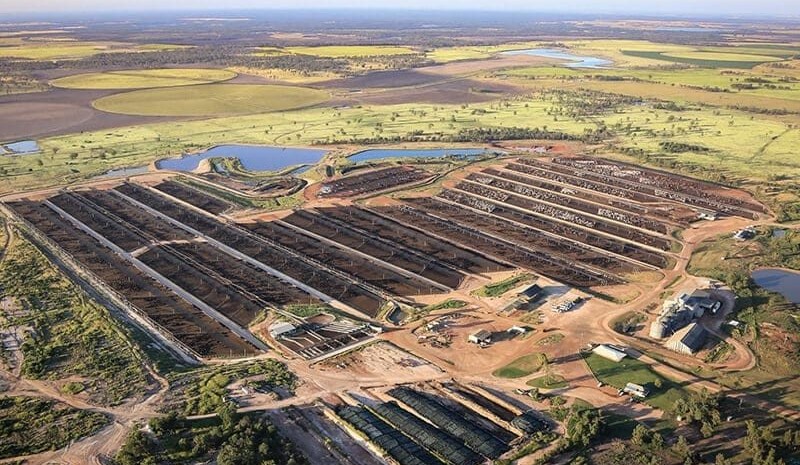
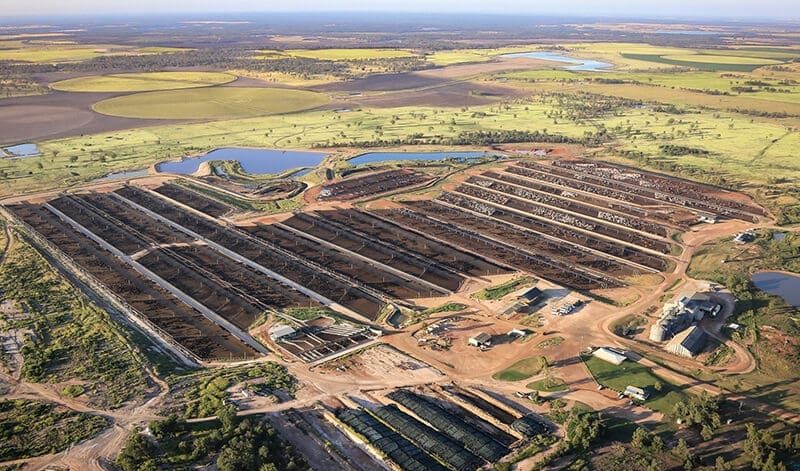
PLANS to grow Australia’s feedlot capacity are colliding with a single major barrier in water availability.
Tightening supply means some feedlots must now pay over $20,000 per Megalitre to secure water for their enterprises.
Beef Central yesterday summarised more than a dozen large feedlot expansion projects recently completed, or about to start, across Queensland, NSW and South Australia.
Industry consultant Dr Simon Lott, EnviroAg, has worked with many feedlots across Australia in his 30-year career on issues related to water, approvals, licensing, design and construction, and was a direct author in the development of all three editions of the feedlot industry National Guidelines.
Dr Lott said odour and then traffic were once the major issues confronting feedlot developments in Australia.
“Now we’ve got a handle on all of that,” he said.
“The number one constraint now is water, and it is what our business is spending the vast majority of its time doing – finding water if it is there for new feedlot developments, large and small.”

Dr Simon Lott
Dr Lott said that in southern Queensland in particular, both catchment and groundwater resources are now fully subscribed.
Additionally, government buy-backs and regulatory measures have steadily reduced available supply.
The Condamine Alluvium groundwater supply for example had over time essentially been halved, he said.
Construction of new dams is also now largely prohibited across much of the Queensland Murray Darling Basin, apart from small dams for stock and domestic and those below 5 megalitres.
Additionally Government water allocation from reserves tend to favour the resources sector with minimal amounts of remaining groundwater allocated to intensive agriculture.
“The supply of water in those systems has gone down, not up.”
Dr Lott said the price of water had roughly doubled in the past five years to over $20,000 per Megalitre today.
“There’s only one way the value of water goes, and that’s up,” he said.
 He said the tightening market reflected a combination of state policy changes and the reallocation of water to federal environmental programs, which had steadily withdrawn large volumes from agricultural use.
Going “deeper” was not necessarily an option given many deeper aquifers are already fully allocated and any new access rights are difficult to obtain.
“It’s very multi-dimensional, and getting harder and harder,” he said.
“First, there’s less water.
“Second, you need to find a groundwater licence that someone’s willing to sell.
“And then if you do find one, that doesn’t mean you’ll be allowed to drill and take it.”
Each potential project now requires Departmental approval and often detailed impact assessments, which is a large part of the work Dr Lott and his team now perform for feedlots looking to expand.
Lack of precise knowledge about on-farm storage capacity
Another factor affecting water availability can be a lack of precise knowledge as to the size of existing storages.
“Does their dam really hold the 500ML they think it holds? And is that volume properly certified and approved?”
“With all of our clients, we make sure their water assets are secured first, before we even think about expansion.”
CSG water
Early expectations that treated coal seam gas (CSG) water could be redirected to support agriculture have also largely failed to materialise, due to the high costs involved of treating water, getting it to where it is needed and the consistency and longevity of supply.
“There is probably not as much CSG water in those projects as people thought there was going to be,” Dr Lott said.
Finding existing allocations that can be secured and piped to a new feedlot is another strategy.
“Potentially there are water supply opportunities there,” Dr Lott said. “Normally what we suggest to clients is take an option on the water, pay an option fee to hold it and allow us to go to work, to see whether we can make a relocation work.”
The absurdity of growing Australia population at 2.68% annually in a drought prone country is farcical and dangerous to both National security and food security of Australia.
Lessons from the Millennial drought and the Tinderbox drought are not be referenced when planning both population growth , regional security and national security
The Murray Darling Basin Plan (MDB Plan) is a environmental plan, not a plan of community and commercial resilience during periods of droughts and floods.
The MDBP, proposed Net Zero and Population growth are on a dangerous collision course ruin the future prosperity for both country and citizens
New and better natural water logistics assets and policy are required to secure Australia future
Common Sense must prevail
David Farley