
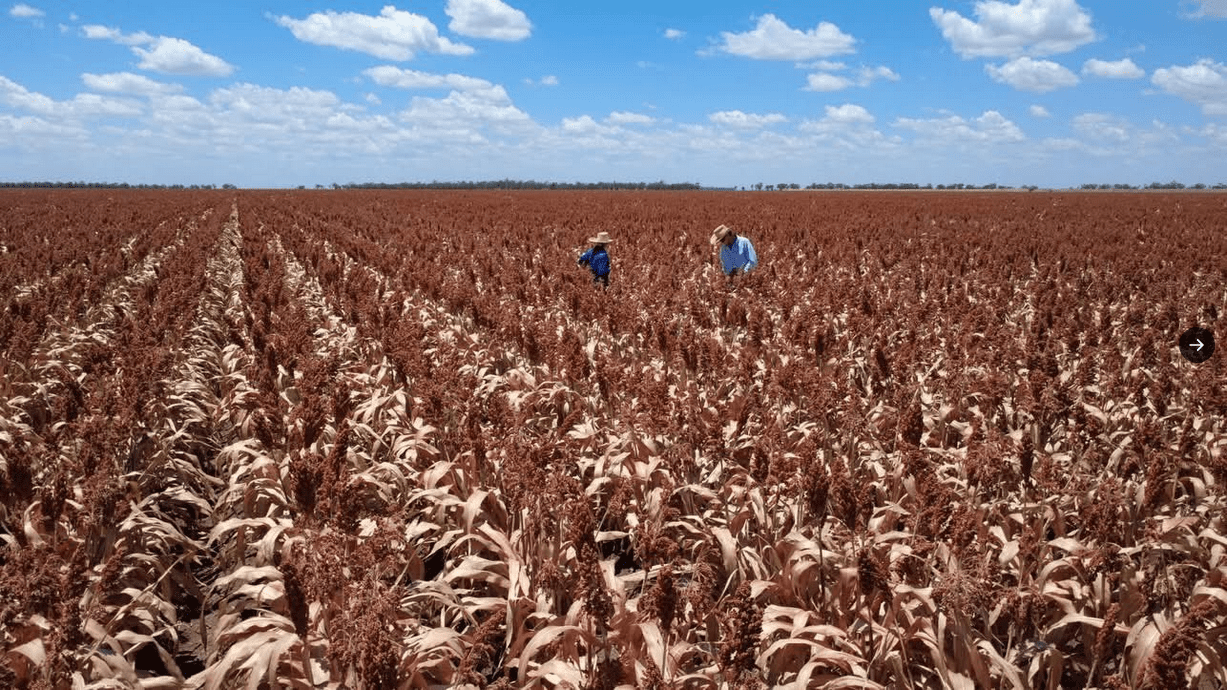
A crop of Pacific Seeds sorghum close to harvest south of Goondiwindi late last month. Photo: MCA Ag
MARKETS are showing little movement ahead of soaking rain forecast for the northern region, and as the stronger Australian dollar quashes demand for wheat and barley for export.
Sorghum harvesting is still taking place in northern New South Wales and southern Queensland, and the market is steady as the supply chain starts to fill ahead of new-crop shipment.
In NSW and Victoria, some growers are selling a load or two of stored cereals or pulses to backload with fertiliser as they prepare for winter-crop planting, and barley and faba beans are finding local homes for those supplementary feeding stock.
| Feb 5 | Today | |
| Downs barley | $340 | $340 |
| Downs SFW | $342 | $344 |
| Downs sorghum | $334 | $333 |
| Mel barley | $332 | $328 |
| Mel ASW | $342 | $338 |
Table 1: Indicative prices in Australian dollars per tonne.
Sorghum harvest keeps rolling in north
Feedlots are active on barley and poultry mills are buying wheat as the northern market trades sideways.
The stronger Australian dollar has on paper depressed prices for both grains, but reluctant grower selling has been supporting the bid side.
“Consumers are buying; they need to,” one trader said.
Southern Qld and northern NSW are believed to have ample warehoused and on-farm stocks of wheat and barley.
 Trader sources say engaging growers to sell at current rates is challenging, with many still out-turning chickpeas for the last cargo or two booked out of Brisbane, or busy harvesting their later-planted sorghum before rain arrives today.
The Bureau of Meteorology has 25-100mm on the forecast for coming days for Narrabri north and west, and into southern Qld.
For Central Qld, where sorghum has just been planted in the ideal window, up to 150mm is expected over coming days.
According to Digital Agricultural Services latest summer-crop estimates released last week, NSW sorghum area is around 226,000ha, 23 percent higher than last summer’s.
“The increase is largely driven by a rebound in Moree Plains plantings, back to roughly 60,000ha plus, alongside above-average plantings across other major producing shires including Liverpool Plains, Gunnedah and Narrabri,” the report said.
DAS estimates Qld area at around 214,000ha, but notes CQ sorghum is typically not detected until March-April.
Excluding CQ, DAS data shows southern Qld plantings are around 25pc lower than last season, particularly in the Western Downs and Goondiwindi regions.
On the demand side, Broun & Co director Charlie Coventry said there has been an uptick in interest in buying stockfeed for on-farm use.
“There’s definitely more stockfeeding inquiry; with the hot weather, everyone was alarmed and hit the phones; it’s tyre-kicking at this stage,” Mr Coventry said.
Ahead of new-crop ginning starting after Easter in southern Qld and northern NSW, current-crop cottonseed is hard to find at prices deemed workable by graziers.
“That means they’re generally looking at barley or faba beans.”
Those markets delivered Liverpool Plains are quoted at around $410/t for fabas, and $325/t for barley.
“The market hasn’t been swamped with supply, and sorghum’s now taking the spotlight.”
The red grain is rolling into an effective China-facing supply chain, and facing little competition from wheat for stem space.
“Wheat’s not working; we’re so far away from connecting with Asian consumer.”
Southern market stronger up-country
Those with livestock in the south are also in the market for loads of barley or faba beans to feed out.
In southern NSW, barley is trading at $300/t delivered, with spot loads up to $310/t.
Grain Focus managing director Michael Jones said barley was the preferred buy for those with lambs to finish.
“Lambs are worth good money; one tonne of barley is worth the same as one lamb,” Mr Jones said.
Most graziers see lupins at around $645/t on farm as too expensive to buy in for feed, although they are still finding demand from some with specialist requirements.
The delivered Melbourne or Geelong export markets are paying around $440/t for faba beans, on par with the up-country feed market.
“There’s talk of a few fertiliser bills starting to arrive now, and it’ll probably be the case of growers selling a load because they need to rather than because they like the price.”
In Vic, where a surprisingly large faba bean crop was grown in the Wimmera and Western District, some domestic feeders are snapping up fabas at around $410/t.
Riverina’s Hanwood wheat market is trading at around $15/t below the delivered Geelong rate, indicating that bids from up-country consumers are strong enough to keep it in the district.
Traders have said the strong AUD has gone against the writing of new export business, but domestic stockfeed mills are well aware that could change if the dollar drops below US 70 cents.
“These prices are probably $10 above where they work into the export market,” one trader said.
On the barley front, exports are continuing at pace, with Western Australia leading the charge.
“The talk is barley from the east coast is $10 from pricing into China.
“If the dollar got back to even…the high 60s, we could see that correlate.”