
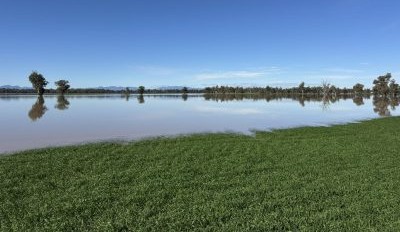
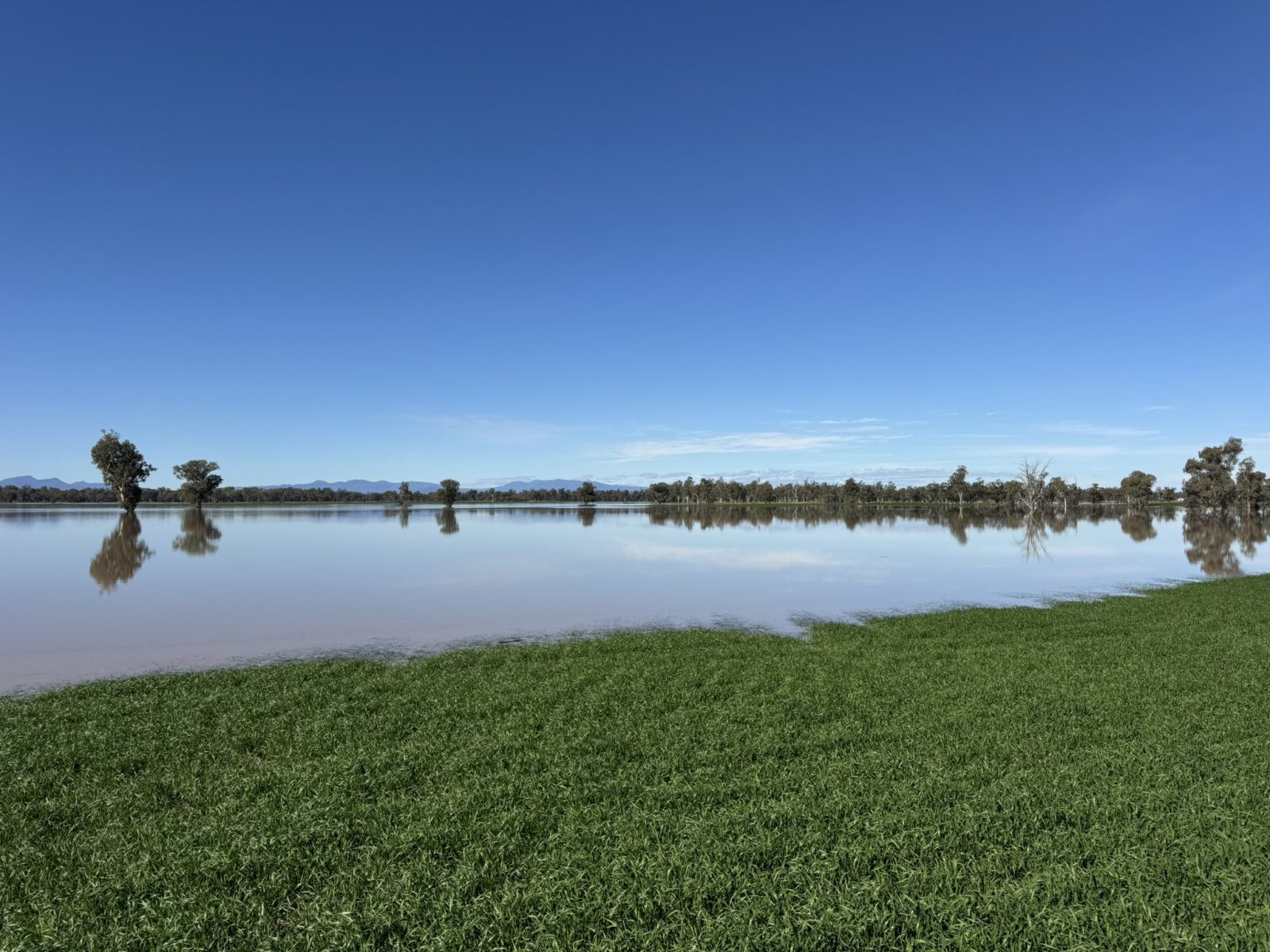
A swollen Namoi River is flooding some crops, including this wheat paddock downstream from Narrabri, where the grower is expecting winter crop losses of 30-40 percent. Photo: Matt Norrie
OPPORTUNITY finishing of sheep and lambs is providing some unseasonal demand for barley centred in Victoria and New South Wales as global values continue to weaken.
Rain in the past week has caused some localised flooding, and bolstered yield prospects for wheat and barley crops in northern NSW and southern Queensland ahead of sorghum planting, which will start in earnest next month.
In South Australia and Vic, a mostly dry week has allowed growers to spray or top dress crops, and yield prospects in parts of both states have improved considerably.
| Prompt July 31 | Prompt today | Jan July 31 | Jan today | |
| Downs barley | $324 | $320 | $321 | $315 |
| Downs SFW | $330 | $330 | $330 | $325 |
| Downs sorghum | $357 | $355 | NQ | NQ |
| Mel barley | $358 | $355 | $330 | $335 |
| Mel ASW | $355 | $352 | $347 | $350 |
Table 1: Indicative prices in Australian dollars per tonne.
Minor flooding in north
In southern Qld, rain mostly hugged the ranges, with patchy falls in cropping regions in the week to 9am today.
Higher registrations included: Dalby and Pratten 9mm; Felton 7mm, and Macalister 5mm.
Some parts of northern NSW received substantial rain, and low-lying areas have flooded, which could kill small areas of short crops, namely chickpeas.
Registrations for the week on the Liverpool Plains and north-west slopes and plains include: Gunnedah 69mm; Narrabri 22m; Moree 12mm; Mungindi 13mm, and Walgett 18mm.
AgVantage Commodities broker Brendon Warnock said the Namoi River has just peaked in Narrabri following some big weekend falls in its tributaries including the Peel and Mooki rivers, and Cox’s Creek.
Flooding has impacted crops from the Liverpool Plains to west of Wee Waa, and also in the Gwydir and Macintyre valleys, but losses are expected to be minimal overall.
 “Taller crops like canola and wheat should be okay,” Mr Warnock said.
As days lengthen and temperatures rise, most crops from around Forbes north are looking to set above-average yield potential, provided the season is kind from here on in.
“New crop is looking good from a moisture point of view.”
While crops are looking good, prices are not.
“Prices have really come off pretty strongly.
“That’s not unexpected with what was coming with the Northern Hemisphere crops getting bigger, and northern NSW getting bigger too.”
New-crop wheat on a multigrade contract has fallen $30-$40/t in recent weeks, dropping the bid at remote warehouse sites like Walgett to $275/t.
Not surprisingly, growers are reluctant to lock in at reduced levels.
“Right at the moment, demand is on the bear side, and the ship is leaning very much that way.”
Volume consumers like established feedlots and poultry operations are said to be hopeful of further price drops in the lead-up to the northern NSW and southern Qld harvest, when they are expected to advance buying.
“Those consumers want their silos empty for harvest.”
“I think it’s a period where feedlots…are looking to try and get it cheaply; supply is plentiful.”
Greenoaks Agriculture broker Richard Perkins said carry-out for wheat in NSW looks like being historically high, and growers in more marginal country are holding the volume.
Aware of how quickly their seasons can cut out, or not shape up at all, they are generally in no hurry to quit their stocks after a big cereal, chickpea, and faba bean harvest.
“They are very well cashed up, and they know how to store grain.
“We’re seeing a bit of resistance to selling coming more so from those areas.”
Likewise, consumers are generally in no hurry to buy.
“The bigger end of town is covered until the Oct-Nov and Nov-Dec slots on wheat, and to a lesser degree on barley.”
South improving but far from secure
In the southern half of NSW, and into Vic, falls in cropping regions were light at best, but SA got some handy falls concentrated on Eyre Peninsula, and a few millimetres in parts of the Mid North and into the South East.
Higher EP registrations included: Cleve 9mm; Cummins 14mm; Elliston 17mm, and Lock 13mm.
As lamb prices continue to set new records, including Monday’s national high of $477.20 set at Dubbo, finishing lambs or fattening stores remains a viable option for the mixed farmer.
Based on the idea that southern NSW, Vic and SA have entered the flock-rebuilding phase after a dry one or two years, livestock prices are expected to hold in the short to medium term.
 “There’s definitely money in converting grain to lamb and beef,” Peters Commodities Wagga Wagga-based trader Peter Gerhardy said.
Combined with finished feed, demand for which has started to tail off as pastures get closer to jumping away in spring, barley stored on farm or bought out of warehousing is making its way into livestock rations.
Almond hulls at $300/t plus are also in demand, particularly from producers using them in lamb starter rations.
While rain in recent weeks has set crops up for the coming month, Mr Gerhardy said crops were short, and three or four weeks late.
Consequently, growers are in no hurry to commit on new-crop volume, well aware that current bids will not cover costs on a low-yielding crop if the season cuts out.
“If barley’s $282 or $290 on farm, and if you’re only stripping 1-2t/ha, your balance sheet’s in the red.
“I haven’t got any growers keen to sell anything forward; it’s too early for them.”
“Even today, after the rain, you can still see dirt through cereal crops; they haven’t tillered out.”