
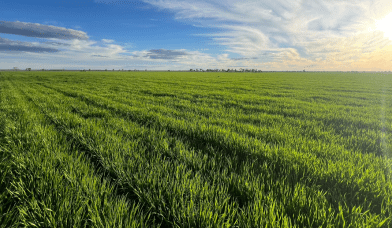
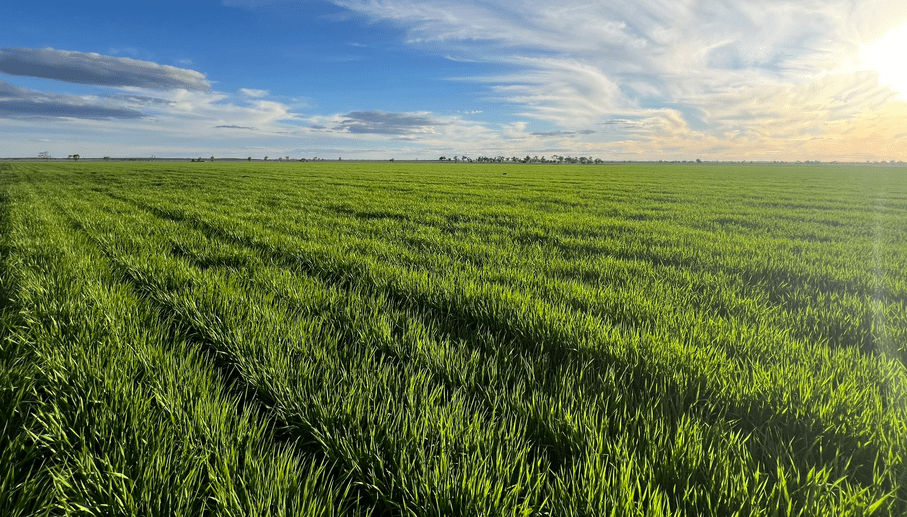
A crop of Neo CL barley growing on the Darling Downs. Photo: Lance Wise
A BIG spread between bids and offers, combined with the southern grower’s lack of confidence in forward selling volume, has kept traded volume to a minimum.
Likewise, current-crop business is slow, as accumulation winds up for the last few wheat and barley cargoes for the season.
In the north, growers are keener to forward sell chickpeas than cereals, while in the south, canola’s rally on the back of hopes around China reopening is making it the forward sale of choice.
| Prompt Aug 7 | Prompt today | Jan July 31 | Jan today | |
| Downs barley | $320 | $317 | $315 | $317 |
| Downs SFW | $330 | $330 | $325 | $330 |
| Downs sorghum | $355 | $350 | NQ | NQ |
| Mel barley | $355 | $350 | $335 | $335 |
| Mel ASW | $352 | $355 | $350 | $350 |
Table 1: Indicative prices in Australian dollars per tonne.
Harvest start nears in north
Central Queensland received some handy rain in the week to today ideal to help fill cereal and chickpea crops ahead of harvest, which will start late next month.
Falls in the week to 9am today include: Clermont 14mm; Emerald 11mm, and Springsure 17mm.
Very little, if any, rain fell in southern Qld and northern New South Wales, which has allowed low-lying country in the Namoi Valley particularly to drain after minor flooding last week.
As new-crop prospects consolidate, trade sources said bids and offers are too far apart to see much trade.
Prompt business is also thin.
 “When we talk to end users, they’re pretty comfortable going into harvest,” Norco accumulator David Henderson said.
“There’s still grain available, and there’s a large divide between the sell and the buy side.
“Bids are lower but offers aren’t changing.”
Consumers are thought to be hopeful of harvest pressure once southern Qld barley starts to hit the market in volume in October.
Soft global pricing for feedgrain, and buoyant yield prospects for Qld and northern NSW, have consumers hopeful that barley prices in the harvest slot will sink below $290/t delivered Downs, as they did last year.
“Barley will have to go first to make room for everything else on farm.”
That includes chickpeas and wheat for most growers, and faba beans too for some.
In contrast to northern NSW, barley stocks on farm and at bulk-handling sites are believed to be low in Qld.
The ex-farm barley market in northern NSW is believed to have traded below $310/t this week.
South gets showers
Much of the Victorian Mallee, Wimmera, and Western District has had 5-10mm of rain over the past week, while grain-growing regions in SA and southern NSW generally got 5mm or less.
Grower interest in forward selling is currently focused on canola, with hopes that China will return as a buyer of Australian canola now that a tariff on Canadian product is in place.
A Canadian Government statement puts that tariff at 75.8 percent, effective as of today, to follow China’s 100pc tariff on Canadian canola oil and meal put in place in March.
Horsham-based Pinion Advisory broker Andy Brown said the news has helped to lift Australian new0crop canola values by around $10/t overnight to surpass $800/t as some sites.
If and when it returns as a buyer of Australian canola, China buying could be expected to reduce non-GM’s premium over GM from the current $60-$70/t by lifting GM values.
“That’s the main thing we’d like to be seeing,” Mr Brown said, adding that interest in forward selling canola was greatest in country south of Horsham and into the Western District, where crops were “cabbaging up”.
“A lot of the canola north of Horsham is patchy because of staggered emergence.”
New-crop cereal prices are under pressure, and growers are in no hurry to sell, with canola and possibly lentils once again shaping up as the crops to sell off the header.
“If cereal numbers are sub $300 delivered site, growers will probably sit on them.”
“Growers are forward selling what they can, but with where the crop is, we’re not going to have a massively above-average crop.”
“We’re late; we’re going to need a kind finish to get us through.”
That includes mild and showery weather for another four weeks at least to help compensate for the delayed emergence across much of Vic, SA, and southern NSW.
Supplementary feeding not over
Pastures are expected to start regenerating in coming weeks in Vic’s WD, and in SA’s South East, and are already jumping away in more northern parts of both states after recent rain.
Ahead of warmer weather and spring growth, most graziers are still supplementary feeding sheep and cattle with purchased and donated inputs.
The Rapid Relief Team has its next fodder drop organised for August 29 at Paruna in SA’s Murray-Mallee.
It will distribute 1000 large square bales of premium-grade vetch hay to registered producers, as well as hosting a Farmers Community Connect event at the Brown’s Well Football Club.
After setting up profitable systems during the drought, Mr Brown said some livestock producers look set to continue supplementary feeding.
 “Those sheep guys south of Horsham have now got set-ups to feed sheep, and instead of selling them as stores, they can keeping using the equipment they have…to feedlot lambs.
“Now that they know what they’re doing, guys we’ve been selling barley and pulses have indicated they’ll keep going.”
“They can put $20-$30 worth of inputs through them, and get an extra $60-$80.”
Mr Brown said the strategy also allows an earlier weaning, which helps the ewe maintain condition.
Lupins have featured heavily in Vic, SA, and southern NSW drought rations, and Mr Brown said they may be in short supply locally.
“Lupins are mainly grown in the Mallee, and after all the wind we’ve had, a lot of them have been sprayed out, or won’t make a crop.”
A 22,000t cargo of Western Australian lupins which discharged in Geelong last month has helped to shore up protein needs.
Mr Brown said more may make their way east if new-crop WA lupins are competitively priced, and south-eastern Australia’s lupin crop is as small as expected.
“We’re probably going to have to look at other protein sources like fabas or field peas to fill that demand.”