
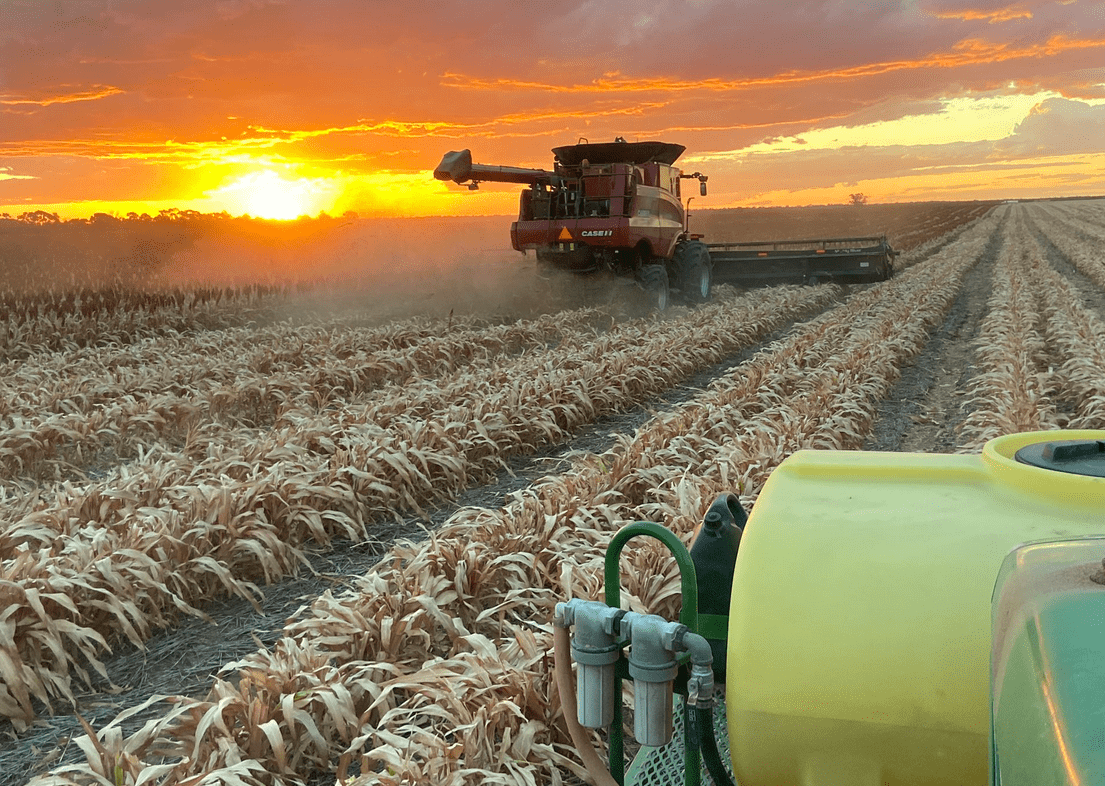
The sorghum harvest wrapped up this week on this farm near Goondiwindi. Photo: Dave Beare
SUPPLEMENTARY livestock feeding and a lack of grower selling has put some heat into eastern Australian feedgrain markets this week.
Sorghum values have firmed by a couple of dollars, despite harvest selling taking place in northern New South Wales and southern Queensland.
Buoyed by solid export demand from China and the Middle East, barley at levels up at least $10 per tonne on last week are inspiring some selling interest from the trade and growers.
A run of days over 40 degrees Celsius is forecast for many parts of inland eastern Australia this week.
While not unusual for the middle of the Australian summer, trade sources say the hot and dry conditions have those with livestock looking to ensure they have adequate nutrition on hand for coming months.
| Jan 15 | Today | |
| Downs barley | $315 | $333 |
| Downs SFW | $326 | $333 |
| Downs sorghum | $336 | $338 |
| Mel barley | $328 | $340 |
| Mel ASW | $347 | $350 |
Table 1: Indicative prices in Australian dollars per tonne.
Sorghum deliveries accelerate in north
Growers in southern Qld and northern NSW are ripping into the sorghum harvest, with some just starting, and others finished.
Many up-country bulk-handling sites are accumulating sorghum for export, and road deliveries are rolling into Brisbane sites for bulk export once the loading of booked chickpea vessels is completed.
Feedlots and mills have lifted their bids for barley by more than $15/t in the past week.
“Barley is getting harder to dig it out, and there’s been some selling from the trade and grower at these higher levels,” one trader said.
Dry south buoys feed demand
In southern markets, barley and faba beans are finding some up-country demand as those with sheep look to ensure they have enough on hand for maintenance rations ahead of the expected autumn break.
Mixed farmers generally have ample stocks of faba beans, if they grew them, and barley after harvest, but graziers who have seen little pasture response after limited spring rain are looking for loads.
“Barley seems to be kicking along,” Peters Commodities Riverina-based trader Peter Gerhardy said.
“There’s a little bit of drought demand starting to kick from sheep feeders, and that was to be expected after a dry spring.”
Faba beans are trading at $415-$430/t, depending on up-country location, against field peas at $540-$550/t and lupins in the low $600s.
“Fabas at the minute are the cheapest source of protein out there,” he said of the up-country market.
Harvest across much of southern and south-central NSW was a lean one this year on plains and outer slopes country, meaning stubble is missing bulk, particularly with so much cut for hay or straw.
Therefore, supplementary feeding of sheep is starting early in some districts, and some cattle are also being fed.
“If you look at that hill country, a lot of it is bare; they didn’t have much of a spring, and we’ve got February and March to go yet.”
Export demand for wheat is thin, and barley is being drawn from regions close to port, such as the Wimmera and Western District in Victoria.
Mr Gerhardy said grower interest in selling was overall limited.
“Growers are still on holidays.
“They aren’t going to put grain into a silo in November or December and get it out again in January-February to sell at the same price they saw at harvest.”