
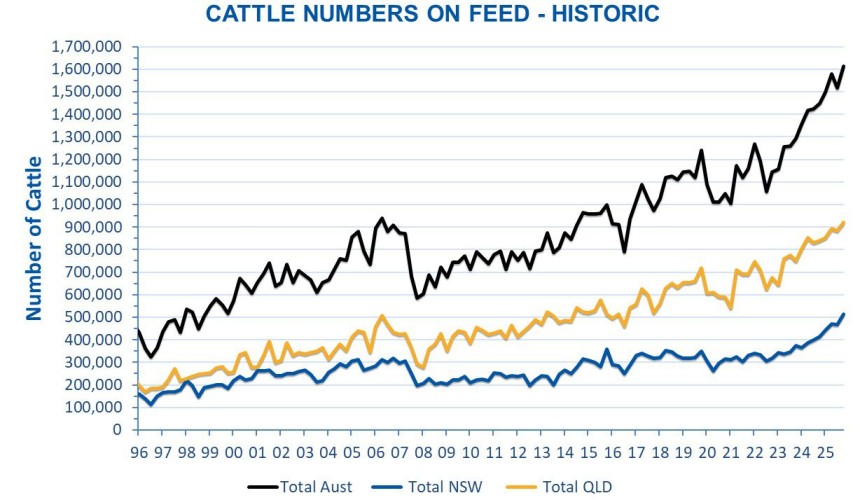
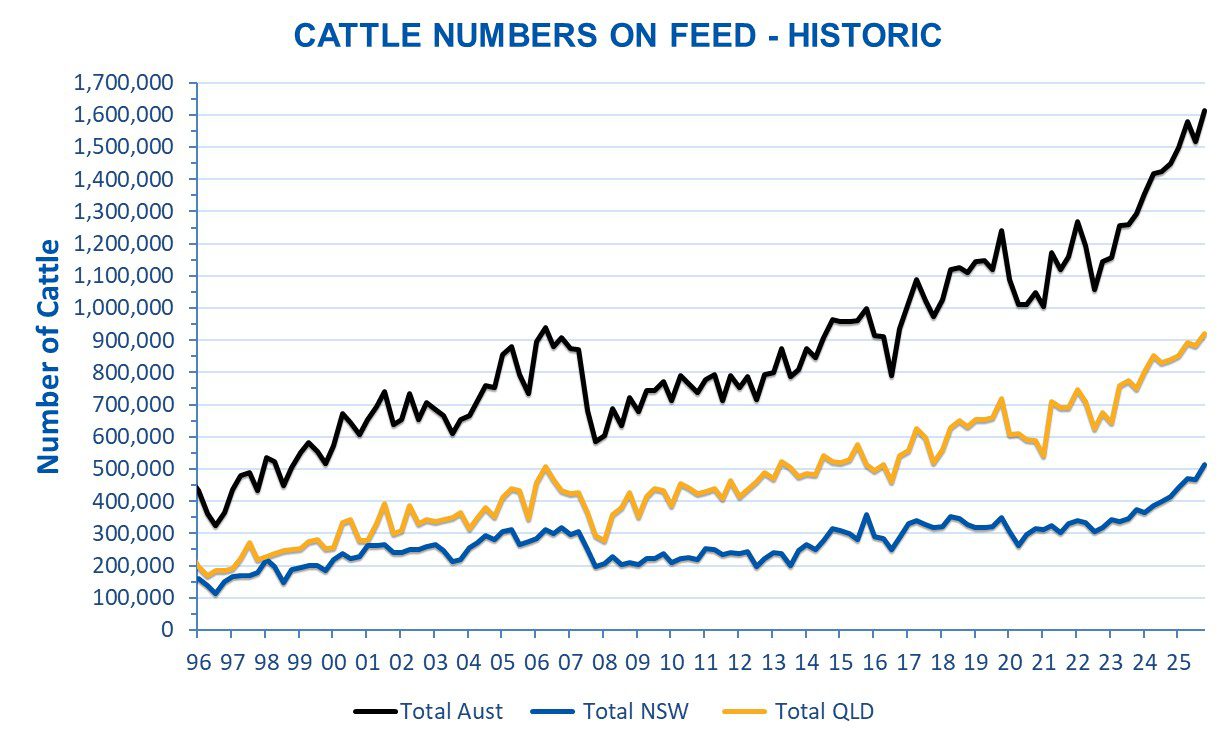
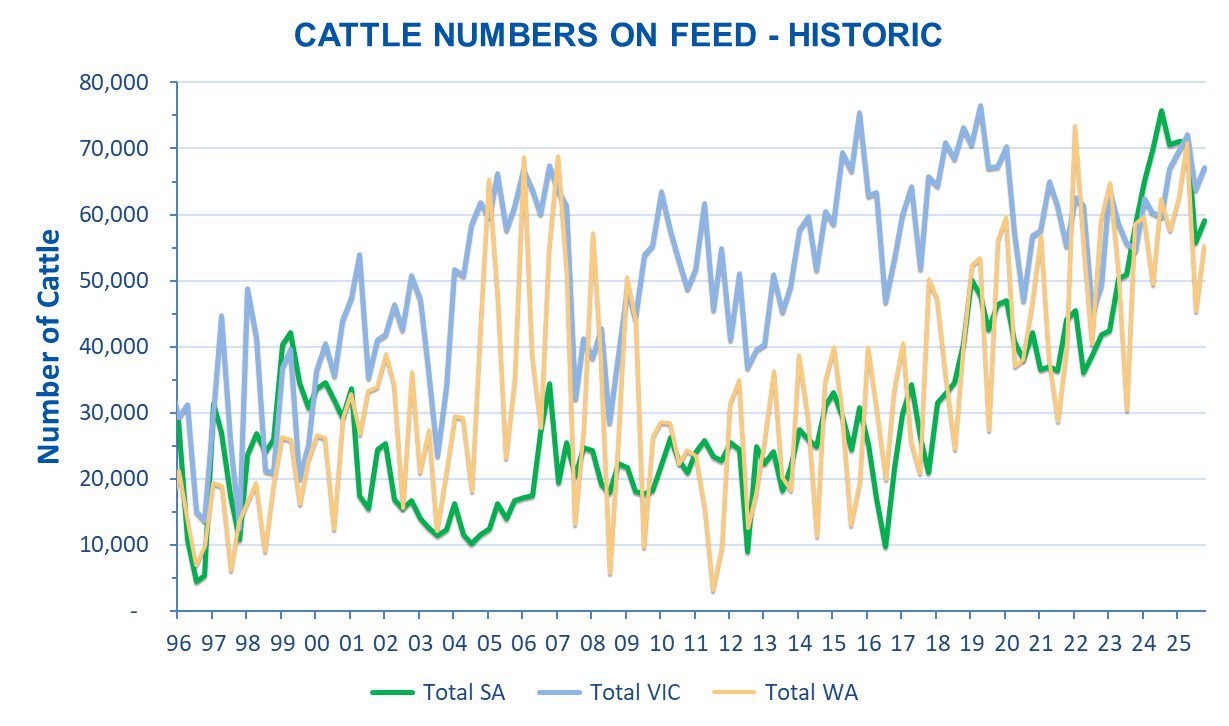
National numbers on feed (black line), plus Qld (yellow) and NSW (blue), Smaller states appear in a separate graph below.
NUMBERS on feed in Australian feedlots have continued to climb to new records, hitting 1.6 million head for the first time in December quarter survey data released this afternoon.
With the exception of a single quarter in 2025, numbers on feed in Australian feed yards have grown consistently since the 2023 start to herd rebuild after earlier drought.
Last quarter saw the number hit 1.614 million head, up a further 6.4 percent on the September quarter survey, and 11.3pc or 165,000 head more than the December quarter a year earlier.
Most states showed solid growth:
- Queensland numbers on feed at almost 920,000 head were up 35,000 head on the September quarter, and 80,000 head or 10pc higher than the previous December

- NSW numbers at 513,000 were up 45,000 head on September, and almost 100,000 head or 23pc higher year-on-year
- Victorian numbers reached a record 67,100, up 6pc on September and marginally above December the year prior
- South Australian numbers at 59,100 were up 7pc from September, but marginally behind December quarter numbers the year before
- Similarly, Western Australian numbers at 55,200 were down about 4pc on the same time the year before.
In line with recent reports on feedlot expansions published on Beef Central, national feedlot capacity also climbed to a new high of 1.762 million head, reflecting ongoing investment in infrastructure and long‑term confidence across the supply chain.
Biggest capacity increases were seen in Queensland, up another 61,000 head over the past 12 months to 976,000 head, and NSW, up another 46,000 to 537,000 head. At some stage soon, it’s looking likely that Queensland’s feedlot capacity will exceed one million head for the first time, as evidenced by this report about proposed expansion at Stanbroke’s Bottletree feedlot near Chinchilla. Another large Downs feedlot is in advanced stages of a significant expansion plan.
Feedlot utilisation at 92pc was not a record, as claimed in the MLA/ALFA results release issued today. The June quarter last year registered a utilisation level of 92.55pc – the highest ever seen.
Utilisation levels were strongest in New South Wales and Queensland, where the numbers reached 96pc and 94pc respectively. Any numbers above 90pc are regarded as more or less ‘full’, in a commercial operations sense, due to downtime between intakes for pen cleaning, maintenance and other issues.
ALFA president Grant Garey said the results demonstrated a sector that is continuing to strengthen and evolve.
“These figures reaffirm the strength, resilience and forward momentum of Australia’s grainfed beef sector,” Mr Garey said.
“Over the past year, lotfeeders have continued to invest with confidence – expanding capacity, improving infrastructure and embracing new production efficiencies,” he said.
“We’re now seeing that investment paying dividends not just for feedlot operators, but for the broader beef supply chain and our international customers. Record numbers on feed, high utilisation and sustained turnoff reflect an industry responding to global demand and delivering reliable, high quality grainfed beef.
“As an industry, we remain focused on sustainable growth, animal welfare, innovation and meeting the needs of both domestic and export markets.”
Quarterly grainfed turnoff totalled 947,200 head in the December quarter, easing slightly (1.6pc) compared to record September turnoff, driven by declines in NSW and WA. However, Queensland (+4pc), Victoria (+28pc) and South Australia (+5pc) all recorded increases, keeping total turnoff well above the 900,000‑head threshold.
MLA senior market information analyst Emiliano Diaz said the sustained high level of turnoff highlighted the impact of long‑term capacity growth.
“This is only the second time grain fed turnoff has exceeded 900,000 head. This demonstrates the long‑term investments in capacity are now translating into increased production volumes,” Mr Diaz said.
“The high national utilisation rate shows new pens being built are being filled, reinforcing that demand for grain fed animals and beef remains extremely strong.
“With both numbers on feed and utilisation at record highs, the December quarter results point to continued expansion potential, particularly in NSW and Queensland where feedlots are approaching maximum capacity use.”
Fewer Wagyu, more domestic and 100-200 day programs
The graph below plotting four days-on-feed categories suggests Wagyu numbers on feed (blue shaded area), as a percentage of overall cattle on feed, have continued to ease since early 2024, as has cattle fed 200-299 days and less than 60 days.*
There was a little growth seen last quarter, also, in domestic supermarket type cattle fed 60-99 days
- This category is something of a mystery, as by NFAS regulation, heifers must be fed 60 days and steers 70 days in order to gain a grainfed cipher.