
 Sharp increases in feeder cattle and ration prices have blown-out the result in Beef Central’s latest 100-day grainfed trading budget, delivering a theoretical loss of $45 on cattle entering the feedlot yesterday and closing-out in early October.
The big hikes in feeder steer price and ration cost overwhelmed an encouraging jump in forward finished steer sale price in our regular grainfed trading budget calculated yesterday.
Using the standard set of variables (see list at bottom of this page), the latest $45 loss is $11 worse off than this same calculation carried out a fortnight ago, on a flatback feeder steer entering a Darling Downs feedlot yesterday, and closing-out after 105 days on feed on October 2.
It’s a big slide from a $4 net profit on the same exercise calculated a month ago (May 16).
Exerting the greatest influence over the outcome was a big surge in purchase cost for feeders.
After slipping to a record-low 150c/kg liveweight in our budget a month ago due to drought supply pressures, yesterday’s allocation for the flatback 450kg feeder steer ex Darling Downs has been lifted another 10c/kg from the last breakeven to 170c/kg, driven by the improvement being seen in the cattle market. Higher indicus types which some operators may be feeding for contracts are still 10-20c/kg below that rates, subject to quality and condition.
Part of the explanation for the rise is that a lot of pre-winter sales have already been made, and numbers are now lighter. Demand for feeders to utilise the good oats crop that has benefitted from recent rain has also helped shorten feeder supply.
While the oats crop in southern Queensland and central/northern NSW is a touch late – producers would like to have had cattle on oats a month ago, but did not get the ‘second break’ to allow that to happen – there’s now plenty of cattle being pushed into oats paddocks.
The Eastern Young Cattle Indicator on Tuesday shot up by 7.5c/kg in a day to 316.25c. That’s a 13.5pc rise since its low-point a month ago, pretty much in line with recent feeder movements plotted on Beef Central’s feedlot breakeven.
The increase in c/kg price values yesterday’s 450kg feeder steer at $765, a huge $90 rise in the last month, and a big part of the explanation for why profitability has dried-up.
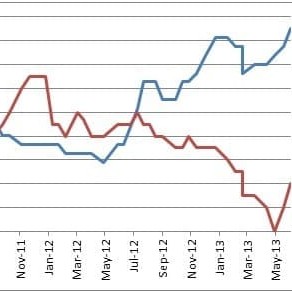 Historically, it’s the biggest one-month shift in feeder price we’ve seen since starting this data-set in May 2011. Back in mid-May, feeder value fell to $675, its lowest value seen in this trading budget so far.
This time last year, that steer was worth 195c, and ration price then was at $250/tonne.
Ration price lifts again
Given recent rises in domestic grain pricing (see Luke Walker feedgrain column published on Beef Central on Monday), ration cost for yesterday’s budget has been lifted another $10 to $315/t.
That ration price represents a ‘mid-point’ in what is an exceptionally wide spread in Darling Downs feedlot ration price quotes at the moment. Ration prices, as this report was being compiled yesterday, ranged anywhere from $300/t to +$340/t. That’s a massive spread, driven by the circumstances highlighted in this week’s feedgrain column, and lotfeeders’ grain purchase positions.
Subject to availability, producers looking to custom-feed cattle should look closely at quoted ration price, together with likely cost-of-gain from feedlot to feedlot, before committing.
Most regular longer-term feeders have a degree of cover, however, which enables them to price rations at levels closer to $300-$310, but spot feeders currently may find it hard to get commitments below $320-$330/t, blurring the lines a little on the current market.
Yesterday’s $315/t ration price (again, a record high since our breakeven started, having previously peaked at $310/t in January) represents a total feeding cost over 105 days of $493 on our trading steer, up $16 on a fortnight ago. Combine that rise with the higher feeder price, and the total production cost rises to $1348, a big $61/head rise on the June 5 figure.
Cost of gain, using our chosen variables (2kg/day ADG, for 210kg gain over 105 days) is higher at 235c/kg, up 8c from last time. This time last year, the cost-of-gain was 187c/kg on a $250/t ration price, making today’s figure about 22pc higher.
On that basis, a feeder steer putting on 210kg over a 105-day program is costing an additional $100 to do it, compared with this time last year.
Looking ahead, there’s little likelihood of grain prices easing, at least until new season grain starts to come in.
The variables outlined above deliver a breakeven figure in yesterday’s budget of 383c/kg – another 18c/kg rise on our last calculation, but still behind the record breakeven figure of 400c/kg calculated back in mid-January, and 386c around this time last year.
Even a month ago, the breakeven was still 349c/kg – a 34c/kg dressed weight difference, meaning the breakeven has effectively gone up $120 per beast in four weeks.
Forward pricing
Current forward public grid prices for 100-day ox from Southeast Queensland processors for October, week one, are moving in the right direction, however. Public quotes obtained yesterday were around 370c/kg dressed, up 20c/kg from a month ago.
A currency worth US10c less than it was this time in May is part of that, as well as a strong likelihood of short supply of quality slaughter cattle by October.
Using the old principle that a 1c drop in the currency is worth 4c/kg/head, dressed weight basis – all other pricing influences excluded (demand, season, supply etc) – it’s not surprising that forward offers are heading north. Under this crude measure, it represents a 40c/kg dressed weight improvement in value on a 100-day steer carcase compared with a couple of months ago, solely on exchange rate.
As mentioned in our intro, all the above suggests a trading result on Beef Central’s regular variables today of minus $45.
As discussed a fortnight ago, however, there have been some cattle placed on feed by owners recently that are out of spec, mostly on weight, due to dry conditions. For those owners, who may elect to feed-on sub-380kg intake cattle for a few weeks to get them into a more desirable grid slot, their outcome would obviously be worse than yesterday’s trading budget figure.
The exception would be if a big shortage of slaughter cattle emerges due to rain disruptions, for example, when they might be worth a little more to the processor.
5-10c/kg spot advantage over earlier forward contracts
Looking backwards at 100-day flatback cattle that went on feed in March for slaughter this week, forward-contract meatworks rates then were around 370c/kg. That’s 5-10c above where the southeast Queensland processor grid spot market is today, at 360-365c. On that basis, processors buying those cattle forward were about $18-$36 worse off, than if they’d bought on yesterday’s spot price.
- Beef Central's regular 100-day grainfed breakeven scenario is based on a representative standard set of production variables, ex Darling Downs. They include a 450kg liveweight feeder steer fed 105 days; 356kg dressed weight at slaughter; ADG of 2kg; consumption 15kg/day and a NFE ratio of 7.5:1 (as fed); $25 freight; typical implant program. Bank interest is included. It is important to note that variations exist across production models (feed conversion, daily gain, mortality, morbidity, carcase specification); from feedlot to feedlot; and between mobs of cattle. For a more specific performance forecast on a given mob of cattle, consult with your preferred custom feeder.