
AUSTRALIAN cattle prices continue to grind higher as local grazing conditions continue to improve, and on forecasts suggesting the best widespread rainfall event for the season across southern Australia and the east coast.
But while local conditions are starting to strengthen its worth noting what’s happening in the United States, where the beef industry is navigating a complex landscape of high cattle prices banging up against a challenging wholesale market environment.
 US beef prices have been forced up this year by falling supply with cattle slaughter down 5.7 percent year-on-year. The outlook for US supply is no better with June cattle on feed placements the lowest since 2016, as US herd rebuilding looks set to hit full tilt.
But while US fed cattle prices have reached record levels, there are signs that US beef demand is easing, with the US beef cut-out falling this week from $391/cwt to $377/cwt, mainly due to pressure on loin cuts as grilling demand eases seasonally.
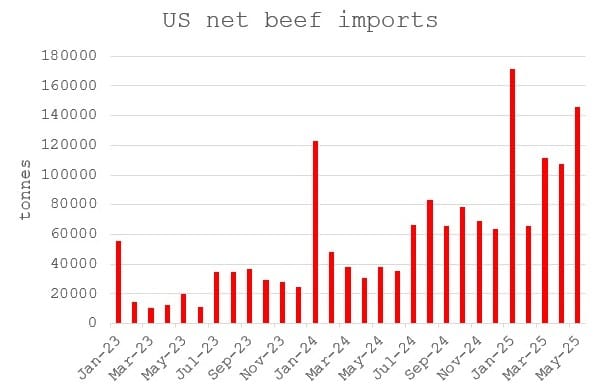
Shifting trade dynamics also presents a challenge for the US industry with imports surging 34pc and exports falling almost 6pc. Recent policy shift such as a ban on Mexican feeder cattle and prohibitive tariffs proposed on Brazilian beef signal a more complex and restrictive trade environment moving forward.
Source:: USDA
This chart shows the monthly difference between US beef exports and imports.
Australian exporters appear to be the beneficiaries of these trade policy shifts. The benchmark 90CL cow beef price lifted US10c/lb last week as buyers move to secure supplies of lean beef ahead of the imposition of tariffs on Brazilian beef.
The international landscape would suggest that Australian processors will be doing all they can to secure supplies to meet any shortfalls in the US market caused by a lack of Brazilian supply.
Local prices are holding up well against sustained heavy turnoff from northern areas assisted by strong competition from southern processors looking to keep their kill chains moving at maximum capacity.
WA
Across in WA, prices moved 10-30c/kg lw higher this week with heavy cattle over 380kg the most sought-after, selling to a top of $4.24/kg lw and an average of $4.05/kg. Heifers sold to a top of $3.48/kg lw to average $3.30/kg lw. Cows were the big movers, up to $2.90c/kg lw to average $2.75/kg, up 30c/kg.
Whether this was a processor short or a genuine market lift time will tell, because they haven’t really started mustering across the Pilbara or Gascoyne regions yet, so there are still decent numbers of cows to come down south.
Southern Australia
Across the southern states, saleyard numbers are tightening with some pasture starting to get away in coastal areas which has prompted a bit of a lift in interest on lighter restocker cattle, as some producers look to get ahead of the rush that may come if forecast rain arrives in the next week.
Some little black cattle at Ballarat making $6/kg lw. But most southern markets featured plenty of fat score 1 & 2 cattle as producers decided to take the money rather than continuing to feed. The heifer portion was selling in the $4/kg lw range which is up to $1/kg kw better than a month ago.
Indications are that calves that normally would not be available until November could be sold in the next month or two as producers decide to give their country time to recover from two years of drought.
There are very limited numbers of slaughter cattle available across the south. If you visit any southern processor’s holding yards, they are full of Queensland cattle and they look magnificent. Big lines of Certified Organic cattle are coming from Alice Springs and western QLD.
NSW
Working north, black feeder cattle are selling over the $5/kg lw mark but increased numbers of these cattle may start running in the next month or so with cattle moved out of the south earlier in the year to western NSW doing exceptionally well. They will be ready to come into feedyards at decent weights of 480-540kg gaining 1.3kg day on western country around Walgett.
British cross feeder heifers are still available from the north at $3.70-3.80/kg lw and will fit into domestic trade feeding programs for Nov/Dec coming out for around high $7’s/kg and low $8’s/kg.
QLD
Big numbers in yards in southern QLD last week with close to 17,000 cattle between Roma and Dalby. The market held up exceptionally well considering those numbers with some of the younger cattle dearer in places. There were almost 7000 head booked for Tuesday’s Roma sale on Friday so that gives an indication that there will be no shortage of cattle in the yards across southern QLD again this week.
Flatback feeders $3.95/kg lw, $5/kg lw for Angus, while bullocks dropped off a bit but that was more quality related than anything.
The market’s going along very well, and the season is holding up with plenty of oats in this area around Dalby and the southern Downs. But out west there’s been another three or four really good frosts in the last week. We are starting to see some of those younger cattle that people have held on to showing the effects of winter with more store conditioned cattle that are not as fresh a month or so ago.
Central QLD
Up in Central Queensland the season’s holding quite well. There’s been a bit of frost when you get out off the coast, but plenty of dry feed around and the cattle look good. Saleyards numbers seem to be running steady with winter sales done and dusted. Gracemere last week had 3000 and there’ll be a few more this week, but not extreme numbers.
Feeder cattle are trading at a discount to the Downs $3.60 to 3.65/kg lw and they are buying plenty at that. So that’s a 10-15c/kg lw discount when you take freight into account, Brahmans $3.10-3.20/kg lw and on flatback heifers you’re looking at $3.10-3.15/kg lw.
But CQ feedlots are basically full, not a spare pen in sight.
The processors in CQ are still getting plenty of cattle which is presenting an opportunity for these southern competitors. There are cattle that have gone south from as far north as Hughenden. But the first question you get asked if they are HGP free or not. So, plenty of demand for non HGP, some of the bigger southern yards will do HGP cattle but they would just rather do a cow.
Weaner steers have been going quite well in CQ $4.30-4.40/kg lw on better types, but there is some opportunity in your little heifers with the more content you get the less buying support for some of those little heifers 200-250kg, especially when they’re starting to get a bit of shoulder about them.

Richard Koch, Elders
Author Richard Koch is Elders’ business intelligence analyst. He discusses local market conditions and trends with senior Elders managers from across Australia each Monday morning.