A THREE-YEAR long debate around the issue of breed content brand claims in the Australian beef industry has finally been resolved.
In what’s turned out to be one of the most polarising and at times bruising processes seen in the industry in recent times, the broader beef sector has now reached agreement over the issue of protecting the integrity of brand claims around the descriptions attached to breed-derived words like ‘Angus.’
 The AusMeat Language and Standards Committee has this week endorsed revised guidelines under the Animal Raising Claims Framework for Beef Production in Australia, including the formal approval of a 50 percent minimum Angus breed content requirement for use in the trade of Angus beef. Details are outlined below.
From this week, a new term, ‘Angus 50’ will be used under Australia’s revised Angus Breed Claim Framework. Similar terms are likely to emerge for other breeds, where brand managers choose to identify the breed source.
The amendment brings Australia into alignment with its largest trading partner, the United States, where ‘Angus’ claims are permitted with 50pc Angus content under the US Department of Agriculture guidelines, based on the American Angus Association’s livestock specifications. Australia’s Angus 50 program will meet those minimum requirements.
At the core of the amendments made today are Breed Content Raising Claims administered through the AusMeat Language & Standards Committee. An example covering the Angus breed content claims can be read here.
Beef Central understands that the final outcome announced today has been broadly endorsed across industry sectors. To see today’s separate industry response item, click here.
Describing 50pc Angus
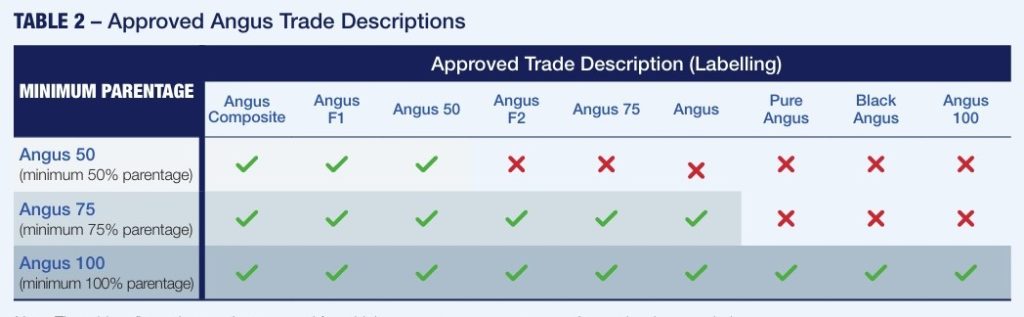
One of the key elements to the application, which formed the sticking point in earlier debate, is that beef from 50pc Angus breed content cattle cannot be described simply as ‘Angus’, but in trade and labelling descriptions (see graphic below) can only carry one of three terms including ‘Angus 50,’ ‘Angus F1’ or ‘Angus composite.’
This report uses Angus as an example of the new standard, however it apply to all beef breeds, as well as other species like lamb. Dorper and Suffolk lamb claims are understood to be close to approval. Herefords are understood to be lining up for similar claims.
 Conceivably at some future point, a processing plant could take Angus x Hereford F1s and pack ‘Angus 50’ primal cuts into one carton, and ‘Hereford 50’ trimmings from the same animal into another, if market forces required – all under the one livestock sourcing program.
The new 50pc Angus breed claim includes phenotypic criteria aligned with the American Angus Association’s USDA published specifications to ensure consistency and market access.
There will be no change to existing phenotypic standards for animals meeting the 75pc and 100pc genetic content thresholds.
AusMeat will start auditing under the new arrangements from 1 July, but processors and exporters wishing to pack under the revised claims will have to submit their QMS quality management plans, covering labels and procedures, for approval, in advance.
Uniform trade descriptions for product labelling are designed to ensure breed claims are accurate, clear, and consistent across all market channels, AusMeat told key stakeholders yesterday.
Strong, pragmatic outcome
“The introduction of the Angus 50 (F1) pathway is a strong and pragmatic outcome for the Australian meat industry, built on extensive consultation and collaboration with key stakeholders.” AusMeat and AMILSC chairman Allan Bloxsom said.
He said that the outcome would further underpin the integrity and robustness of Angus and other breed claims.
“The revised criteria will undoubtedly unlock new opportunities for producers and processors through the capture of additional value from livestock that meet the 50pc Angus program. This review has established a clear and transparent pathway for all breed related raising claims ensuring consistency, and confidence across the supply chain.”
AusMeat said the update made today reflected the industry’s ongoing commitment to facilitating market access and value creation for producers and processors. AusMeat will continue to oversee compliance and verification measures which provide the foundation for maintaining truth in labelling, which is fundamental to the credibility of breed claims.
“To ensure the continued accuracy of Angus-related claims, cattle marketed as Angus 50 must meet the prescribed parentage, phenotype, and trade description standards. There have been no changes to the eligibility or trading requirements for Angus 75 and Angus 100 products,”
See the graphic below, using Angus as an example, outlining how trade descriptions will apply from 1 July on beef from 50pc, 75pc and 100pc Angus. Terms like ‘Angus’ will apply only on 75pc Angus content and higher, while beef from F1 cattle will be limited to ‘Angus 50’, ‘Angus F1’ and ‘Angus Composite.’
Background
The breed content claim issue has been one of the more polarising topics seen in the beef industry in recent times. Lotfeeders, especially, rallied agaist the original proposals put forward.
Words like ‘hysteria’ were used to describe the initial days in 2024 when the first iterations of the proposal were brought forward.
Click here to read Beef Central’s story from September 2024.
Historically, Angus breed claims in Australia have been limited to a minimum of 75pc breed content. Many of the nation’s large export meat processors have for decades run large, flagship Angus branded beef programs on this basis.
Earlier, the view of many of those brand owners was that any move to accept 50pc Angus content labelled simply as ‘Angus’, would dilute the value of their existing programs – hard-won over many years of trading into international markets. Justifiably, brand equity, to those operators, was critically important.
In the opposite corner, supporters of the reform argued that the 75pc minimum breed standard put Australian beef at a distinct disadvantage to our major beef export competitor, the US, where 50pc has been the Angus breed content standard for decades.
As the issue dragged on through 2024 and into 2025, it was looking like the industry would be unable to find common ground. AusMeat established a special working party involving all stakeholders (processors, lotfeeders, grassfed producers, regulators and others) to try to find a workable solution. Ultimately, the default position would be to do nothing.
An early iteration of the proposal, ultimately rejected by AusMeat, would have allowed 50pc content cattle to carry an ‘Angus’ descriptor. The message that came back from influential lotfeeders and processors at the time was that this would damage meat price premiums for beef from cattle carrying 75pc and 100pc Angus genetics.
The model launched today, seeks to overcome many of those concerns.
What impact does the change have on processors?
Beef Central has asked around, and nobody has yet done any sums on how much additional beef may now be produced, carrying some form of Angus brand claim.
However for meat processors developing brand programs associated with the Angus breed (again using Angus as an example), it was essential to maintain a clear and robust understanding of the approved breed eligibility requirements and associated trade description criteria, AusMeat said.
By aligning brand programs with the approved Angus criteria and consistently applying the required trade descriptions to each consignment, processors would help safeguard the integrity of Angus-branded beef, strengthen consumer confidence, and support compliance across both domestic and export markets, AusMeat said.
- See today’s separate story on industry reaction to the breed content description news.
Or conceivably put the primal cuts of a Hereford 50 into one carton and Angus 50 trimmings into another, both from the same beast?
<strong>That's correct, in theory, Mark, according to AusMeat. Of course nobody has tried it yet - we'll look into where the new program is going after 1 July, when the new process kicks in. Editor</strong>