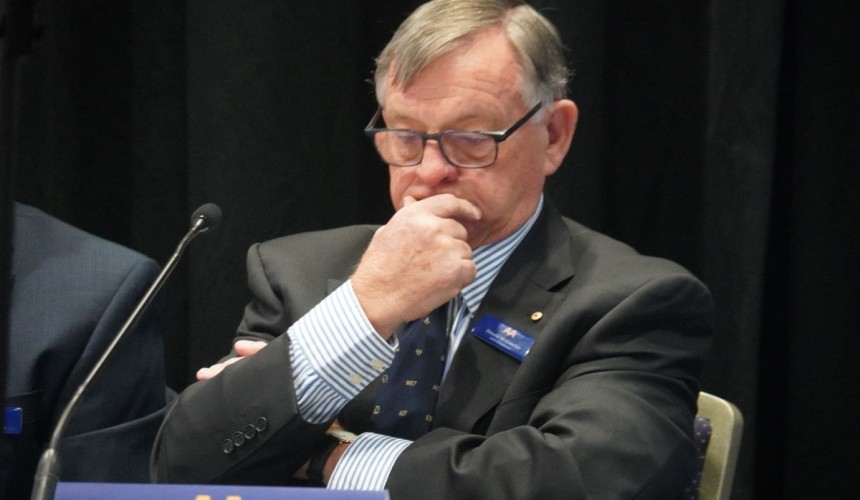
AUSTRALIAN Agricultural Co annual general meetings are often pretty tame affairs, but some robust exchanges between shareholders and chairman Don McGauchie set this year’s gathering held yesterday apart.
In some prior years, shareholder AGM questions could be counted on one hand, meaning the whole event was over in less than an hour. This year, the AGM went for two hours, with a small but vocal group of shareholders piling on.
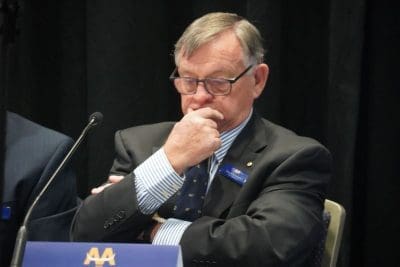
AA Co chair Don McGauchie
The ubiquitous questions about the future of the mothballed Livingstone abattoir, and when shareholders can expect a dividend were met with the ubiquitous responses – essentially nothing; and that funds are being directed into asset development rather than shareholders’ pockets.
Two large shareholders now dominate the stockholding: UK billionaire Joe Lewis, who holds 53pc of the shares through his Tavistock investment vehicle, and Twiggy Forrest’s private investment vehicle Tatterang which now holds 22.4pc. That leaves just 24.6pc held by other institutional and private investors.
Prominent activist investor David Kingston asked chairman Donald McGauchie if the business was ‘chronically flawed’ given its one percent annual return during his 15 years at the helm of the company.
AA Co has a current market capitalisation of $855 million, but some shareholders at the AGM asked how much more valuable it would be if assets were sold off.
Chairman Don McGauchie shut down a line of questioning from Mr Kingston, who asked one of Tavestock’s AA Co board representatives to explain to shareholders why “they are not investing in a moribund company with zero returns.”
Mr McGauchie also took issue with Mr Kingston’s attempts to extract a commitment for better returns to shareholders, telling him at one point to sit down.
Some of Mr Kingston’s questions were backed up by the Australian Shareholders’ Association, which asked Mr McGauchie what the “motivation to stay public” was for AA Co.
“It is what it is,” was Mr McGauchie about remaining publicly traded. “If I had my way it would never have been a public company,” he was reported as saying.
Livingstone Beef abattoir
Mr McGauchie told shareholders a review of the company’s mothballed Livingstone beef processing facility near Darwin was ongoing, “but we anticipate it reaching the final stages in the near future.”
He said AA Co’s business investment surpassed $31 million in FY25, which went towards a range of initiatives and activities across its properties, including station facility upgrades, fleet optimisation, connectivity and the completion of our solar bore program.
“This level of investment is why we have a positive operating cashflow, but a negative free cashflow of $11.9m. This approach to reinvestment is also why we will not be paying a dividend for the FY25 financial year. Investing cash outflows reflected the Board’s continued focus and investment in optimisation programs for the future.”
US tariffs
Both chairman Don McGauchie and managing director David Harris touched on the impact of recent US tariff measures on trading partners including Australia.
Donald Trump’s recent tariff measures were another example of evolving global market and trading conditions, Mr McGauchie said.
 “We are treating and working to respond to this latest headwind with the same level of determination that we have other market-based challenges of recent years,” he said.
“The situation regarding tariffs is fluid, both in the US and with respect to how that impacts the supply and demand dynamics of other markets that we operate in. We will continue to monitor the circumstances and respond as appropriate, leveraging the strong presence that AA Co has in our global markets, along with our distribution relationships and product allocation strategy.”
David Harris said global market dynamics remained fluid, with US tariffs adding another layer of consideration.
“We are keeping a close eye on how the situation evolves both in the US market and how it influences other markets around the world. Our integrated supply chain positions us well to respond to movements, including where local supply may contract and demand for Australian beef may increase, as well as where opportunities might change in response to the tariffs,” Mr Harris said.
Strong financial year
As reported earlier, AA Co’s 2024-25 year ended 31 March posted operating results that were among the best in recent times. Last financial year was the company’s highest operating cash flow, and second highest operating profit since 2017. The operating profit of $58.4m was up $7.3m on the previous year and the operating cash-flow of $27.1m was up almost $18m.
Both the operating profit result and the operating cashflow were achieved by using higher sales volumes to offset some of the challenging global meat sales and market conditions, shareholders were told.
Alongside increased revenue which was up around $52m to $388m, the operating results were the best indication of AA Co’s performance and progress, according to manager director David Harris.
“The statutory net loss after tax of $1.1m in FY25 was a $93.5m improvement versus the previous year, driven by an improved mark-to-market value of the cattle herd. As we’ve indicated in previous periods, the statutory outcomes include those mark-to-market movements, which are largely unrealised and generally outside our control,” he said.
“They have limited connection to our day-to-day operational performance, which is why we emphasise operating results as the best indication of our progress.
AA Co’s Wagyu meat sales price per kilogram was down 10pc last financial year, impacted by the challenging market conditions of the first half, including the prolonged herd liquidations in the US and increased local supply in Korea, shareholders were told.
Much of that price movement came in the first half of the year, before the average meat sales price improved in the second half, as supply dynamics and global inflationary pressures eased.
In fact, market reports indicated that local beef supply is expected to contract in some of AA Co’s key markets, particularly the US where the drought-fuelled herd liquidation appears to be reaching its conclusion.
Mr Harris said there was a 9pc overall increase in sales value across AA Co’s brands– Westholme, Darling Downs and 1824 – with new branded menu placements in established restaurants and expanded offerings in gourmet marketplaces, among the highlights.
Mr McGauchie’s chairman’s address said last financial year’s results were achieved in the face of evolving market and trading conditions.
“We were able to leverage our strong long-term commercial relationships to balance anticipated demand with global conditions and we are proud of the results.
Our properties are in excellent condition, with most having enjoyed around average or better seasons over several years. Our cattle herd, numbering 456,000 head in 2024-25 is thriving, with improved productivity and high branding rates. They are the foundation of our premium brands – Westholme, Darling Downs and 1824 – which are enjoyed by an increasing number of people in more locations around the world.
He stepped through the company’s Refresh strategy involving a thorough assessment of the business undertaken over the past 12 months, including its strengths and the opportunities it could leverage to launch into AA Co’s third century of operation.
It involved three components – Better Beef, Partner and Invest, and Unlocking the Value of the Land.
- He said Better Beef was how AA Co referred to those dedicated and targeted cattle programs and the continued development of its brands
- Partner and Invest was how the company viewed developing those strategic opportunities with key partners to solve problems for AA Co, but also the broader agricultural community; and
- Unlocking the Value of the Land was the way the company realised the opportunities which can be unlocked from its extensive pastoral assets and properties.
“They are three streams of work that will become the foundation of our activities into the foreseeable future,” Mr McGauchie said.
“While the shift in strategy might appear subtle to some – indeed, the fundamentals remain the same, with nature continuing to lead our ambition and cattle production remaining at our core – I can assure you that the opportunities are significant and potential benefits equally so.”
“Changes on our properties or in our supply chain can also take time to bear fruit through improved productivity and efficiencies. To realise our ambitions, we can’t just look one, three or even five years into the future. We have to look beyond that, which is what we have done with this refresh of our strategy,” he said.
Managing director David Harris said while AA Co had been impacted by external factors, including drought and flooding events of recent years, the company also now had an increased level of sophistication and planning across the supply chain, with a better understanding of the supply and demand requirements and drivers in its markets and the ability to respond accordingly.
“This is what we meant when we talked previously about herd optimisation –being able to grow, manage and adjust our herd at rates and to levels that are optimal for our markets, our strategy and our properties. That approach will help underpin the better beef strategic focus area that our chairman spoke to earlier.”
Heard it all before Chairman and no doubt the exact same report will be delivered in 2026. Your record in corporate management is not flattering.