
- Canada regains beef export access to China
- EU beef imports rise 13pc as production drops
- Winner of inaugural Women in Saleyards Scholarship announced
- Replacement close for London’s historic Smithfield meat market
- US beef exports lowest since mid-2020
- Banned hormones found in Brazilian beef as consumers urged to be vigilant
- Final chance to enter AgriFutures Horizon Scholarship
Canada regains beef export access to China
Canada and China have this week agreed to a trade deal, easing tariffs on thousands of Chinese-made electric vehicles in exchange for China easing retaliatory duties on some Canadian agricultural goods. China has also resumed access for Canadian beef, from 20 eligible facilities and one that was relisted following a Covid-related suspension dating back to 2020. The agreement includes provisions for China to accept Canada’s beef safety assessment reports and the health certificates issued by Canada. In 2021, Canada voluntarily suspended beef exports to China following an atypical BSE case. Canada’s beef exports to China had reached 18,500t worth C$155 million that year.
EU beef imports rise 13pc as production drops
Data from the European Commission shows that EU beef production for the year to the end of September decreased by four percent (169,000t) year-on-year to 4.1 million tonnes. Of the main producing nations, the Netherlands experienced the steepest decrease of 11pc (31,000t) to 255,000t followed by Germany with an 8pc (50,000t) decrease. Output from France, the largest EU producer, fell by 3pc to 832,000t.
Over the same period, total EU cattle slaughter fell to 13.9 million head, a decrease of 5pc. Total EU cow beef production fell to 1.2Mt, a decrease of 5pc. Ireland saw a 15% decrease, the largest of the main producing countries. Total cow slaughter numbers decreased by 6pc to 3.8 million head.
Total EU imports of fresh/frozen beef for the year to the end of September increased by 15pc (28,500t) year-on-year to 223,900t. The UK has remained the largest supplier, shipping 69,500t across the period (-1pc year-on-year).
The majority of growth in EU beef imports this year have come from South America. Brazil has increased volumes by 26pc (11,100t) whilst Argentina and Uruguay increased by 21pc (7700t) and 32pc (7900t) respectively. Brazilian beef exports have maintained a strong pace, reaching record high levels throughout 2025, supported by competitive pricing and strong production levels.
Prices
For the week beginning 10 November, the average EU R3 grade steer price was 650p/kg equivalent. This is 206p/kg higher than the same period in 2024. These prices reflect the reduced supply picture on the continent generally. European Commission forecasts and cattle census figures point to lower EU beef production in 2026, suggesting continued supply-side support for prices.
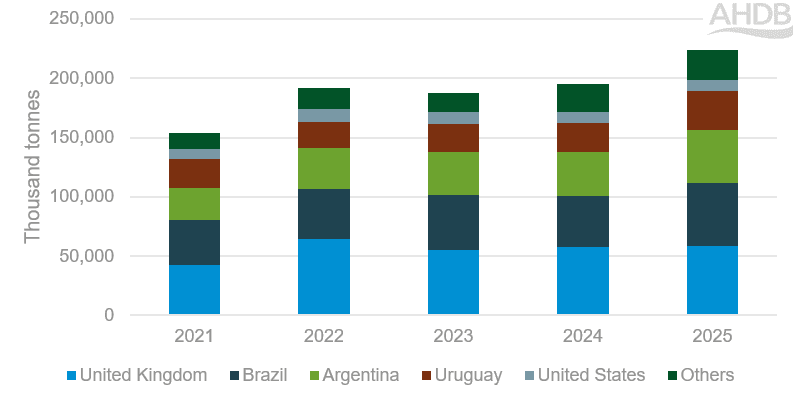
Source: AHDB Graph EU imports 2025
Winner of inaugural Women in Saleyards scholarship
In an effort to support the continued development and visibility of women across the saleyard sector, Saleyards Australia has launched the inaugural Women in Saleyards Scholarship, announcing the winner this week.
Following a strong and competitive field of applications, Maddy Wightman from Emerald Saleyards in Queensland has been selected as the recipient of the scholarship.
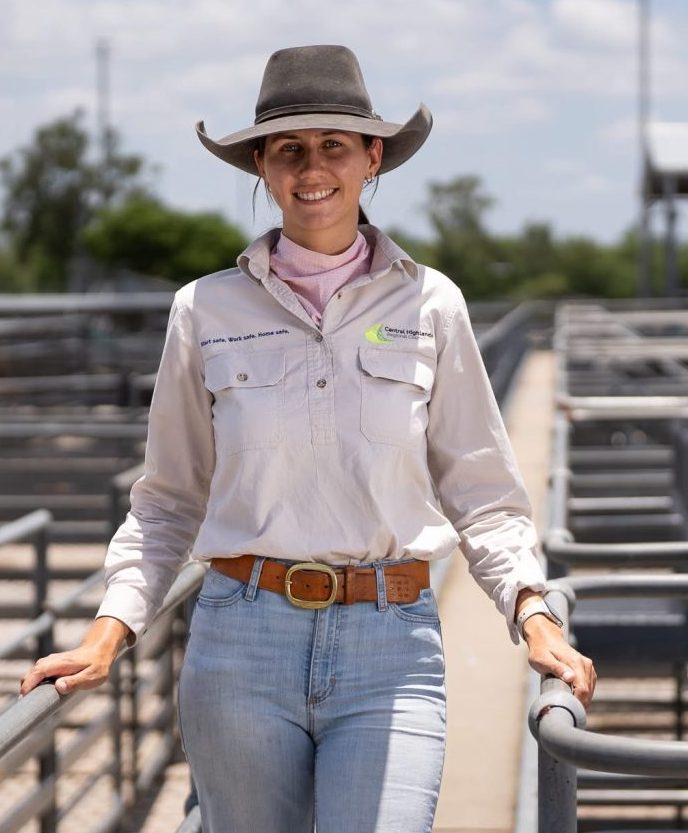
Maddy Wightman
As part of the award, Maddy will represent Saleyards Australia at the Meat Business Women Conference in Sydney in March and will also attend the National Saleyards Conference in Rockhampton later this year.
Tara Withers from Tamworth Regional Livestock Exchange in New South Wales was named runner-up and will receive a 12-month membership to Meat Business Women.
Both candidates demonstrated exceptional professionalism, leadership potential, and a strong commitment to the saleyard industry and its ongoing development.
The judging panel comprised Amy Perfrement, Executive Officer of Saleyards Australia, Directors Daniel Haslop and Paul Martin and Emily Perkins, Feedlot General Manager at Ravensworth Agriculture Co.
“Maddy will be a fantastic ambassador for the saleyard industry in Australia. She is extremely humble, considered, and passionate about the role that saleyards play not only within the agricultural industry, but also for the broader community,” Emily Perkins said.
“Maddy is committed to defining clear career pathways for women in the industry. This depth of passion and her well-rounded approach position her strongly as the inaugural recipient of this award.”
The panel noted the depth, diversity, and professionalism of submissions, reflecting the strength of women working across saleyards nationally.
Replacement close for London’s historic Smithfield meat market
London’s iconic Smithfield meat market could be relocated to a new site in the capital’s Royal Docks area after a deal between the City of London Corporation and the Greater London Authority. A memorandum of understanding has been agreed by the Corporation, which has been responsible for the market for centuries, and the GLA, which owns the waterfront site in Newham.
The announcement puts an end to a period of uncertainty for traders at Smithfield, after the collapse last autumn of a previous plan to relocate the facility to a site in Barking & Dagenham.

Traders gather at London’s historic Smithfield meat market
The current Smithfield market is considered too constrained and the buildings no longer fit for purpose. One former market building at Smithfield has already been closed and is currently being redeveloped as the new home of the Museum of London.
After the planned Barking & Dagenham move fell last autumn through, due to spiralling costs, the City said it would help market traders search for a different site within the M25, but also put forward a parliamentary bill to remove its statutory duty to provide the markets.
Traders from Smithfield welcomed the announcement of Albert Island in the Royal Docks as a preferred site for relocation.
Greg Lawrence, chairman of Smithfield Markets Traders’ Association, said the announcement was a “significant step forward” and put them “well ahead of where we thought we’d be by Christmas.”
“This location offers Traders the space and opportunity to grow our businesses while continuing to serve customers across London and the South East,” he said.
According to the City, most traders have agreed to move together to a new site, with the remainder planning to transfer their business to other locations. A new onsite food school will also be delivered as part of the move.
The market will be known as New Smithfield. The market will continue to remain open at the current location until at least 2028.
The council plans to turn the existing Grade II listed Smithfield building into “an international cultural and commercial hub”.
Click here to read Beef Central’s earlier article about London’s historic Smithfield meat market.
US beef exports lowest since mid-2020
USDA has released US red meat export data for September, which was delayed due to the recent government shutdown. September data showed monthly beef exports were the lowest in more than five years, with shipments to China effectively halted and exports to other Asian markets also trending lower year-over-year.
“While encouraged by robust and resilient global demand for US pork USMEF President and CEO Dan Halstrom said the situation was obviously much more challenging on the beef side, primarily due to the ongoing impasse with the Chinese government, which continues to ignore its commitments under the US-China Phase One Agreement.
“US industry losses continue to mount as a result of this lockout, and relief simply cannot come soon enough,” he said.
The Office of the US Trade Representative (USTR) is conducting a Section 301 investigation of China’s implementation of the US-China Economic and Trade Agreement, popularly known as the Phase One Agreement, with a public hearing set for Tuesday.
September US beef exports were just 80,835t, down 22pc from a year ago and the lowest since June 2020. Export value was US$661m, also down 22pc and the lowest since February 2021. Even when excluding China, beef export volume fell 11pc year-over-year, due in part to lower production.
January-September US beef exports totaled 856,023t, down 11pc from a year ago (and down 4pc when excluding China). Exports trended higher to leading value market Korea and to Central and South America, Hong Kong, the Philippines, the Dominican Republic, the Bahamas and Africa. But these gains were more than offset by the steep decline to China and lower shipments to Japan, Mexico, Canada and Taiwan.
Banned hormones found in Brazilian beef as consumers urged to be vigilant
UK consumers have been warned to beware, after Brazilian beef was recalled across Europe following the discovery of banned hormones, prompting fresh concerns over the safety of lower-standard imports entering the UK food chain.
According to Farming UK website, the recall follows an investigation by the Irish Farmers Journal and the Irish Farmers’ Association, which found hormone residues in consignments of Brazilian beef imported into the EU late last year.
The Ulster Farmers Union said the incident confirmed long-held fears about food safety, traceability and oversight in Brazil’s beef production system, and warned that Northern Ireland was among the regions affected.
UFU deputy president Glenn Cuddy said the findings represented a serious breach of trust for consumers and producers alike. “This is an extremely serious public-health incident,” he said.
“For years, farmers here have operated under some of the strictest food-safety, traceability, and animal-health standards in the world. Yet we are now seeing products enter our market from systems that do not meet the same basic requirements.”
He said the recall risked undermining confidence in the wider beef supply chain, despite local producers complying with rigorous rules. According to the UFU, repeated problems linked to hormones, antibiotics and traceability in Brazil demonstrate that assurances around import controls are inadequate. “This is not a hypothetical risk,” Mr Cuddy said. “It has already happened.”
The union warned that continued access for large volumes of lower-cost beef produced under weaker regulatory regimes could distort the market and penalise domestic producers who have invested heavily in welfare, environmental standards and food safety.
“Allowing cheaper products from countries with weaker requirements to enter the market would reward poorer practices abroad, and punish farmers here who are doing things right,” Mr Cuddy said.
Entries closing for AgriFutures Horizon Scholarship
Students entering their final two years of an undergraduate degree and passionate about the future of Australian rural industries are encouraged to apply for the 2026 AgriFutures Horizon Scholarship Program, with applications closing next Monday 26 January.
The AgriFutures Horizon Scholarship is a collaboration between AgriFutures and industry groups that provides students with a $10,000 bursary over two years, as well as professional development and networking opportunities to a total value of over $20,000.
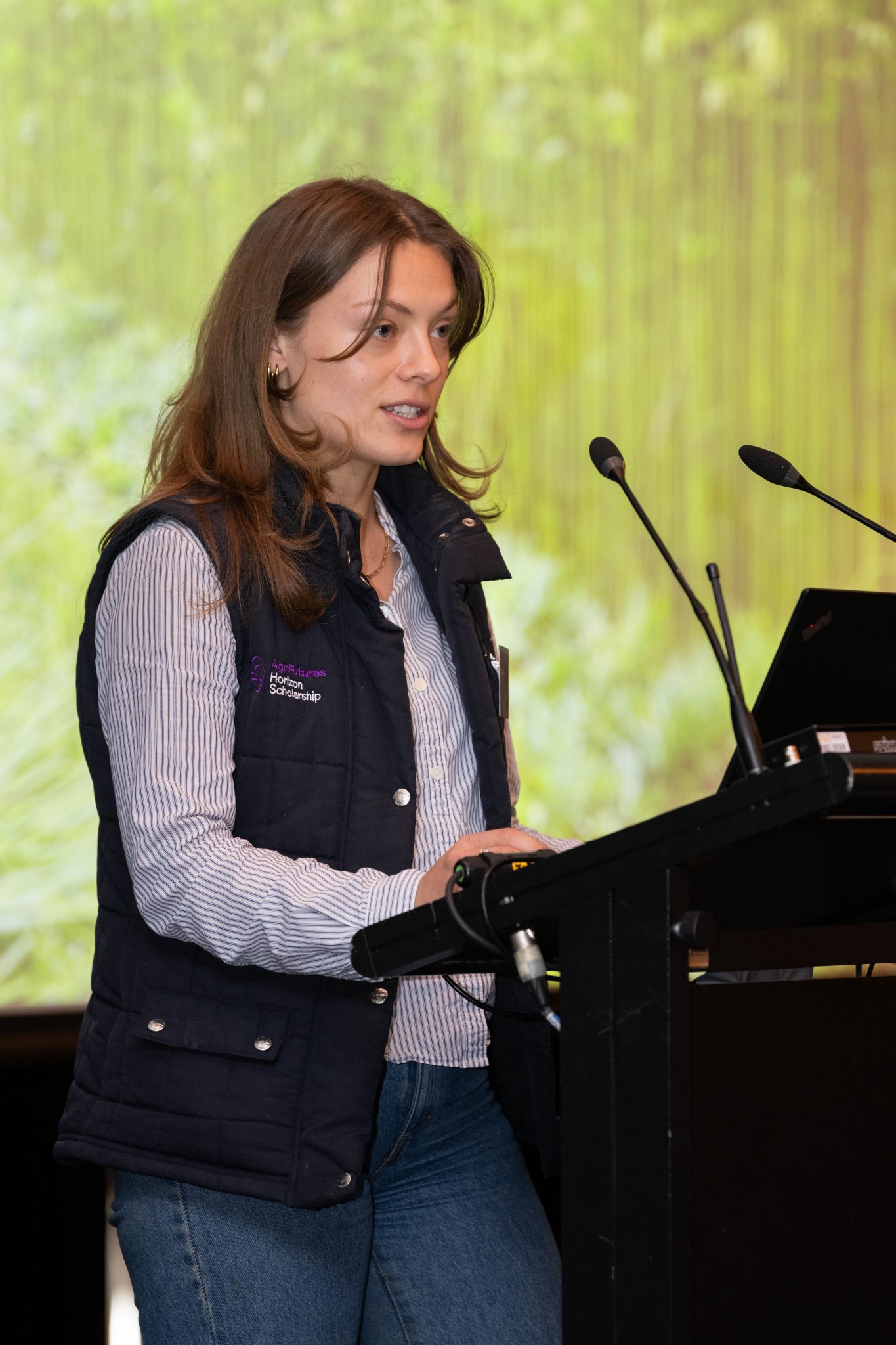
Isabelle Duff, 2024 AgriFutures Horizon scholar.
The Horizon Scholarship Program is open to students enrolled in full-time study at an Australian university, who are studying an agriculture-related undergraduate degree or a Science, Technology, Engineering, Maths/Finance (STEM) degree with relevant majors that align to agriculture.
AgriFutures Managing Director John Harvey said the scholarship not only provided recipients with financial support, but also invaluable development opportunities that set them up for a long-term career in the rural industries.
Among the previous recipients is Isabelle Duff, a 2024 scholar who just graduated from a Bachelor of Advanced Science and Commerce (Genetics and Accounting) at The University of New South Wales.
Growing up on her family’s Merino sheep, beef cattle and cropping farm near Manildra in NSW, Isabelle discovered the Horizon program during her gap year, when she travelled to evokeAG.in Melbourne. There, she met a group of Horizon Scholars whose work was so inspiring that she went home to immediately mark in her calendar to apply in October 2023.
“Growing up, I always thought working in ag meant going home to work on the farm. This program showed me that ag can also be molecular biology, startups, genetic engineering and really technical content,” Isabelle said.
“Some of the most impressive people I’ve met in this industry didn’t grow up on farms at all. You can be studying any STEM subject and if you’re interested in ag or care about sustainability and innovation, there’s a place for you in this industry.
“The best thing about Horizon is that it’s not just a bursary, and the real value is the connections and the confidence you build.”
“The placements, public-speaking workshops and networking events involved in the scholarship have taught me so many professional skills and I would encourage everyone to apply.”
Scholarship recipients will be selected on the basis of their commitment to a career in rural industries, as well as their leadership potential and tertiary academic record to date.
Applications close on Monday, 26 January. For more information and to apply visit the AgriFutures website here.