
CHINA has followed-through on its year-long investigation into imported beef and its alleged impacts in the Chinese domestic beef industry, announcing a series of trade restrictions overnight.
China’s Ministry of Commerce imposed a series of Safeguard limits on major beef exporters for the next three years, effective today – but the measures are far from impartial and impact Australia more than some others.
Early last year China announced an investigation into imported beef’s impact on the domestic Chinese beef industry, following claims of complaints from Chinese cattle breeders and others who claimed competitive disadvantage.
Under great fanfare, the two nations brought a Free Trade Agreement into force in December 2015, with tariffs to gradually disappear over the following nine years.
China’s commerce ministry overnight said the country’s total beef import quota for 2026 for countries covered under its new ‘safeguard measures’ will be 2.7 million tonnes, roughly in line with the record 2.87mt it imported in 2024.
“The increase in the amount of imported beef has seriously damaged China’s domestic industry,” the ministry said in announcing the measure following an investigation launched in December 2024.
All beef exporting countries eligible for China are exposed to the new tariff, with the exception of a handful of lesser exporters including China’s allies Russia, Belarus, Colombia and Paraguay (which does not currently have beef access).
Under the terms of the announcement made this morning, Australia will this year (2026) be subjected to a Safeguard TRQ of 205,000 tonnes*, representing about 75pc of the 2025 total exported volume. Next year (2027) Australia’s safeguard rises a fraction to 209,000t, and 213,000t the year after that. (* Editor’s note: there have been some changes since the initial summary was issued – revised table below.)
The out-of-quota tariff rate on Australian and other imported beef for the next three years will be 55pc. To be clear, no tariff on Australian beef will apply until the trigger level is reached – likely around August/September next year, if last year’s trade is anything to go by.
However local export trade sources have already said that business into China under a 55pc tariff burden would be prohibitive, meaning likely diversion into other markets.
China’s new country-specific allocations were based on July 2021 to June 2024 imports. The safeguard covers all chilled and frozen beef, but not offals or beef variety meat.
As can be seen in the attached table, the treatment of other exporting countries servicing the China market is inconsistent, to say the least.
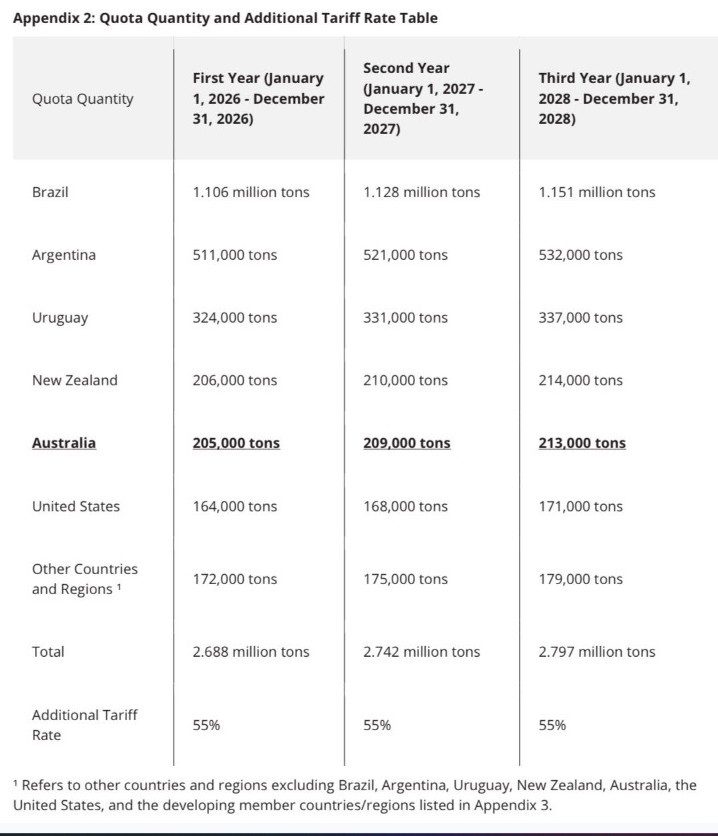
Brazil has been allocated a Safeguard for 2026 of 1.106mt, or about 80pc of last year’s shipments. Brazil exports well over 50pc of all its offshore beef to China, meaning it is heavily exposed to any tariff rise this year. New Zealand has been granted a quota of 206,000t – close to double its 2025 volume of 109,000t, but unlikely to be filled any time soon.
The United States – seriously limited not only by a cattle herd at 70-year lows, but also Chinese actions to delay the re-issuance of access to more than 300 US meat processing plants – has received a 2026 TRQ quota of 164,000t, on a total shipment for the 2025 year to November of 55,000t.
Other big winners include Uruguay, with a safeguard figure next year of 324,000t on a 2025 shipment to November of 188,000t, and Argentina, with a safeguard this year of 511,000t on tonnage last year of 435,000t.
Clearly, despite having by far the largest impact on China’s domestic beef industry through sheer volume, South American exporters have been heavily favoured in the Safeguard measures.
For the 2025 year to the end of November, Australia exported just short of 250,000t of chilled and frozen beef to China and Hong Kong. In order to escape tariffs, about 50,000t of similar volume would this year have to be exported to other customers.
‘Unfair, inappropriate’, claims AMIC
In a statement issued this afternoon, the Australian Meat Industry Council said it was extremely disappointed with today’s announcement.
AMIC chief executive officer Tim Ryan said the new restrictive trade arrangements imposed on Australia are not fair, appropriate, or reflective of the long-standing, mutually beneficial trade relationship Australia has with China.
“This decision appears to reward other countries who have surged their volume of beef exported to the Chinese market in recent years,” Mr Ryan said.
“This decision will have a severe impact on trade flows to China over the duration of the measures’ enforcement, disrupt the longstanding relationships fostered under the China–Australia Free Trade Agreement, and restrict the ability for Chinese consumers to access safe and reliable Australian beef,” Mr Ryan said.
AMIC, along with Meat & Livestock Australia, engaged with the Chinese Government safeguard investigation team throughout their year-long investigation process. This included providing formal evidence at in-person hearings in China and hosting Chinese investigators in Australia.
“In these representations, AMIC and MLA repeatedly stressed that Australia remains a trusted, reliable and stable source of beef into China, helping to meet Chinese consumer demand. Imports of Australian beef are not a cause of damage to the domestic beef industry in China,” Mr Ryan said.
Australian beef is high-quality, safe, and sustainably produced, but accounted for just 8 percent of China’s overall beef imports in 2024. Nearly 80 percent of beef imported into China comes from South America.
The new restrictions announced this morning, have the potential to reduce Australian beef exports to China by about one-third compared to the last twelve months – trade worth more than A$1 billion, AMIC suggested.
AMIC said it would consider today’s announcement and the safeguard measures in more detail.
“We will make strong representations on our members’ behalf to the Australian and Chinese governments regarding the severe and unnecessary impact of these new measures,” Mr Ryan said.
Australia’s beef industry maintains longstanding collaborative partnerships in China – including tailored technical, research and development projects – which help improve the sustainability of China’s domestic beef industry.
The TRQ will be managed by China’s General Administration of Customs (GACC) and further work likely needs to be done to set up a transparent and timely system for tracking imports within the safeguard, as it will operate on a first-come-first-served basis, trade sources said.
“While the safeguard measures represent another trade barrier in China, the most-impacted suppliers will be Brazil and Australia. However, there are potential global market distortions, especially late in the calendar year when the safeguard would be expected to be triggered,” the US Meat Export Federation said in reaction this afternoon.
MLA response
Meat & Livestock Australia expressed its disappointment on behalf of Australia’s red meat industry following the announcement.
“Australia has consistently engaged with China throughout its investigation process, making clear at every opportunity that our exports are not the cause of any alleged injury to China’s domestic beef sector,” managing director Michael Crowley said.
“We have also reminded China of Australia’s position as a trusted free trade partner and hope that will continue to be respected.”
“China remains and will continue to be an important market for Australian beef and this tariff will impact our customers within China significantly. MLA’s China offices will liaise closely with our customers and importers in-market as this measure is implemented,” Mr Crowley said.
“MLA plays a critical role in driving market access and marketing Australian red meat globally, including maintaining a strong presence in China to support trade relationships and promote Australian beef. Importantly, MLA will continue to work with industry and trade partners to actively promote Australian red meat in China, ensuring we remain well-positioned to capitalise on our strong reputation.”
“While this safeguard measure will impact all major beef suppliers to China, not just Australia, we will continue to work closely with the Australian Government and industry partners including the Australian Meat Industry Council to seek clarity on the measure and pursue the best possible outcome for Australian beef producers.”
Government, Opposition response
Prime Minister Anthony Albanese has confirmed Australian officials are communicating with their Chinese counterparts over the tariff developments.
He suggested Australia was not being singled-out by China’s policy, and the move had been a broad one.
“This is a general position that China has put,” he said. “We are advocating, as we always do, for Australian industry.”
Pressed on the potential impacts of the announcement, Mr Albanese declined to go into specifics, instead pointing to his belief that Australian beef was “the best in the world”.
“We compete in the world very well, and our products are in great demand right around the world, we expect that will continue to be so,” he said.
“The Australian beef industry has never been stronger than it is today as we enter 2026.”
Nationals leader David Littleproud said China’s decision to restrict the import of beef from Australia was extremely disappointing for the cattle industry.
“Cattle Australia is warning the beef industry stands to potentially lose $1 billion in beef exports, following the announcement,” he said.
“China’s announcement is devastating to the beef industry this year, but unfortunately it is also the latest development of failures under the Albanese government,” Mr Littleproud said.
“The Prime Minister and Trade Minister must make urgent representations to their counterparts in Beijing.”
Australia should hold the upper hand in any trade negotiations with China as I believe they rely heavily on our iron ore, coal and gas commodities. All we should have to do is react by restricting the flow of these their way. Unfortunately the Australian government has lost sovereignty of these assets and continues to rely too heavily on China's manufacturing economy to be able to play hardball in any trade deals. It seems nothing has been learnt from trade restrictions during covid. You would think the cost of sea freight in and high port costs and customs inspections should give australian manufacturers a distinct advantage. It would appear it is just easier to out source supply requirements to China - just have to do it as they say if that is the case.
why does new Zealand have more than Australia? maybe a tariff on all the steel and manufactured goods should be imposed to protect Australian industries and top up Australian businesses for the obscene energy bills and high wages
If we had a PM with a back bone
turn around and hit them with a 55% tax on iron ore
pull them back into line , Thats what Trumpy would do
As a producer i dont put any effort into china they always pull the rug and this will now just be a reason to push the cattle price down .
they killed barley wine and beef last time with the games
We expect sympathy from President Xi?
RAAF and RAN monthly poke about in China's backyard.
This aggressive and most undiplomatic behaviour damages our relationship.
How would you feel if China sent its military to our coast?
Former PM Morrison also greatly antagonised China for no good reason
and singlehandedly crippled our barley, seafood and wine exports.
It took years of pain for those exports to recover.
Now will yet again see the pathetic sight of Minister Chalmers cap in hand begging China to relent..
Short memories....
Spot the Chinese spy
I wonder if Xi's Chinese Communist Party would've dared to do deliberately keep Australia off balance ("The Art Of War") if the current gov't was LNP?! The LNP. wouldn't tolerate such deliberate market instability and likely issue China with an ultimatum- from now on always respect trade agreements or face being cut off completely from all trade. China wouldn't dare risk it the long term- they remember wat happened last time- they came crawling back for our steel imports- unfortunately a weak and spineless Albanese Labor gov't will of course do nothing to upset 'precious' China.
It is what it is. Littleproud is being his usual self suggesting the Labor Gov caused it and should "persuade" China to reverse its decision. It can't and nor can any other nation. Littleproud is using politics to swipe Labor on a "no win" cause. The Beef Industry needs to find other markets to sell its best beef or perhaps (god forbid) sell its surplus to the Australian market.