
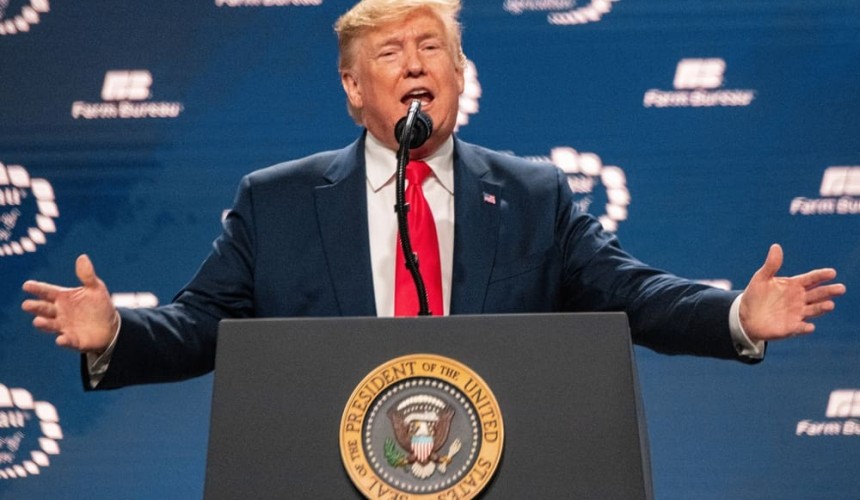
THERE is likely to be an almost immediate injection of significant quantities of Brazilian beef into the US market, following Friday’s surprise announcement by president Donald Trump that the steep 40 percent tariff on Brazilian imported beef would cease.
While the weekend has gotten in the way of clearer trade signals since Friday’s announcement, US live cattle and feeder cattle futures reacted almost immediately, falling to their lowest level since July. By Saturday, the February live cattle contract lost US0.625c/lb at 214.775c. Feeder cattle were down US2.15c in the January contract at 314.225c/lb.
US lean manufacturing beef markets were no quote late on Friday, as the industry adjusts to the news. This current trade week will also be somewhat clouded by the US Thanksgiving holiday.
 The immediate tariff reduction by Trump means large quantities of Brazilian frozen beef presently in bonded storage in the US until 1 January (when the new year Safeguard tariff level resets, removing the second onerous 26.4pc tariff on Brazil) may now be brought forward, and sold between now and New Year, Beef Central has been told.
The latest tariff settings effectively mean Brazil, for the remainder of 2025, pays a 26.4pc tariff for beef exports into the US. From 1 January that tariff is dropped also, as the new quota year starts. From 1 January, Brazil can access the US under the 66,000t ‘Other Country’ quota tariff-free.
But if 2025 is anything to go by, that won’t last long. Brazil in fact filled its entire 2025 ‘Other Country’ quota this year by 17 January, attracting the 26.4pc tariff ever since.
At the same time, apart from the short-lived blanket 10pc retaliatory tariff removed a fortnight ago, Australia has paid no tariff into the US this year, with quotas no longer relevant under our Free Trade Agreement.
“Effectively, all this means the comparison between Australian and Brazilian imports is back to where it was, prior to Trump’s imposition of 50pc (later 40pc) retaliatory tariffs on Brazil,” an export trade source told Beef Central.
He said the trade was interpreting the latest tariff change as ‘short-term bearish’ for Australian exports.
“That’s because there’s already a big supply of Brazilian meat sitting in US bonded cold storage – pre-loaded for the 2026 quota year,” he said.
“In normal circumstances that would not have emerged until January, to minimise the tariff exposure, but with the dropping of the 40pc tariff, it’s highly like that will now come straight onto the market,” he said.
“There could easily be importers who decide to clear it now, and just pay the 26.4pc tariff.”
That could put some downward pressure on demand for Australian beef of all descriptions, and especially manufacturing beef – at least for the short-term until the market gets back to normal.
Prior to the imposition of Trump’s 40/50pc retaliatory tariff in July, Brazil was exporting similar volumes of beef to the US as Australia, but in fact pushed considerably higher than Australia during August and September.
Even during recent months when exposed to 76.4pc tariffs, the US has continued to import around 10,000t of Brazilian beef each month.
Other markets
The counter-point to expanded Brazilian beef volumes into the US, is that Australia will face lesser competition in other markets, like China, the UK and the EU, for example, a trade source said.
“There’s no more beef being produced in the world, with Brazil’s lift in access to the US – it simply comes down to which market it goes to, depending on bid levels from importers, tariff levels and other factors. But it will mean some shuffling of the deck-chairs,” he said.
What happens to imported meat prices into the US, in the medium-to-longer term is another matter, trade sources said.
US meat plant closures
One of the US’s ‘big four’ beef processors later last week announced the closure of one of its larger plants, and reduction in kills at another, in an attempt to rationalise the scarce supply of US slaughter cattle through its other facilities.
It’s been speculated for some time that large US beef processors mat start to shutter some sheds as the extreme cattle price impact starts to bear down on processing margins, often called ‘cut-out’ in the US. But Tyson’s move at its Lexington facility is the first signs of it. The plant processes around 5000 cattle per day, or 5pc of the US total.
“The closure, in the heart of US cattle-feeding country, signalled that supplies will remain tight, forcing meatpackers to pay steep prices for cattle,” Reuters reported. “Beef prices have set records due to low supplies and strong demand, raising costs for consumers,” it said.
Tyson reported losses this year (ended 31 September) of an incredible US$426 million, on top of $291m the previous year, and is projected to lose $US400-600 million in the current financial year ending next September – hence the decision to close its Lexington facility and wind-back at Amarillo.
It’s anticipated that serious shortages of domestic beef in the US will extend right through 2026, with the possibility of a start to a recovery during 2027. That will underpin demand for all imported beef – Australian, Brazilian, New Zealand and from other sources for at least the next two years, analysts say.
“Australian beef export returns may have peaked for a while, with lean beef supply outlook rising with increased Brazilian supply and seasonal rises in US (fall cow slaughter) and NZ (pickup in supply after winter),” Elders analyst Richard Koch wrote this morning. “It means we have seen the peak of lean beef prices for a bit,” he said.
Others have interpreted Trump’s Brazil tariff announcement last week as a ‘purely political response.’
Some market watchers had anticipated such a change might be held over until next year’s mid-term US elections, but the unexpectedly high US food inflation figures – much worse than what the Trump administration had anticipated – combined with the Republican losses in recent State elections – had triggered the response.
One Australian export trade contact suggested it may not be until early next year that the full impact on the market of Trump’s quota relief on Brazil is known.
“All that Brazilian frozen product sitting in US bonded cold storage might clear between now and Christmas, so we may not get a real assessment of available imported product versus domestic until some time in January or February,” he said.
“But regardless, there is still going to be an enormous amount of demand for imported beef into the US next year.”
Tariff turbulence
Respected US market commentator Derrell Peel, extension livestock marketing specialist with Oklahoma State University, summed recent tariff developments up nicely with the comments below, published yesterday:
The latest spins of the big tariff roulette wheel included lifting the 10pc tariffs imposed in April on countries from which the US imports beef. Major beef import sources are Brazil, Australia, New Zealand, Canada, Mexico and Uruguay, along with minor sources including Nicaragua and Argentina.
A few days later, the additional 40pc tariff imposed on Brazil in August was removed. Brazil, who filled the “Other Country” tariff rate quota in January, will still face the 26.4pc over-quota tariff rate. For the first seven months of the year, Brazil was the largest source of U.S. beef imports.
Since the beginning of the year, Brazil has gone from a zero within-quota tariff (filled by January 17) to a 26.4pc over-quota tariff later in January, to which an additional 10pc tariff was added in April (36.4pc total), to which an additional tariff of 40pc was added in August (76.4pc total), back to 66.4pc total after removal of 10pc tariffs in November, followed a few days later by removal of the 40pc tariff and, thus, back to the 26.4pc over quota tariff until the end of the year (maybe) when the “Other Country” quota resets for another year.
If you are confused, don’t feel bad – how can any industry function in such a quagmire of changing rules?
Lack of trade data resulting from the shutdown has made it impossible to quantify the negative impact of the August tariff on beef imports from Brazil, let alone the impacts of now reverting back to the situation from early in the year. There will be impacts, likely relatively small on the ground beef market – probably more likely to simply moderate future increases rather than actually reducing ground beef prices in the US Certainly there will be no relief for high steak prices, with even higher prices likely ahead as beef production continues to fall.