
HAY and agistment requirements for livestock escaping fire-affected areas in southern Victoria are expected to escalate as the state sweltered in 40 degree Celsius-plus heat today.
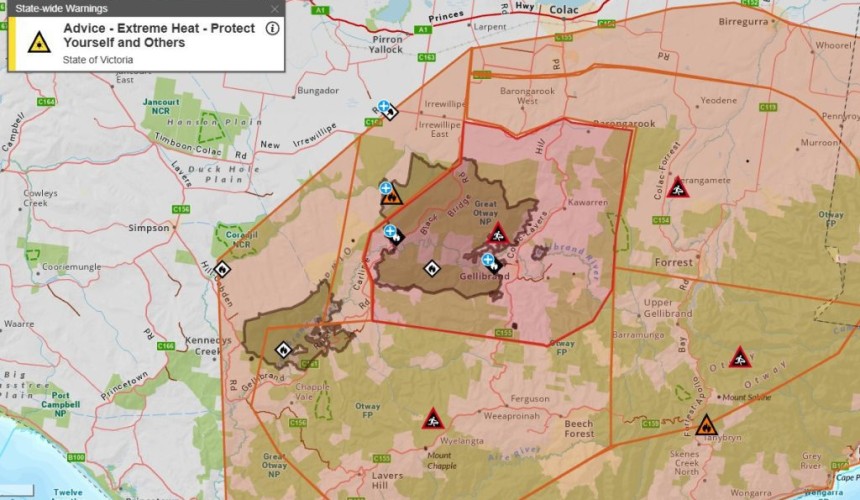
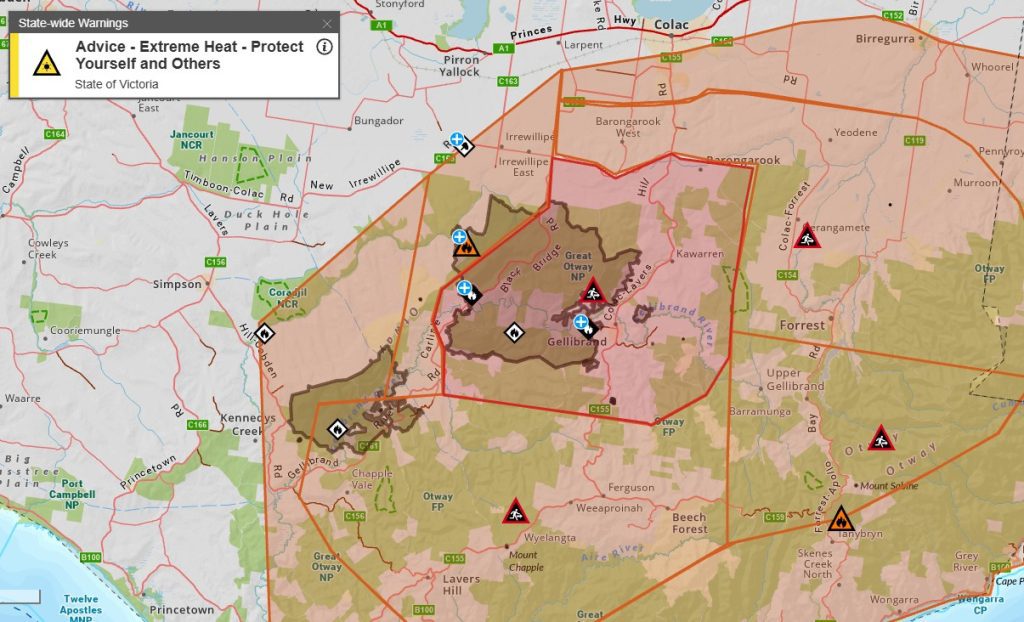
The number of livestock lost in fires in the recent central and north-east Victoria has been put at 41,000, with 90 percent sheep, but now losses are being reported around the still-active Carlisle River fire in the Otway ranges.
Sheep Central was told more farmers were moving livestock out of the fire’s potential path and agistment and hay will be needed for relocated livestock.
An emergency warning to immediately evacuate the Barongarook, Gellibrand, Kawarren and Lovat areas around Carlisle River was issued today, with fire not yet under control and a south westerly wind change expected around 5 pm likely to change its direction. Click here for the latest Vic Emergency advice.
Charles Stewart and Co agent Jamie McConachy said Gellibrand is only 15 minutes south of Colac, “so it’s pretty serious.”
He said there have been significant losses of hundreds of sheep and cattle, shedding and fences on farms in the Carlisle River area yesterday and there could be further losses today.
“As of today we are trying to get stock out of the Carlisle River area, mainly cattle, but closer to Gellibrand one of our (client’s) larger properties has been 80 percent consumed by fire with horrific sheep and cattle losses.
“Up until the last day or so the fire has been running though the national park in most cases,” he said.
“But as we got closer to yesterday and then further today it has actually been starting to encroach on residents.”
Mr McConachy said a relief centre for people and horses has been established at the Colac Showgrounds.
Mr McConachy’s father Peter has been co-ordinating livestock agistment and hay donation for farmers. He said after fires at Skipton and Mt Mercer affected some clients, the agency put out a call for hay and agistment.
“We got about 850 rolls of hay donated which was given to the Hay Runners for distribution everywhere.”
Peter McConachy said clients in the Carlisle River/Gellibrand area were affected by the ire yesterday and last night.
“And I’ve just had two lots of beef cattle – about 60 head — came into the Colac saleyards this morning and a fellow has rang up near Geelong offering free agistment for three months.
“So we are getting support from other people.”
Mr McConachy said future losses will depend on the direction of the fire.
“No one knows which way the wind is going to go.”
Mr McConachy said offers of hay and agistment were needed. To contact him about hay or agistment call 0408 522 878.
Lismore fire also not yet under control
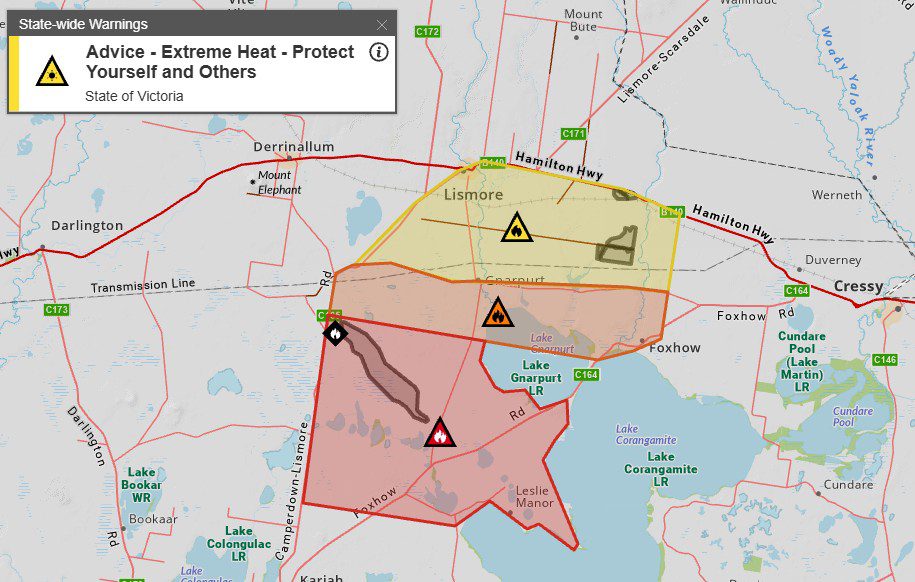
Meanwhile north of Carlisle River today, authorities issued an emergency warning for Kariah, Larralea, Leslie Manor, Lismore and Taaraak residents.
The warning advised there is a grassfire at Camperdown-Lismore Rd, Larralea that is not yet under control. It is travelling from Ettrick Estate Road in a south-easterly direction towards Foxhow Road.
The warning at around 3.30pm advised residents that the time to safely evacuate has now passed. “Take shelter indoors immediately. It is now too dangerous to leave. You are in danger, act now to protect yourself. It is too late to leave. The safest option is to take shelter indoors immediately,” the warning said.
Reconstruction starting on some firegrounds – VFF
Victorian Farmers Federation president Brett Hosking said farmers in the Carlisle River area have had two weeks’ notice of the need to move livestock.
Statewide about 450,000 hectares have been burnt in bushfires at Cressy, Skipton, Ravenswood, Longwood, Walwa, Wonnangatta – Dargo area and the Otway ranges in the past month, he said.
Mr Hosking said was still a need for hay, but this was slowing down as people have found agistment.
“They are starting to re-fence in a lot of places and BlazeAid is starting to clear fencelines and erect new ones.
“Once that is done that gives them the ability to bring livestock back, provided they can grow a bit of feed.”
Mr Hosking said most farmers who have offered agistment might start to want their paddocks back by March-April to prepared for the new season.
“There is probably only 6-8 weeks of agistment out there.”
Power concerns
One Victorian farmer relying on electricity to ensure adequate water for stock expressed concern about the likelihood of power outages and shedding disrupting supply; however, Minister for Energy and Resources Lily D’Ambrosio this morning said she had been advised by the Australian Energy Market Operator that Victoria had more than sufficient power reserves in place to meet electricity demands.
“This is really important, there are no concerns at the moment.”
AN AEMO spokesperson this morning confirmed there are currently sufficient reserves in Victoria and across the National Electricity Market.
“Load shedding is only used in very rare, last-resort circumstances when demand exceeds available supply and all market and emergency reserves have been exhausted.
“It is a controlled action designed to protect the power system from instability or wider collapse,” the spokesperson said.
“Conditions today are not forecast to require this.
“AEMO works closely with governments and industry year-round to prepare the system for peak demand periods, including summer heat,” the spokesperson said.
More information is available in AEMO’s summer operations and load shedding fact sheets.
Livestock sales cancelled
Elsewhere in Victoria, the Swan Hill Rural City Council advised that its scheduled sheep sale on Thursday, would not be held due to forecast severe heat conditions.
The sale’s cancellation follows the suspension of sheep sales at Horsham, Hamilton and Ouyen this week, although the Ballarat sheep and lamb sale today proceeded with an early start at 7.30am and conclusion by 10.30am.
Swan Hill Rural City Council’s director infrastructure, Leah Johnston, said the decision to not hold the sale was made as a precautionary measure to prioritise animal welfare and to protect the health and safety of staff, agents and buyers.
“The welfare of livestock and the wellbeing of all involved remains the highest priority.
“Due to forecast severe heat conditions, the scheduled sheep sale at the Swan Hill Regional Livestock Exchange will not proceed on Thursday, 29 January 2026,” she said.
The council will continue to monitor weather conditions and provide and notify the community if there were any changes to future sales, as required.
Assistance is available
THE Victorian Farmers Federation has announced the opening of applications for primary producer bushfire recovery grants, and concessional loans supporting farmers impacted by the January 2026 bushfires. Applications are for the loans and grants are now open and close at 4pm on 21 October 2026, the VFF said.
Farmers needing fodder support and those wishing to donate fodder are encouraged to register via the VFF Emergency Fodder Program page: https://www.vff.org.au/vff-emergency-fodder-program/ or call us on 1300 882 833. Farmers can also request and offer agistment via the VFF website. Truck drivers are needed to help deliver donated fodder to farmers.
The VFF has also enacted its Disaster Relief Fund to provide immediate, farmer-led support to producers. Financial donations can be made via the VFF website.