
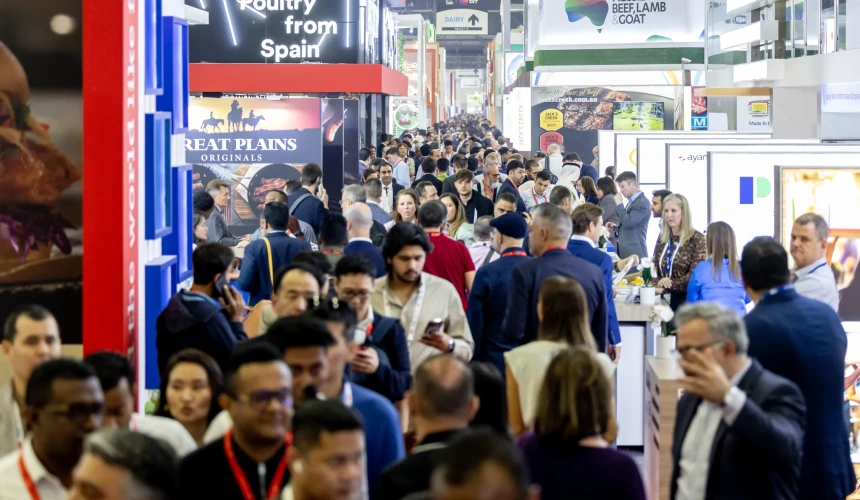
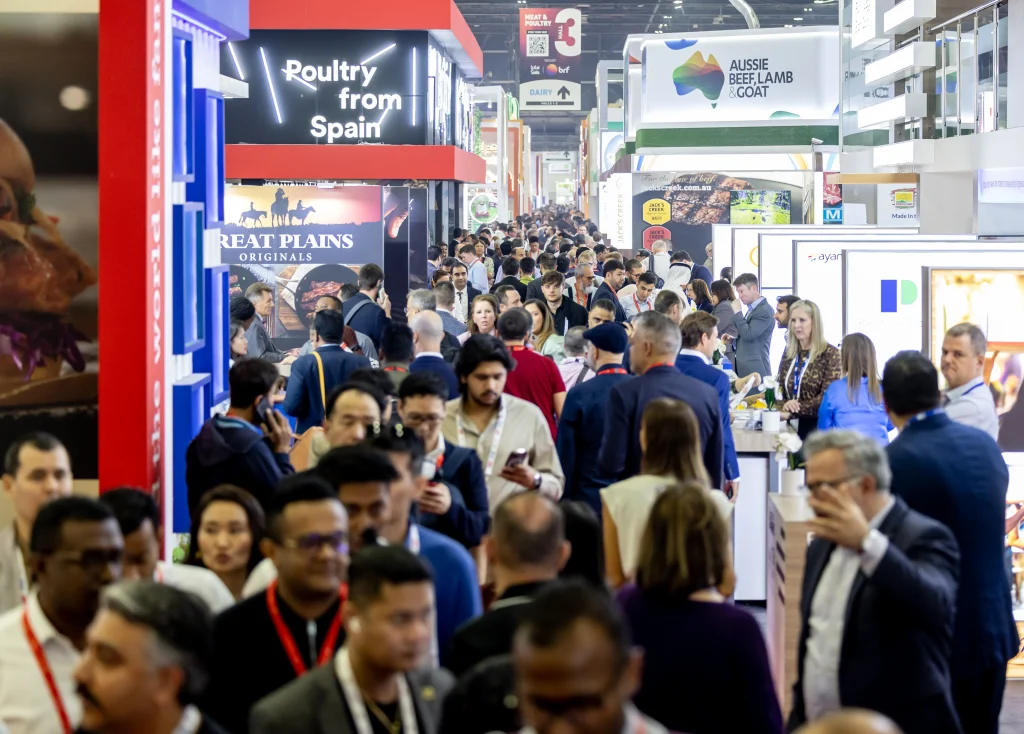
Delegates at the Gulfood event in Dubai this week – Australian red meat presence upper right
DESPITE uncertainty circulating around the global beef industry from tariff and quota moves, geopolitical tension and other threats, Australia remains in great shape to tap into strong global demand for meat protein in 2026.
That’s the main signal to emerge from the enormous Gulfoods food and beverage trade event that’s been held in Dubai in the Middle East this week. dominated discussions at the world’s biggest food and beverage exhibition being held in the Middle East this week
The largest food and beverage trade show in the world, Gulfoods 2026 attracted about 8500 exhibitors from across the globe, with visitors from 195 countries scattered across the sprawling 240,000sq m exhibition space in the Dubai World Trade Centre and Expo City.
Thirty three Australian beef, lamb and goatmeat exporters were in attendance at this year’s trade show, which has a global, rather than just a Middle East regional trade event for buyers and sellers.
Australia’s key export rivals – Brazil, the United States, Argentina, Uruguay and others – also had a large trade presence.
Australian red meat exporter representatives were kept busy throughout the five days the event was staged, fielding inquiries from old and new customers from throughout the Middle East, Europe, North and South Asia and North America.
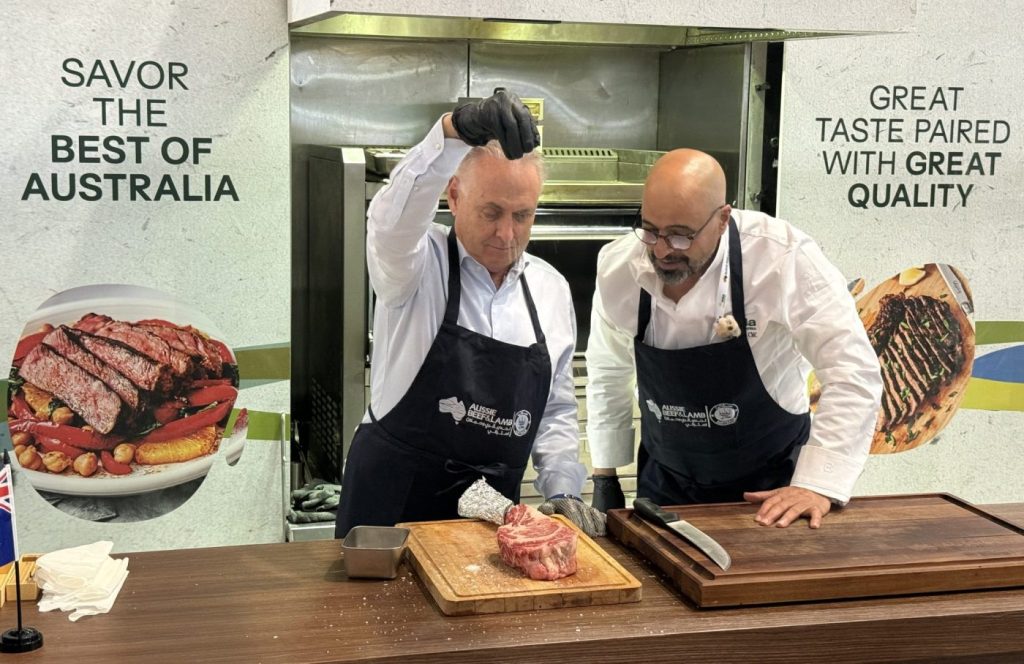
Australian trade minister Don Farrell dresses a tomahawk steak on the MLA demonstration stand
Australian trade minister Don Farrell dropped into the event for a visit, attracting questions from patrons and exhibitors about the state of progress in Australia’s Free Trade Agreement with the European Union.
Melbourne based beef, sheepmeat and goatmeat exporter Gerard Meyn from Stella Foods has attended Gulfood for decades, noting the event’s transition into a global gathering point for the red meat trade – especially over the past five years.
“Global meat protein customers now see this event as a meeting point,” he said.
“This year, we’ve engaged with people from across the Middle East, but also from Mexico, the Caribbean, Canada, and across Asia,” he said.
“I’d say that despite the global challenges and uncertainty faced by the red meat industry, people are still eager to do business. There’s significant economic growth and development in this region, and we’re seeing increased business in areas like value added products, both beef and lamb.
“We’ve also sent quite a lot of goatmeat into the Middle East region this past year, and that’s proving to be a good hedge against rising tariffs into the US market, for example.”
Mr Meyn said while the Middle East was in some ways a mature market for meat protein sales, during Gulfood this week he’d been both dealing with which he’d done business for 30 or 40 years, as well as potential new ones.
“We’re meeting long-term customers, but there’s also new investment and partnerships being created,” he said.
Given the performance of the Australian dollar over the past fortnight, currency had come into plenty of conversations, he said.
“Unfortunately currency is having an impact, but the global market generally is short of product at the moment, and customers are still keen to secure supply.”
Asked about China beef tariff impact, Mr Mehn said on top of filling our quota early this year, he was concerned about product being placed on China’s ‘doorstep’ during November in December in bond, in anticipation of next year’s quota.
“That means we may fill next year’s quota in very short time. “Effectively, we might miss a year altogether,” he said.
“But Australia’s strength is diversity of export markets. Yes, the China safeguard is obviously a major issue for everyone, and yes, South American beef will end up in other markets, but we are seeing growth in other markets like the UK, Indonesia and elsewhere.
“Generally the UK and Europe are short of meat, and there’s good opportunities for diversification. We’ve probably spoken to seven or eight English and European importers over the last few days. They’re short of meat, particularly since declines in production in New Zealand – especially lamb.”
“The export red meat trade faces changes virtually every day of the week – we have to just keep rolling with it to keep up,” he said.
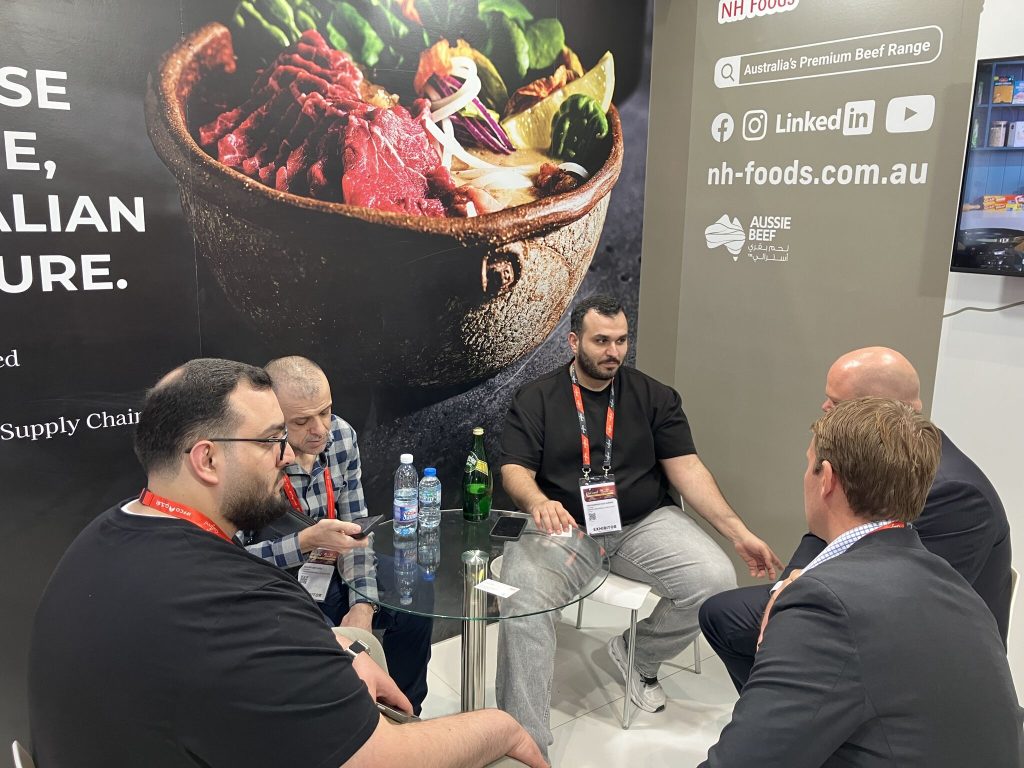
NH Foods sales personnel with customers at Gulfoods this week
China tariff impact
The impact of China’s quotas and tariff on imported beef this year was understandably a hot topic around the trade stands at the event.
While Brazil is yet to officially confirm it has established a quota management scheme for its 2026 China shipments, there’s a strong view that arrangements have been made internally.
A source attending Gulfood said JBS Brazil’s share was likely to be about 350,000t; Minerva Foods 120,000t and Marfrig 100,000t, with the remainder shared among other approved exporters.
Talk at Gulfood yesterday (unconfirmed) also suggested that Brazil has managed to negotiate an exclusion of its product on the water or in bonded storage in China from its 2026 quota. One source suggested this may have been as high as 350,000t. The same source said Australia had not yet managed to negotiate a similar exclusion.
Evidence of Brazil’s quota management plan into China, that is likely to limit monthly shipments to about 80,000t this year, has already been seen in the US market.
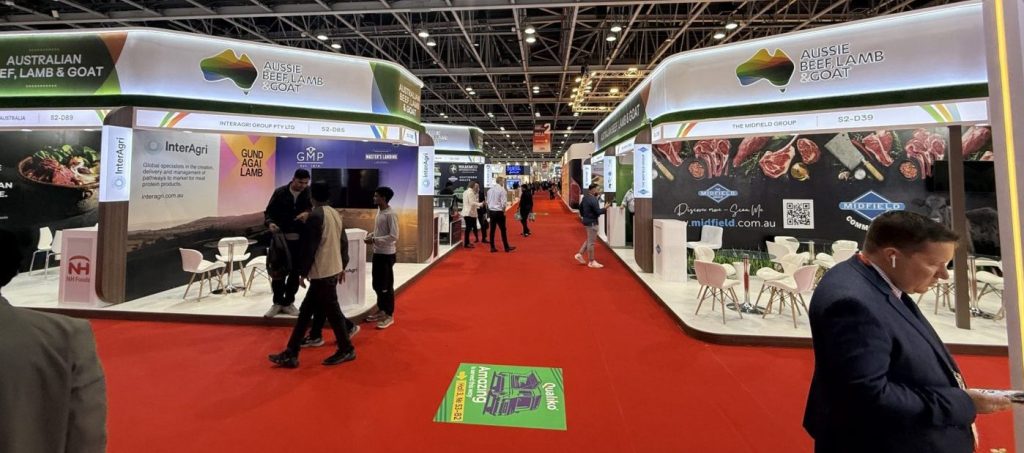
Australian exporters stands at Gulfood this week
Analyst Len Steiner this week reported more beef offers being seen from Brazil, often US10-15c/lb and more below the limited Australian product offered.
“The expectation among US end-users is that Brazil, and likely other South American exporters, will continue to aggressively sell into the US and undercut Australian and New Zealand packers on price,” Mr Steiner said.
“At the same time, high US lean beef prices and limited supplies have users searching for ways to keep costs under control. Some end-users we spoke to said that at this point, those that use imported beef have developed formulations that maximise imported content.
“However, it is important to keep in mind that there are many smaller processors that continue to source based on US-only specifications. This means demand for imported product remains firm and is likely to grow.”
The key question was, who is best positioned to fill this demand.
Brazil shipped 1.6 million tonnes of beef to China in 2025. It’s quota this year is now set at 1.1mt.
“Even if Brazilian beef production and exports decline in 2026, some 200,000 to 400,000t of exports could be looking for a new destination. Among the many countries Brazil exports to, few are as lucrative as the US,” Mr Steiner said.
The bottom line was that the China quota was likely to make Brazil a more forceful beef export competitor in the global market this year, while Australian suppliers compete aggressively to ship meat to China to avoid the 55pc tariff.
“By the time Australia shifts its focus back to the U.S. market in the second half of the year, some regular buyers may already have covered part of their needs with Brazilian beef. As many in this business know, it is easier to keep current business than to win it back once its gone,” Mr Steiner said.