
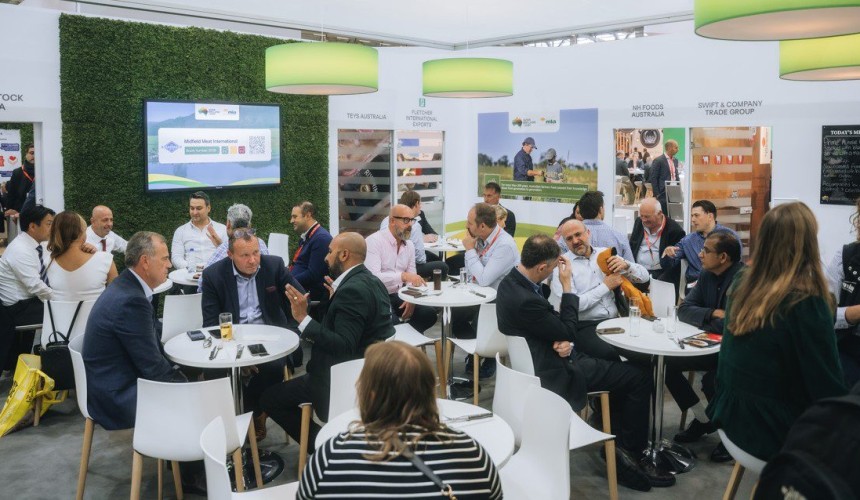
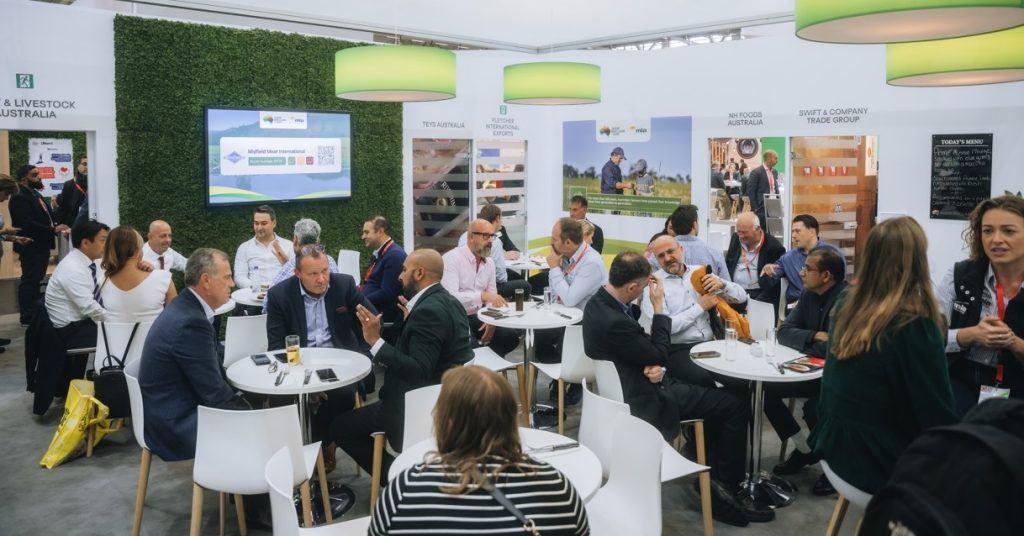
Trade discussions on the MLA stand at Anuga this week
GLOBAL beef supply shortage was front-of-mind among trade visitors at the enormous Anuga food trade show held in Germany this week.
And with Australia the odd man out among major beef exporting nations in terms of its production and herd cycles, it was no surprise that our exporters attracted a constant thong of people on their sites during the event.
 Held in Cologne, Germany every two years, Anuga is Europe’s largest food trade show, supporting 8000 exhibitors (including almost 1000 in meat products alone) and attracting 140,000 visitors from across mainland Europe and the UK, the Middle East, Asia and elsewhere.
Meat & Livestock Australia mounted its usual large display, supporting 11 Aussie beef, lamb and goatmeat exporters, with a host of others operating separately from their importers’ own trade booths at the event. Large multi-species exporters like Thomas Foods International and JBS hosted their own large trade sites.
Beef Central spoke to a number of Australian trade stakeholders during the event. A number said they sensed an element of ‘eagerness’ among potential new and existing customers to do red meat business out of Australia, in light of declining supply from other regions.
While surging prices for red meat remained an important topic, supply assurance in a period when many red meat exporting countries are in downwards production cycles was a common focus in discussion, Beef Central was told.
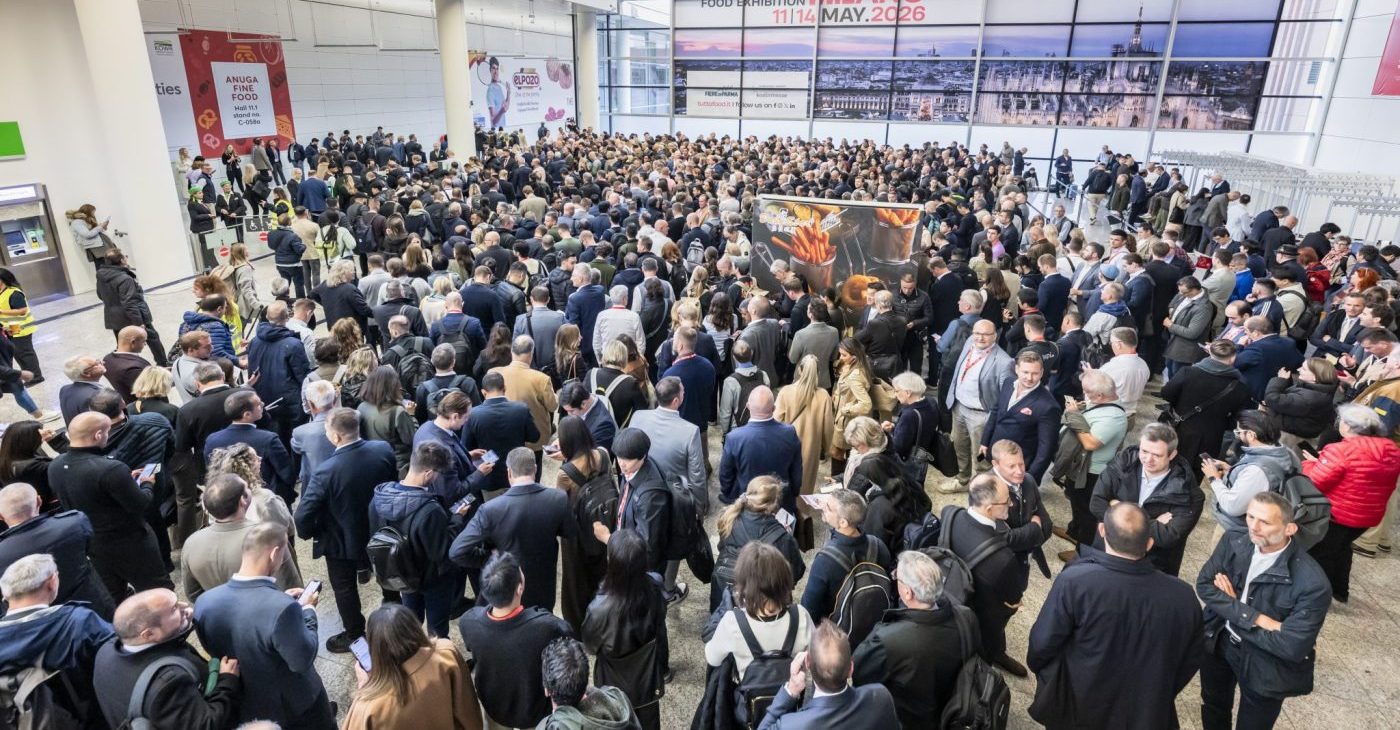
The entry hall at Anuga is a sea of people each day
Brisk inquiry
A senior meat trader with a large Australian beef export company who has spent the past five days at Anuga said trade inquiry had been brisk.
“It’s been extremely busy, from an Australian trade perspective, for a combination of reasons,” he said.
“Global protein shortage, plus livestock shortage – both beef and lamb – on top of record high meat prices in the US and Europe, are dragging product out of traditional distribution channels into other markets. And in turn, that’s shorting-up other markets,” the trader said.
 “Irish beef – a major supplier into the UK – is now more expensive than British beef, impacted by things like Green government policies. Irish slaughter that normally runs at 35,000 head a week is currently running at 23,000 a week.”
“Europe’s green policies implemented a couple of years ago have led to farmers either being paid to reduce their production or to move to carbon production instead of animal production. That’s now being reflected in local red meat production shortage, and it’s really starting to pinch the market,” he said.
“The EU remains heavily restricted on quota for Australia – only 3400t of Hilton access – until some form of trade agreement can be advanced. More immediate opportunity is in the UK, where Irish and UK beef herds are in decline. There’s good opportunity now for Australian beef, with volumes over the past three years going from 3000t to around 15,000t likely this year.”
“Price certainly came up in discussions during Anuga, and especially so for lamb – nobody around the world has any lamb apart from Australia. NZ production is well down in volume as is British lamb.”
“Speculation around customers preferencing proteins other than lamb is ongoing,” he said.
“But there is not going to be any cheap beef or lamb around the global markets any time soon, while ever the US drags in so much product from offshore to fill its enormous void,” the trader said.
A recent development since Trump applied heavy tariffs on Brazilian meat heading into the US was growth over the past two or three months in Brazilian product heading into EU markets, especially loin cuts, with more manufacturing product heading into China rather than the US because of the tariff impact.
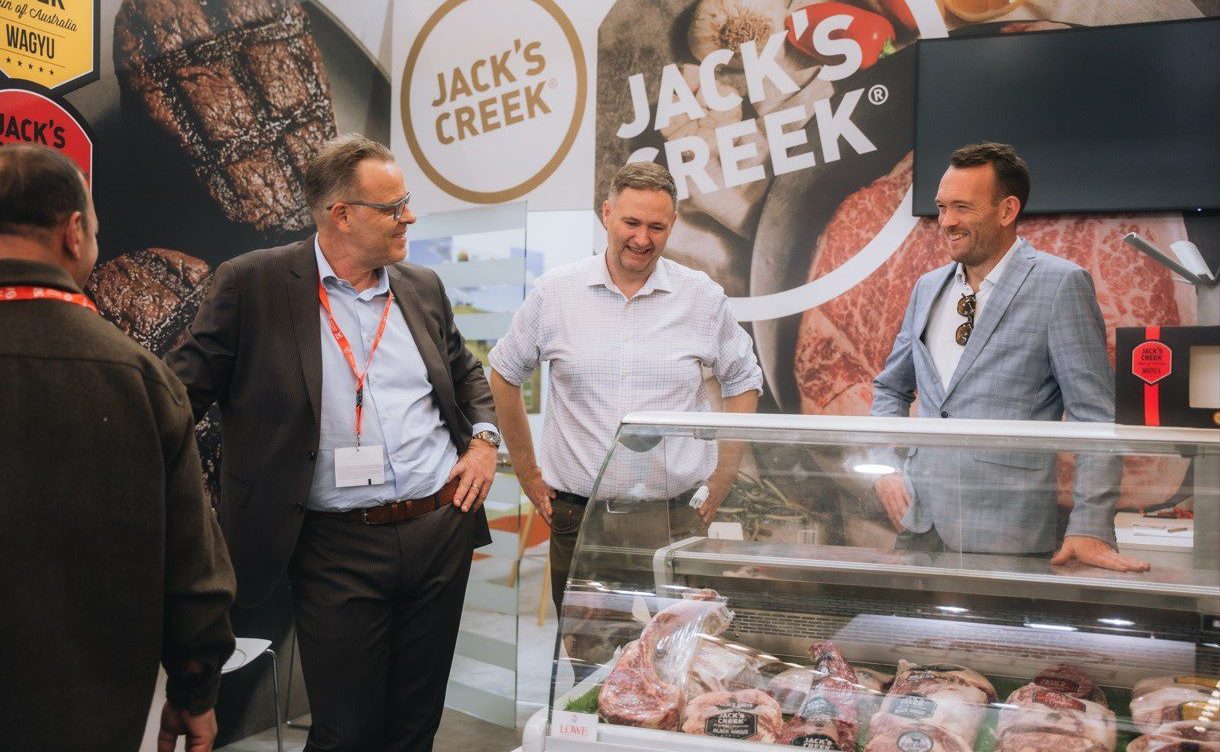
Jack’s Creek Wagyu and Angus out of Tamworth was one of the Australian trade exhibitors this year
Level of optimism
MLA general manager for international markets, Andrew Cox, said this week’s Anuga event was very busy, attracting customers from across Europe, Asia and the US.
“Along with Gulf Food held in the Middle East, Anuga is a true global meeting point for the red meat trade,” Mr Cox said.
There was a level of optimism evident in discussions with Australians present, he said.
Beef remained in short supply right across Europe and the UK, for a variety of reasons, Mr Cox said.
In the UK, Australia was doing quite well, with larger quantities of our beef and lamb in cold stores, and finding its way into the food service and retail markets.
Since the FTA with the UK was struck two years ago, Australia has not gone close to filling its beef and lamb quota, but the FTA has been quite effective in allowing larger quantities to arrive into the UK.
“Year on year, you can actually see the change in the presence of Australian beef in the market, with more product on retail shelves and in the food service market,” Mr Cox said.
“At the same time British farmers remain opposed to imports and remain somewhat protective. We understand that, and UK farmers are not alone in that view, being wary and cautious of competition – it’s seen everywhere.”
“But while Australian beef and lamb is not out to displace local farming, we vigorously counter any misinformation about Australian red meat production systems from within the UK.”
For the first eight months of 2025, beef volume into the UK has reached 10,345t, almost 6400t or 169pc higher than the same period last year.
“It’s very clear now that there is strong demand for Australian beef in the UK, and potentially in Europe, if we are able to improve EU access,” Mr Cox said.
“While it has traditionally been a grassfed market, there are opportunities to build a grainfed market in the UK, on top of what’s already there – especially in the steakhouse and restaurant segment.”
In the European Union region, there was a little cautious optimism present, with potential re-starting of trade negotiations ahead of an FTA between Australia and the EU. A potential meeting between the EU trade commissioner and Australia’s trade minister is planned later this month, but no firm start to talks has yet been announced.
In the meantime, an EU trade agreement with the Mercosor countries (South America) is currently being ratified by the EU Parliament, which would give access for 99,000t of beef tariff-free, with talk of other trade deals with India and others.
Asked whether there had been much talk about EU Deforestation Regulation (EUDR) on red meat products during Anuga, Mr Cox said it was not a major topic of conversation, especially since the EU had recently delayed the process by another 12 months.
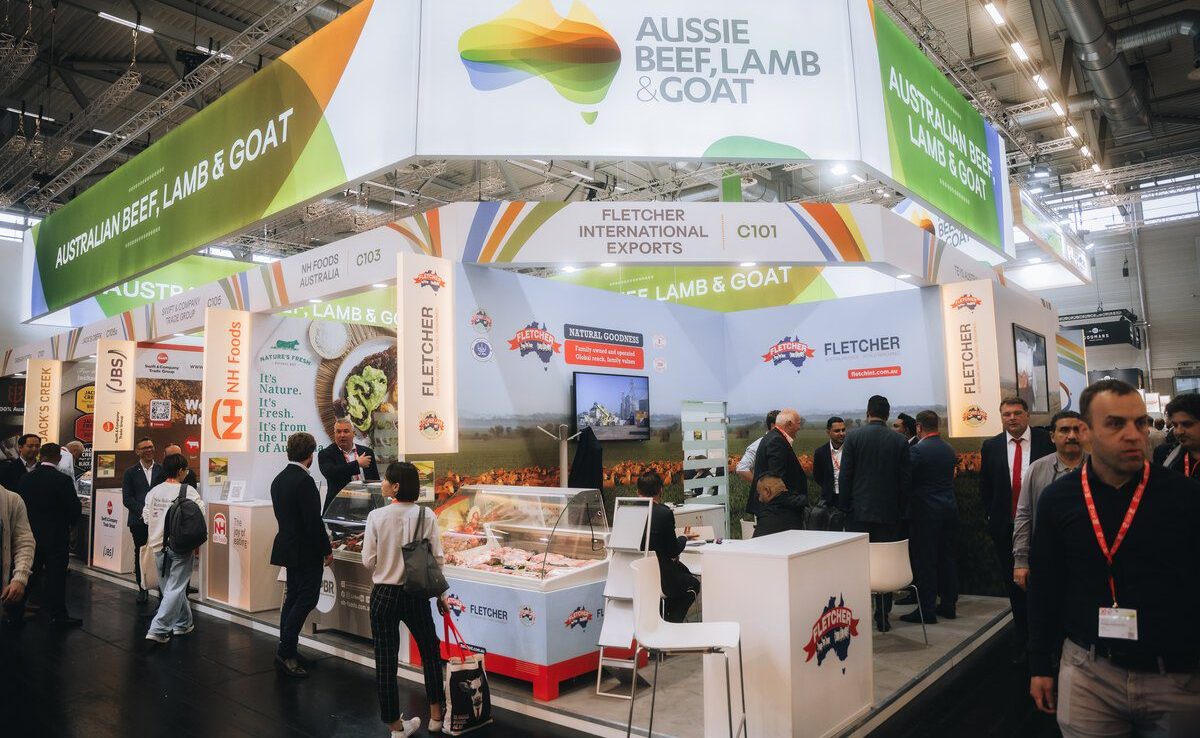
MLA’s trade hub at Anuga this week, with from right, Fletcher International, NH Foods, JBS and Jack’s Creek stands
Imported beef and lamb looms as a ‘tough sell’ for UK retailers
Meanwhile, Major UK red meat retailers are facing a PR nightmare in selling the need for imported beef and lamb from suppliers like Australia to local consumers, as local supply dwindles and prices continue to ratchet up to record levels. Prices in some red meat products have lifted 30pc this year alone.
During a recent exchange with producers in Australia, a representative from one of the UK’s largest retail chains gave a surprisingly open and frank account of the current red meat supply dilemma faced by the retail trade in the UK.
For the purposes of this article, we’ve chosen not to disclose his or his company’s identity, because of the risk of repercussions from the UK’s militant National Farmers Union, which has stridently opposed any notion of larger quantities of imported Australian beef and lamb, often attempting to demonise Australian production systems.
Many UK retailers have for decades sold the ‘domestic only’ policy as part of their red meat offering, but that is becoming increasingly difficult to defend.
“The supply dynamic is reducing – it’s certainly not increasing,” the UK retail executive told the Australian producer audience.
“So why am I here (in Australia)? There are many reasons why we need to broaden our sourcing objective – some of that is around supply, some of it is environmental, some of it is quality – but definitely we see the need for a big shift on how we have done business over the past 15 years,” he said.
During a conversation around food security versus sustainability, he said food security was a hot topic in the UK and Europe, but the two subjects were rarely brought together in conversations.
“What you end up with at the end of those conversations is hard choices and trade-offs,” he said. “The reality of UK food security (for beef, for example), might be that we don’t drive for self-sufficiency in beef production, but home-in on other commodities where it makes absolute sense to be UK food-secure, because we can grow that commodity better in the UK and there might not be options around the world to bring that in to the country.”
“But the bit I’m not seeing is that we’re not having those hard conversations, about what we’re going to do – because there will be winners and losers, and its happening within a political environment.”
Asked about Australia’s Free Trade Agreement with the UK established two years ago and the opportunities that presented for Australian beef and lamb, the audience was told that in the case of lamb, big export competitors like New Zealand had reduced their sheep flock and continued to do so, while the UK/Ireland lamb numbers were also dropping.
“That leaves Australia. The outlook for Australian lamb (into the UK) is really positive, despite some of the humps in the road,” the audience was told.
Under the FTA, one of the highlights was growing volumes that used to be capped under a quota ceiling, with a stepped increase over the next ten years. The demand in the UK for Australian lamb was improving year-on-year.
“It’s still early stages of the journey, but its going to be a positive opportunity,” the audience was told.
Similar to other countries, major UK retailers proudly proclaim the UK origins of their fresh meat offer, and the UK retail representative was asked how his company was going to handle customers questions around stocking imported product.
He took a long pause before offering an answer, separating out the circumstances for beef and lamb.
“Lamb was the gateway drug – it was the starter for us to build relationships with Australian red meat suppliers. We still get the majority of our lamb from UK suppliers or New Zealand, but obviously we are now also sourcing lamb from Australia in growing volume.
“But for beef there is a huge challenge for us (UK’s major supermarket retailers) back at home.
“Beef is the most emotional protein, in the consumers’ eyes. If we make changes, you only need to look at some of the recent UK headlines, with regard to retail groups like Morrisons and Asda offering Uruguayan and Australian beef, to see the results.”
“It would hit our national newspapers if my company was to start stocking Australian beef tomorrow,” he said.
“My job is to give my company choices, in terms of red meat. We have a choice coming up in our beef offer – and its happening a lot sooner than we expected. It’s either sell less beef to consumers, full-stop; try to sell the same amount of (very expensive) beef we do today, from the same sources (unlikely); or we start to look at where else in the world we can get beef from.
“And its not just a price conversation – there’s a big quality agenda in that as well,” he said.
“But we need to make difficult choices, and it’s definitely going to be a huge decision for our company. We need to make informed decisions – and we need to look at who, around the world, has the data, the farm standards and everything else that sits behind the product, to give credibility, that would means our business would feel a lot more comfortable moving into that space.
“But its definitely going to be a huge decision, either way.”
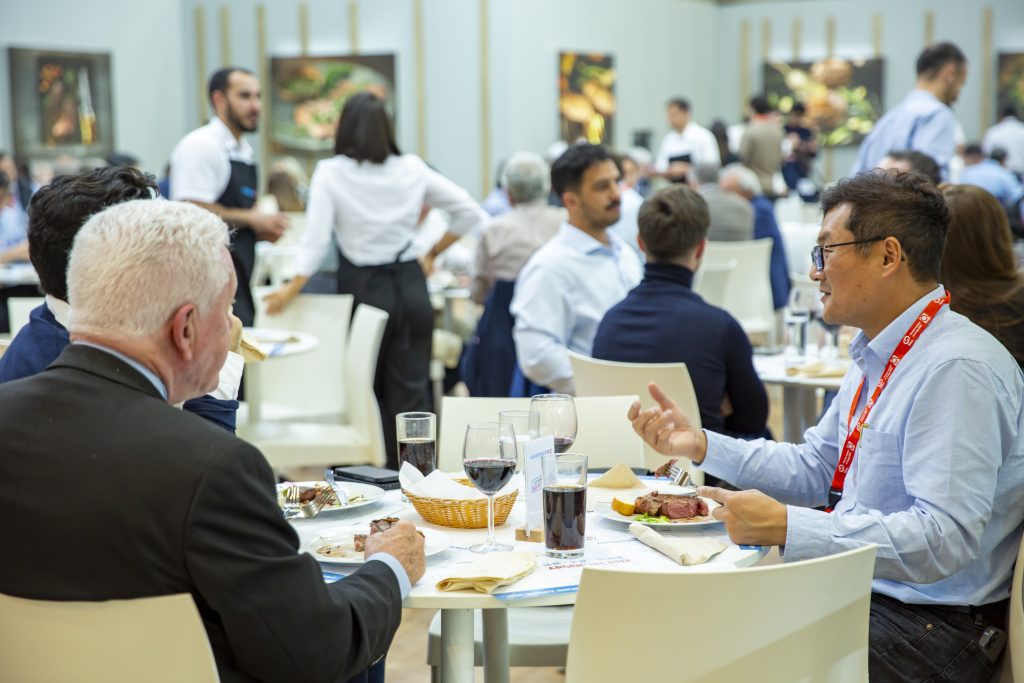
Minerva Foods Iain Mars, left, shares a steak with customers during Anuga