
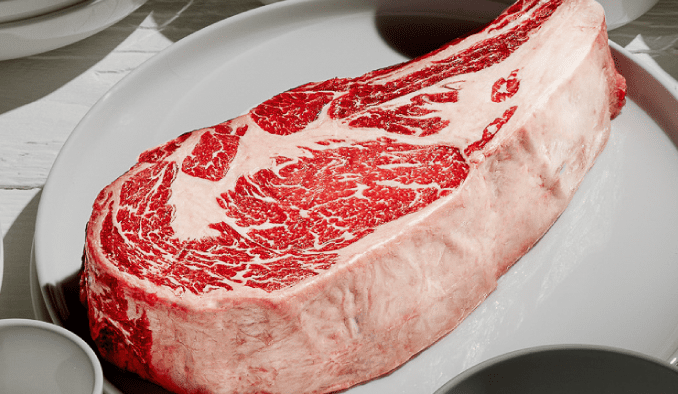
JBS Portoro marbling score 4+ OP rib
GO BACK a couple of decades, and Australian 100-day grainfed beef program managers were celebrating marbling score 2s and better as ‘something special.’
JBS (then Australia Meat Holdings) blazed a trail in this space with the launch of its ‘Your Choice’ brand program out of Beef City feedlot near Toowoomba, around 1991, drawn from carcases with marbling scores 2 and better.
Scroll forward to 2025 though, and there are numerous grass and shortfed grain beef brand programs now in place where marbling scores 4 and better are routinely being harvested from the chillers and marketed separately, at higher prices.
The first challenge when any brand manager is considering ‘segmenting out’ a premium run of beef from a base brand program like this is volume. There is little point in producing a marbling score 4 and better carton lid and promoting that as a premium product, if there’s only a handful of carcases hitting the spec in each week’s kill.
But clearly, over time those numbers have grown, and are now regularly being seen in the chillers.
Driven by genetic improvement and better nutrition and young cattle management, beef brand programs in Australia are increasingly segmenting their offering to include separate sub-brands for marbling score 4 and higher premium carcases.
The trend is evident both in Angus breed-specific brand programs, as well as those where breed type is not prescribed, and equally extends beyond 100-day and 150-day programs into specialist premium grassfed programs.
Big wholesale premiums
What’s clearly evident is premiums for higher marbling score shortfed beef in the wholesale market – especially for the sweet cuts.
“Any reasonably-sized brand program manager not segmenting out the marbling scores, 3-4 and higher and selling them separately is leaving money on the table,” a leading wholesaler told Beef Central.
For example, in the domestic wholesale market this week, a good quality shortfed striploin, marbling score 2, is worth around $25/kg, the wholesaler said. The same striploin but producing marbling score 4 is worth $32/kg, while a 0-1 score strip is making around $18/kg. That’s a $14/kg spread from best to worst.
At the retail level, Cape Grim Select MB4+ sirloin is selling in whole primal form (cut steak portions are inevitably a lot more expensive than whole vac-pack) in Super Butcher this week for $77/kg.
Here’s a short, albeit incomplete list of some grass and short/midfed grain programs that now segment score 4 marbling carcases out into separate brands and price-points:
Grassfed:
- JBS Great Southern certified grassfed’s Little Joe MB4+ program. JBS blazed a trail when it launched its Little Joe MB4 Certified Grassfed brand as an off-shoot of the Great Southern program in 2017. The program today sees 5-10pc of all Great Southern carcases grading Little Joe, year-round. That’s up from only 1-2pc when the program started. JBS Southern pays a 40c/kg premium for carcases grading 4+, and some of Great Southern’s ‘gun’ suppliers are routinely hitting 40-50pc score 4s in their consignments
- Greenhams Cape Grim Select and Bass Strait grassfed
- AMG Southern Ranges grassfed
Grainfed:
- AMG Southern Grain (150-day)
- Kilcoy Black Diamond
- JBS Portoro
- Teys Certified Angus, Teys Black, Teys 360South
- TFI Angus Pure
- At the extreme end of the scale, both Stockyard Beef and Rangers Valley run +200 day programs partitioning marbling score 5 and up Angus carcases. In Rangers Valley’s case, the program is called Black Market.
While some of these programs are not breed specific, many are in fact underpinned by a strong Angus base. The prevalence of Angus in southern Australia has no doubt helped drive the marbling performance trend.

David McNally
David McNally, principal of large domestic wholesaler business Australian Wholesale Meats, said the consumer was the winner in the recent changes in this space.
“Pay a little more an have an incredible marbling score 4 steak experience, or a good everyday pub or hotel experience at a softer price,” he said. “Previously, when marbling scores 0-4 were still being packed in the same carton, there was just too much variability.”
“It’s got to a point where the typical pub restaurant/steakhouse in a metro area of Australia now requires a minimum marbling score 2 sirloin for their steak menu. It’s becoming much harder to place that bog-standard 100-day marbling score 0-1 product in any decent food service outlet. Most of that is now going as commodity beef into export,” Mr McNally said.
“As a brand program manager, if you aren’t grading out a consistent number of score 2s or better, you aren’t even in the race in the better end of the domestic food service market. The goalposts have shifted, and the commodity end has been taken out of the market,” he said.
 “It’s the same in the portion-cutting rooms, servicing restaurants, hotels and pubs. They tend to latch onto a brand and want to stick with it, but they also chase those marbling score 2s (and sometimes higher) to create a point of difference for their customers.”
“There’s definitely less speculative buying happening, and more consistent forward programming going on – especially for this higher marbling score product scores 2 and higher.”
“It’s taken some price volatility out of that part of the market. And the other point is that this better quality meat holds up better in price over winter. Traditionally, steak cuts fall out of bed (price wise) during winter, when nobody want to BBQ – but this higher-marbled shortfed product is a bit immune to that.”
“That’s not just greater international demand – it’s about recognition and demand in the domestic food service area supporting those prices for better-marbled product.”
Relentless genetic improvement
While many of the MB4 brand programs listed above are not breed-specific, there’s no doubt that the advances made in Angus genetics, and the sheer popularity of the marbling-oriented breed in southern Australia is playing a part.
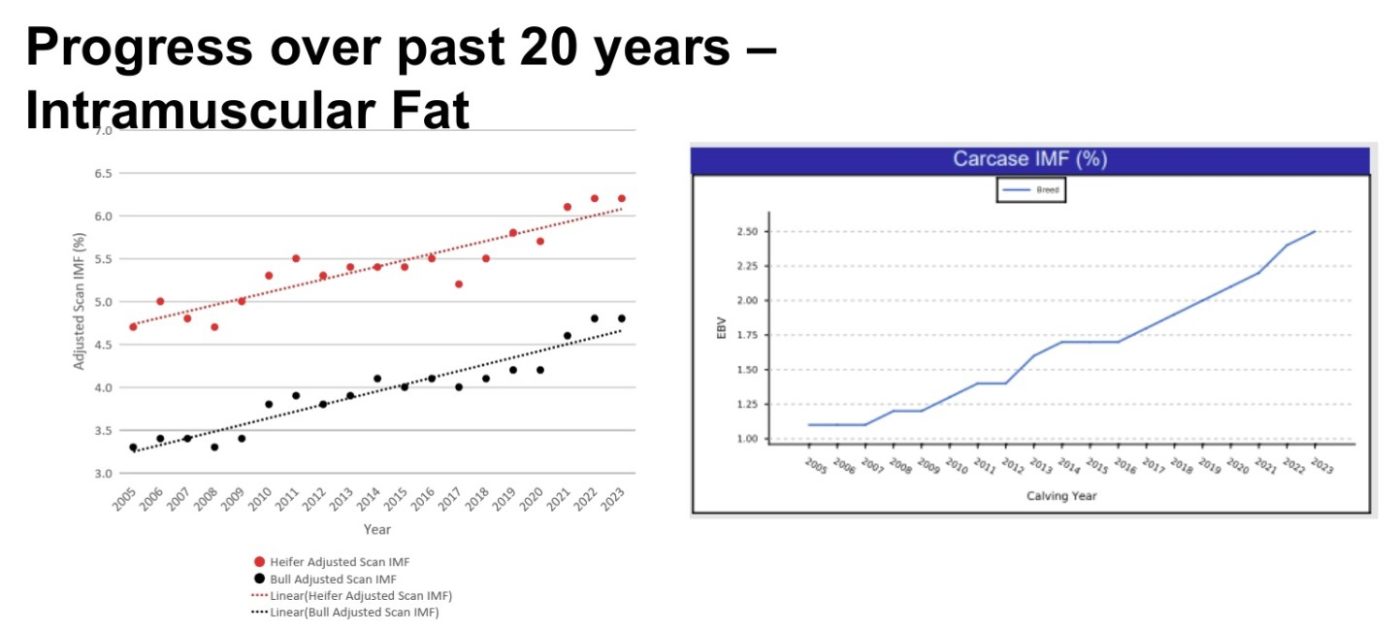
The graph below plots Australian Angus Breedplan IMF (marbling) improvement over the past 20 years.
“Marbling is the one of the strongest growth traits recorded over the past 20 years for the breed,” Angus Australia chief executive Scott Wright said.
“That’s been driven squarely by market demand, from processors and end-customers,” he said.
The marbling impact being expressed in the above brand program discussion was all the more notable because it was being delivered by younger and younger cattle over time. The ability to express marbling becomes more challenging as age at slaughter reduces – effectively working against the marbling performances being seen, Mr Wright said.
Australian Angus breeders were clearly placing greater selection emphasis on marbling than seedstock producers overseas.
“It’s been a huge focus for our breeders. Australian Angus marbling scores are now actually higher than those in the US Angus industry,” Mr Wright said.
“Australian Angus breeders over the past 20 years have gone to the US and consistently, have selected the best marbling genetics. When the first World Angus Evaluation came out in late 2023, we saw distribution graphs comparing Australian, US and Canadian Angus populations for marbling.
“Australia’s registered Angus cattle were in front of both the US and Canada for marbling. That’s a result of selection pressure – it’s moved our cattle population very quickly.”
Nutrition, management plays a big part
UNE meat scientist Dr Peter McGilchrist noted the progression on marbling performance over time.
He said while genetic improvement obviously played a part, he suspects 70pc of the marbling performance result outlined above can be explained by superior nutrition and management, with genetics contributing perhaps 30pc.
“But to get results like this, you can’t have one without the other,” he said.
Peter McGilchrist
“Greenhams and JBS Great Southern went the earliest in this, in the grassfed space, where it is much harder to achieve than on grain.”
“What I’ve seen over time among producers chasing these kind of targets is pulling that maturity pattern back a bit, when selecting bulls,” Dr McGilchrist said.
“As well as lifting marbling (IMF), just pulling that mature cow weight back and putting a little more selection pressure on 400-day growth instead of 600 days, is helping. Ideally you want steers at 80-90pc of their mature weight potential, by the time they are slaughtered, in order to really lay down that marbling.”
“If you have 700kg or 750kg liveweight cows, it is much harder to achieve that higher marbling performance, because their steer progeny are still growing when processed.”
Dr McGilchrist said it was much harder to ‘wreck’ a piece of marbling score 4 or better beef.
“These days, a marbling score 2 steak is likely to be considered ‘good quality’ in a steak restaurant market, but once you get into that marbling score 4 range, it will be exceptional, every time – almost regardless of how it is cooked.
However he warned against simply buying product on marbling score alone.
“Use MSA, but marbling score can still be a brand specification,” was his advice.
“The major influences on eating quality continue to be ossification, hump height, HGPs and marbling. Selecting on marbling alone does not tell the whole story. It’s nice to use all of those levers to get the best product in your brand, rather than just one.”
Branded beef businesses need to move beyond their definition of brands. While marble score may be a valid ( and delicious) way to segment product, and seeing the increasing quality across the industry is inspiring, competing in a +4 marble score segment (or any segment) will only end in reduced profitability over time without a clear distinctive promise built into your brand. The only way to “build a moat” around your offer is to ensure customers and consumers see your brand as distinctive (unique and valuable) to them. Otherwise you will find yourself, sooner rather than later competing on price in THAT segment. While taste will always be paramount, building authentic story (and I’m not talking just clean and green ) around why a Dubai property developer, a Hong Kong VC CEO, a Michelin star chef or a pub line order cook chooses your marble score product over a similar spec, will build pricing power you can leverage.
<strong>
Great advice, Graeme. Editor</strong>