
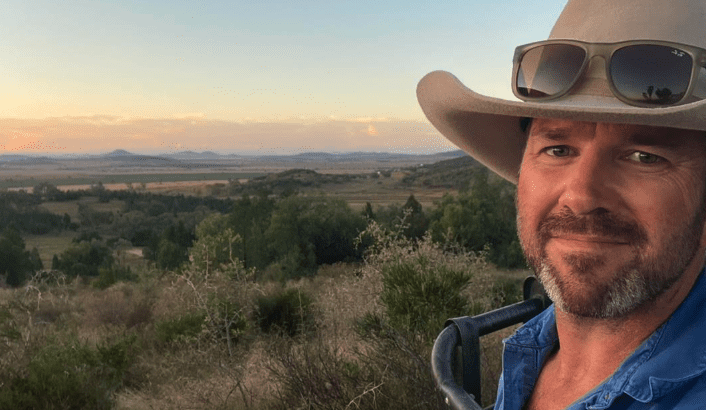
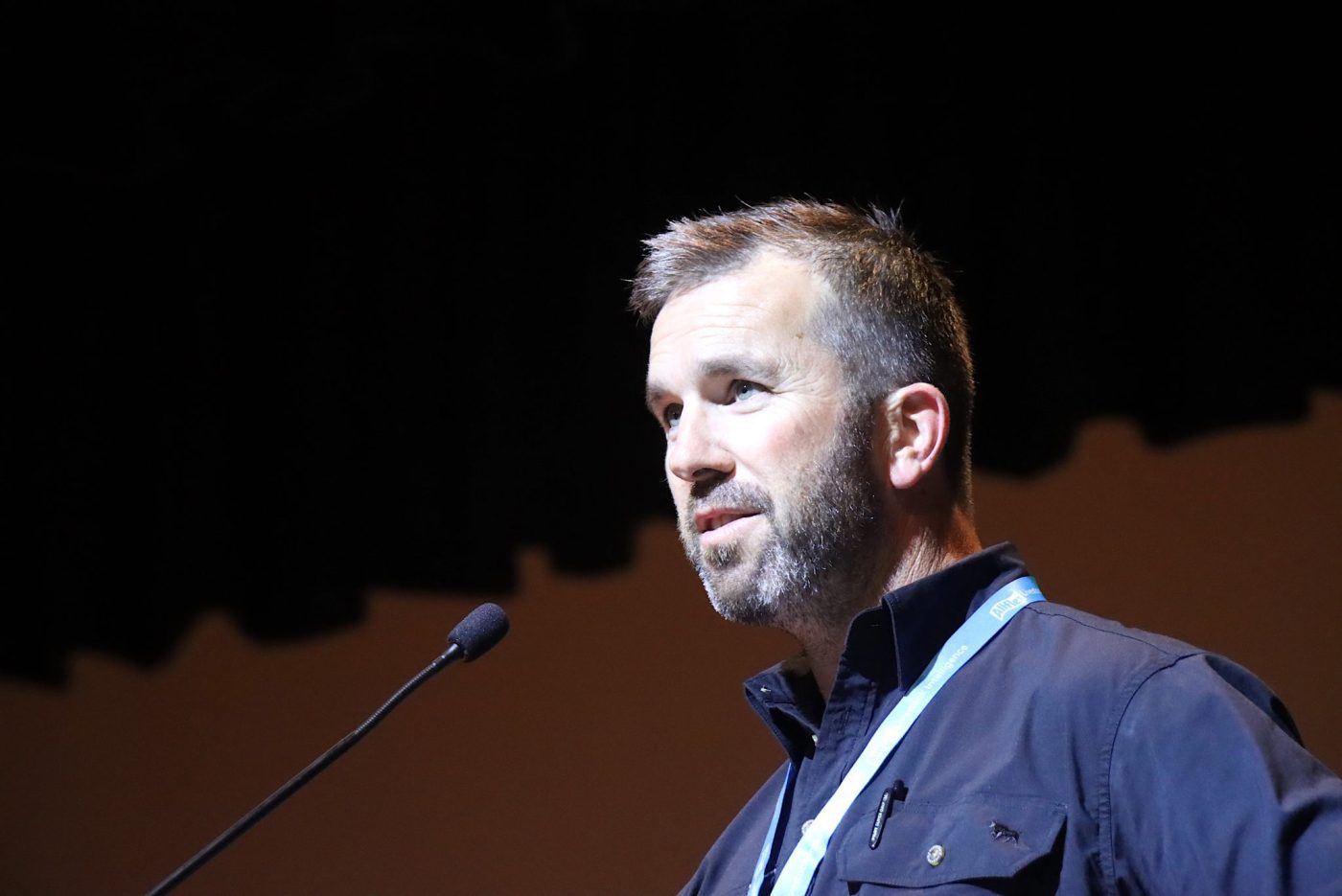
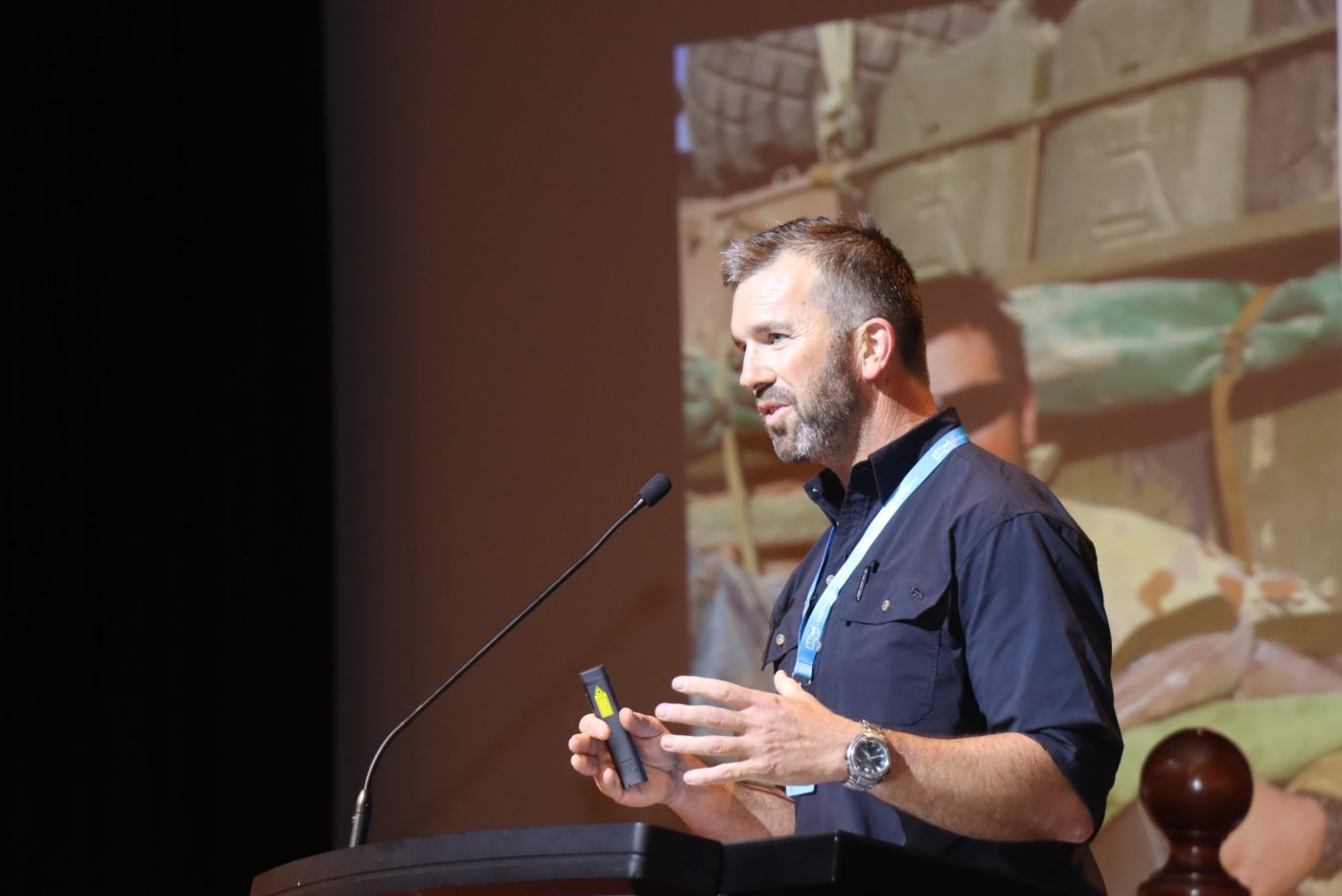
SOLDIERS are known for their courage. Gunnedah farmer and Australian army veteran Tim Lee showed boundless depths of that trait when he stepped up to the microphone and shared a deeply personal story in front of 250 people at the Young Beef Producers Forum in Roma last week.
Despite their courage to go where others would not dare, soldiers do indeed feel fear, his story revealed. They do indeed carry the scars and trauma from the battlefield, and they can indeed be severely damaged by the extreme stress and losses they experience.
Some hard-hitting statistics also revealed that the transition from military service to civilian life can be one of the most dangerous periods Australian veterans can face: 41 Australian soldiers died while on active duty in the 20 years Australia had troops in Afghanistan, but more than 1800 have died from suicide since returning home. (See this earlier ABC article for more details)
Despite his at-times harrowing story, Tim’s address closed on a profoundly uplifting note, enabled by a life-changing stumble into regenerative agriculture and, in turn, the Lachlan Hughes Foundation.
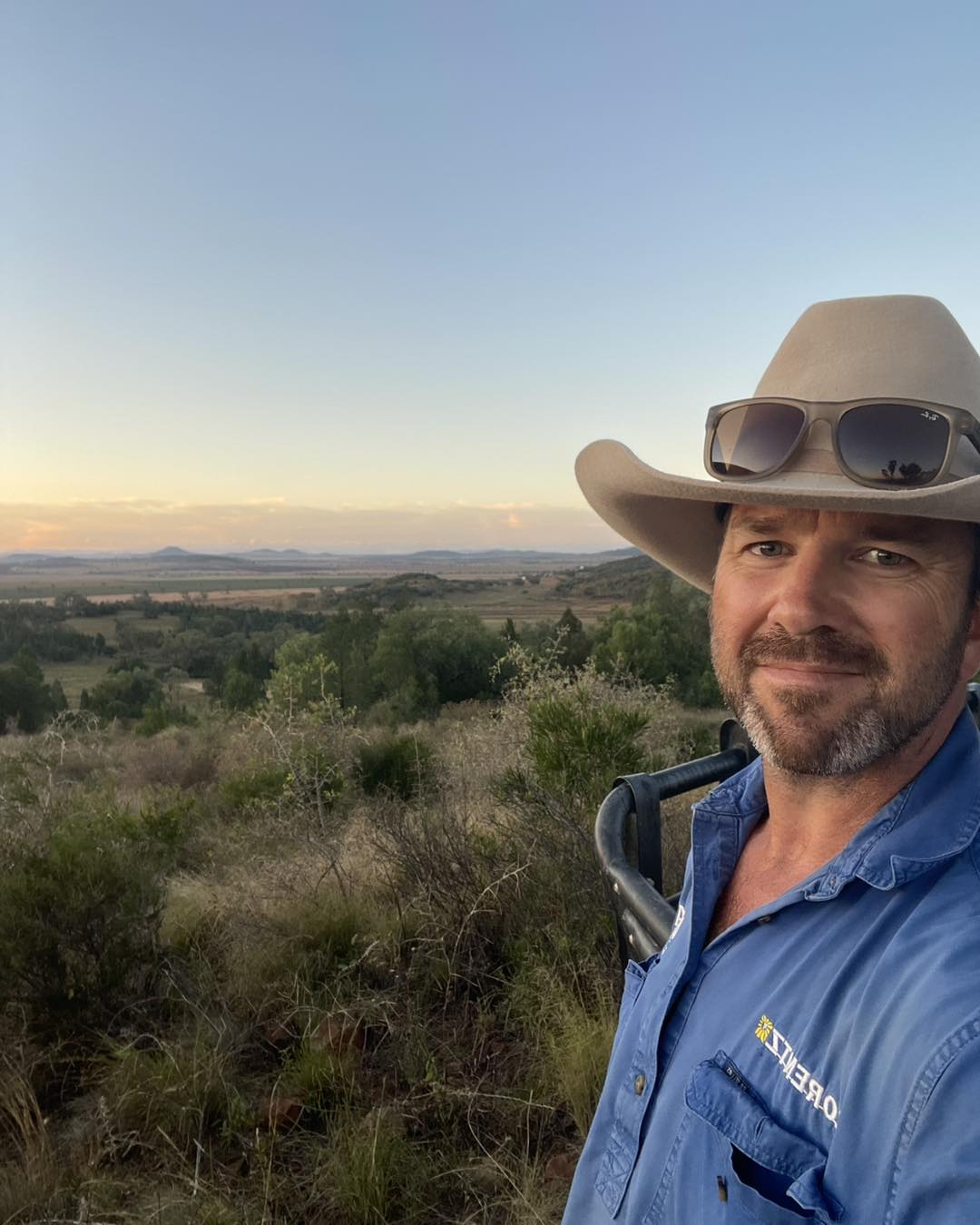 In a gripping 20-minute address, the veteran of tours to Afghanistan and Iraq explained how, since returning to his family property, he has overseen its conversion from a traditional high-input cropping operation to a fully grassfed beef grazing enterprise, which has “regenerated my land and regenerated myself.”
“I drive around most afternoons that I’m home and look like an absolute lunatic – I’m just fist pumping, seeing what the grass is doing, seeing what the animals are doing, seeing what the trees are doing,” Tim said.
“I really get pumped up thinking where this is going.”
Tim used his address to share with the young audience several things he wished he had known and understood when he was in his twenties, through a series of straight-talking, no-nonsense tips – starting with this:
“Tip number one: the only thing standing between you and your goals is the bullshit story you keep telling yourself why you can’t achieve them.”
The good days
His story started back in ‘the good days’, with pictures of Tim on deployment in Afghanistan in 2011.
“This is happy Tim” he said, flanked by images on the big-screen showing he and his army mates dressed in desert pattern camouflage, sun-browned skin and broad grins, opening care packages, posing in poppy fields and standing alongside bushmaster vehicles.
“I had no self-preservation or care in the world,” he said.
The bad days
But then Tim showed another picture, which was taken two days after the deaths of one of his colleagues and their interpreter.
“This is when things really started to change”, he said.
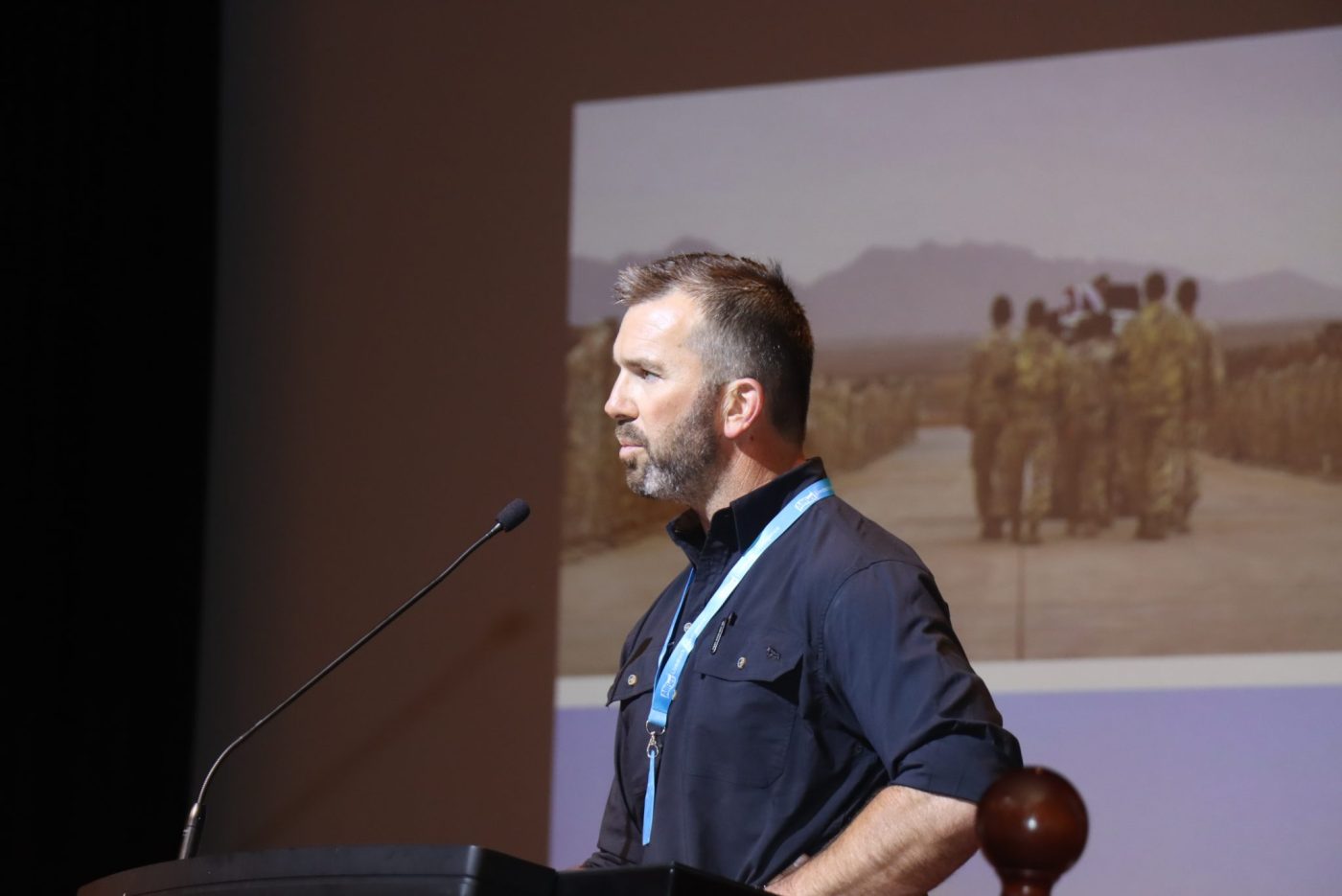 “My mind really started to betray me, with fear and doubt creeping in.
“I went from thinking I was bulletproof to, you know, holy crap, I might not make it out of here.”
He spoke about the constant threat of IEDs and serving in a vehicle that lacked blast protection.
“Every time I was out on a job, I was just waiting for that big pop, and darkness.”
After being medically discharged in 2014 with a broken back, he received diagnoses of PTSD and depression and began to suffer from alcohol dependence.
“For a few years there, after Afghan, I had to drink to black-out drunk just to sleep. I just could not sleep.
“I had lost my identity. After 14 years in the military, I felt alone, defeated and anonymous.”
The danger of self-talk and the power of changing it
Throughout his presentation, Tim often returned to the theme of ‘mindset’.
“Tip number two, be careful with your self talk and thoughts.
“Your brain doesn’t know the difference between thought and reality – if you feed it fear and doubt, that’s what you’ll get.
“If you feed it gratitude, compassion, acceptance or love, your life will start growing in that direction.”
Questioning conventional farming
On returning home, he was spending long hours on a John Deere.
“I used to call the tractor ‘the office’. I spent way too much time in it, spraying expensive chemicals and tilling the soil, because that was just the way we did things on the farm”.
But then he began questioning the logic behind it.
“So tell me if this makes sense to you: We are the only species that sprays food with poison so that other animals won’t eat it, but then we eat it ourselves.
“It just really didn’t sit right with me.”
Hitting rock bottom and looking for a way forward
In 2018, Tim reached what he described as rock bottom.
“I had a massive alcohol induced meltdown… and the next day I finally put my hand up and sought some proper help.
“That was the beginning of a five-year crawl back out.”
As part of his journey to recovery he travelled to Costa Rica in early 2023 seeking an alternative approach to recovery, undertaking “plant medicine ceremonies with Peruvian shamans” and seeing some “pretty trippy things”.
“It was not a bloody Contiki tour. It was not fun.
“You are pooing and spewing, total body purge, coming out both ends. Luckily for me, it wasn’t at the same time.”
But amid the ordeal, he gained “the mental reset I desperately needed”.
And at the same time, an American who was undertaking the same treatment introduced him to the concepts of regenerative agriculture for the first time.
Finding the Lachlan Hughes Foundation
When he returned home to Australia, Tim said he became “hooked on learning”, undertaking training courses in regenerative ag, permaculture and RCS’s farming and grazing for profit schools.
“I went to as many regen ag field days as I could, but I still felt really stuck, like something big was missing.”
Shortly after, a chance conversation led him to the Lachlan Hughes Foundation.
“Somehow the universe tapped me on the shoulder. I’d run into a mate that I hadn’t seen for 25 years, and we just started talking about regen ag.

The Lachlan Hughes Foundation uses the “tree of life” as its logo – “The tree of life means that you are not an island, but are deeply connected to the world around you and dependent on it for your ability to grow and thrive.”
“He would later send me an email with a link to the Lachlan Hughes foundation, and when I opened it and saw the tree of life, it really hit me hard.
“That was in one of my visions during my time in Costa Rica. In that moment, I knew I’d found my path forward.”
He applied and was accepted. He admitted he immediately realised he was out of his comfort zone, and was “sweating bullets and shaking” during the program’s introductory session in Toowoomba during which he had to speak about himself to the group for one minute.
“Being vulnerable in front of people absolutely terrified me,” he said.
“But I had the attitude of, right let’s just see where this goes.
“What you avoid controls you. Growth requires stepping into discomfort on purpose.”
A regeneration project that reshaped land and a life
The Lachlan Hughes project requires participants to undertake a year-long on-farm project.
Tim’s project involved installing nearly four kilometres of level contours to slow and spread water higher in the landscape.
After 70mm of rain in August the contour banks “filled up beautifully”.
“We had a mixed-species cover crop that the cattle disappeared in, the growth rate just took off.
“We rolled out hay above and below the contours to help increase fertility.
“The mixed-species cover crop was actually planted with no starter, no fertiliser, no chemical sprays leading up to or in crop, proving that I could minimise my three biggest expenses of chemical, fertiliser and the diesel to apply them.”
Cibo Labs data showed over five tonnes of dry matter per hectare, which was high as the scale could measure, suggesting growth was likely to have been even higher.
“I couldn’t get enough animals to keep up with it.”
A new community and sense of purpose
Tim said the healing and land generation he has experience could not have happened without the people involved in the Lachlan Hughes Foundation.
“Being around like-minded people opened my mind and helped my confidence grow.
“It gave me a sense of belonging and community. I’m incredibly grateful to the entire Hughes family, and, of course, to Barb (Bishop), who runs the program.
“The program gave me the confidence to lead change in my property, to influence others to change what they are doing, and to create the opportunity to do the things I thought impossible.
“I’m regenerating my land and myself.”
A final challenge to young producers
Tim finished with a direct challenge to the audience:
 “Ask yourself: What’s holding you back? Is it fear? Is it doubt? Are you stuck in your comfort zone?
“I really don’t regret what I’ve been through. It shaped who I am.
“But I do wish I’d found something like this a lot sooner.
“Just think about it – if this program can help a busted veteran turned farmer slash dreamer slash hippie – What’s it going to do for you?”
For more details on the Lachlan Hughes Foundation click here
A story well worth reading and a message for many people both young and old. Congratulations Tim and good luck for the future.
<strong>For younger readers' benefit, Bob McClelland spent his life as a senior pastoral operations manager with the Australian Agricultural Co. Editor</strong>
Incredible story mate. Good onya for putting in the hard yards and chasing what you want. It's all paying off. Your an inspiring bloke mate 🇦🇺👍
Fantastic story
Congratulations
Loved how you spoke good clear “English “ I e very easy to understand where a lot of us could be not only on a farm
🙏🙏
A perfect story to give young people hope and guidance to success in being themselves. Hats off to the Hughes family, and may you continue to love your hard won great life Tim.
Superb piece of writing, James
Well done
My dear James, that's an absolutely lovely yarn -- no doubt inspired by a great presentation -- but still written sensitively and beautifully. I'm sure it took Tim a ton of guts to stand up and tell his story but you did it great justice in your reporting of it. Well done bucko!
What an incredible & captivating story. Best of luck for the future Tim. 👍