

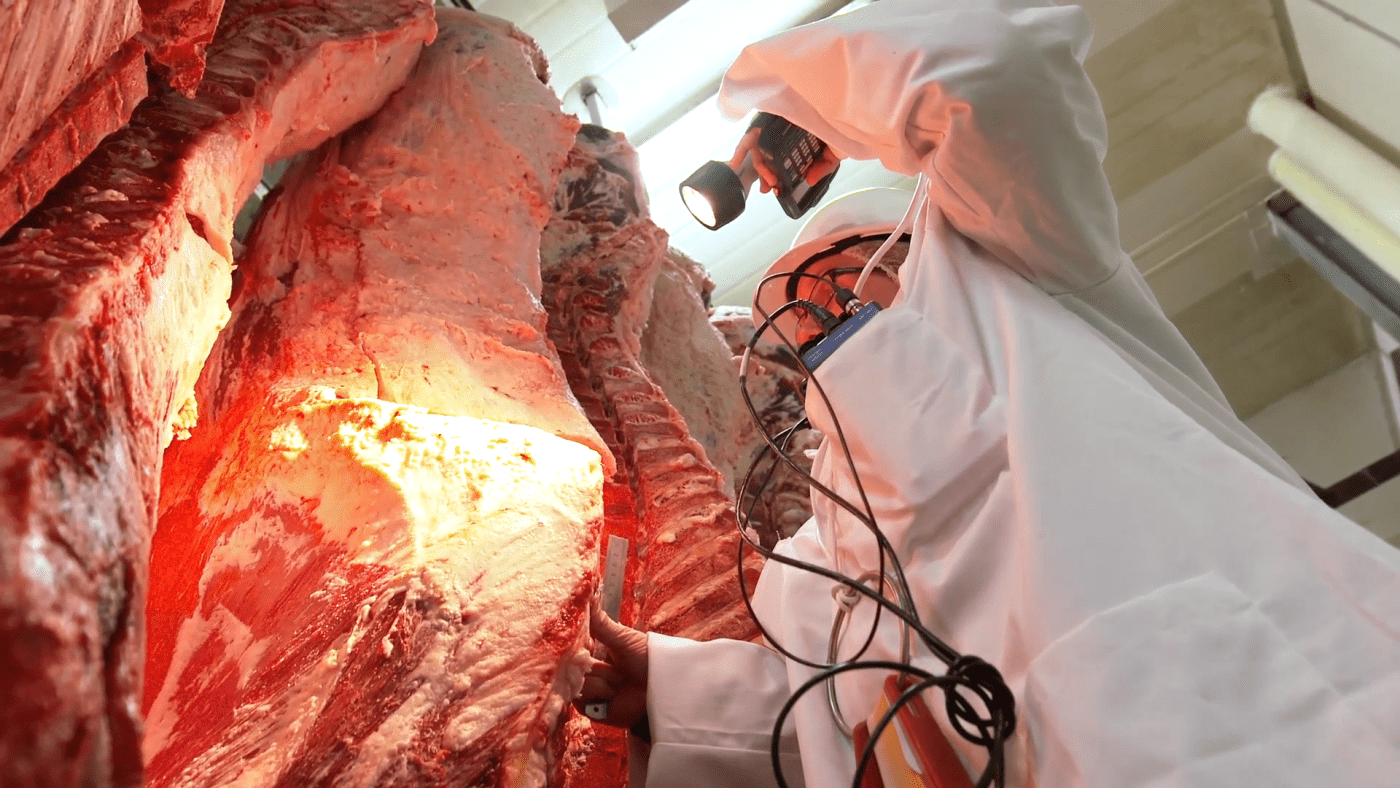
A recent Beef Central article exploring the reasons why two large grainfed branded beef chains have abandoned Meat Standards Australia grading has prompted the contribution below from Meat & Livestock Australia managing director Michael Crowley – himself a former MSA program manager….
RECENT commentary in Beef Central has questioned the relevance of the Meat Standards Australia grading system, particularly for longfed, high-marbled and grainfed beef supply chains.

MLA managing director Michael Crowley
For Australia’s beef brand owners and producers, these questions matter. Their reputation, market returns, and customer loyalty depend on delivering consistent eating quality, every time.
Meat Standards Australia is not only fit for purpose, but it’s also evolving to meet the changing needs of our industry. The evidence shows MSA is driving record value, supporting brand development, and assuring eating quality for consumers.
MSA delivers tangible value
MSA is delivering record value to producers, supporting brand owners in brand development using eating quality credentials, and providing eating quality assurance to consumers.
- Record returns: In 2024–25, MSA delivered an estimated $409 million in additional farm gate returns to beef producers. This value is captured through brands underpinned by MSA and shared across the value chain.
- Growing adoption: In 2024–25, more than 4.13 million head were MSA-graded, representing 47pc of the national adult cattle slaughter. More than 170 beef brands now use MSA to underpin their eating quality claims, reflecting strong industry confidence in the system.
- Brand support: MSA provides the science-based credentials that underpin each brand’s promise, whether it is marketing good everyday beef or premium cuts.
As MLA implements its 2030 Strategic Plan, the MSA program is an important enabler to advancing Value Based Marketing (VBM) and maintaining Australia’s competitive edge in global markets.
Fit for purpose and evolving
MSA was designed to elevate the eating quality and consistency of Australian red meat. Years of continuous growth in the average MSA index and the value of red meat sales prove its impact. Brand owners set the minimum eating quality standard for their customers, and MSA delivers robust, day-in, day-out prediction behind those brands.
MSA has evolved with investments in traits and tools that describe eating quality and carcase value, including genetic and objective measures. These investments keep the Australian beef and sheepmeat industries at the forefront of global quality systems.
The bottom line is as other nations accelerate their grading systems, Australia cannot afford to stand still.
Why MSA matters for long-fed and high-marbling cattle
Feeding duration and marbling are important, but they don’t guarantee eating-quality consistency. MSA’s database, built on over 1.3 million consumer taste tests, shows marbling explains only 10–20 percent of the variation in eating quality.
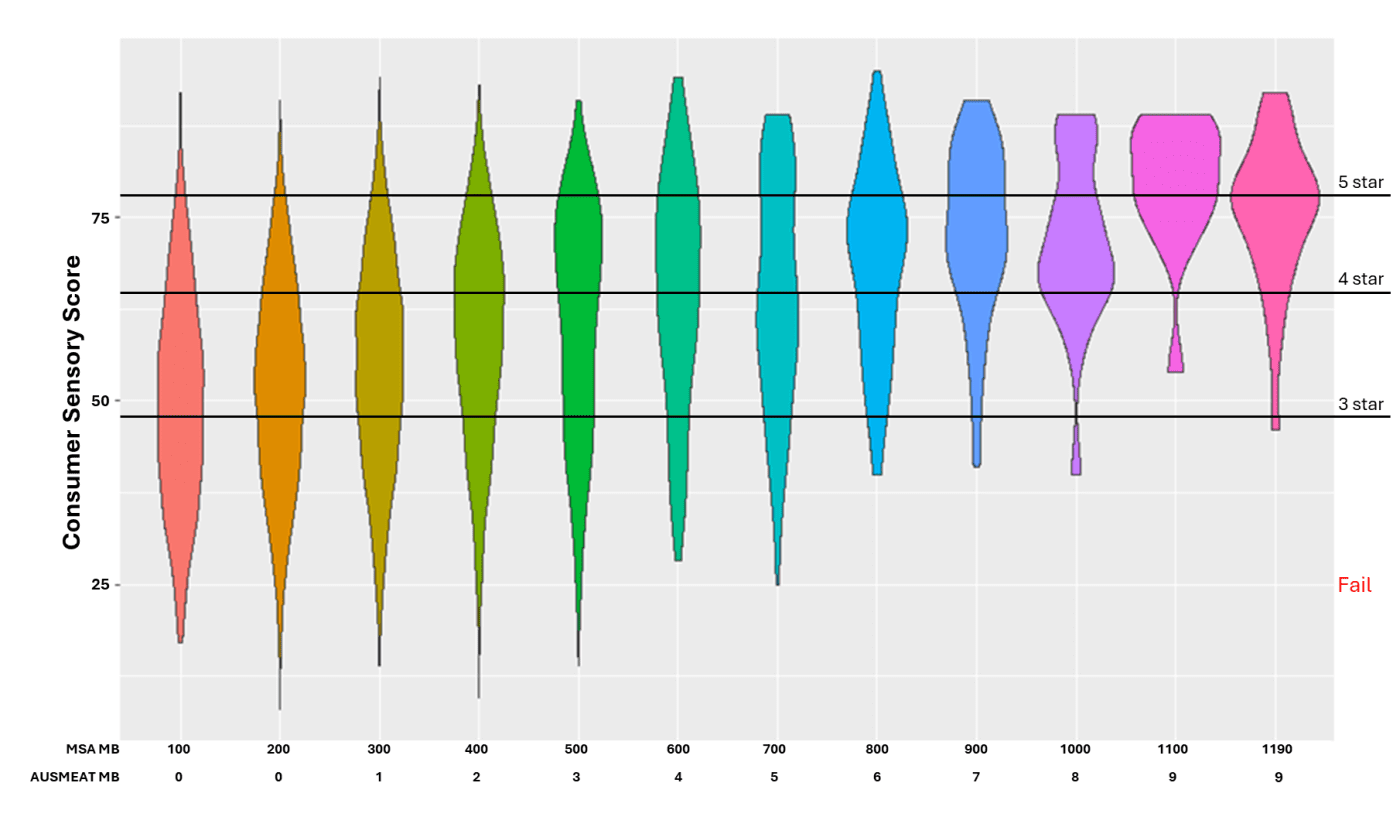
Consumer eating quality across all cuts by MSA marbling score from MSA consumer research. Click on images for a larger view
Even among longfed, high-marbling Wagyu and Angus cattle, other factors – like pH and ossification – affect eating quality. While more longfed, high-marbling animals are being MSA graded each year, there’s been minimal improvement in overall national marbling performance, especially among average and lower marbling animals whilst MSA index continues to increase.
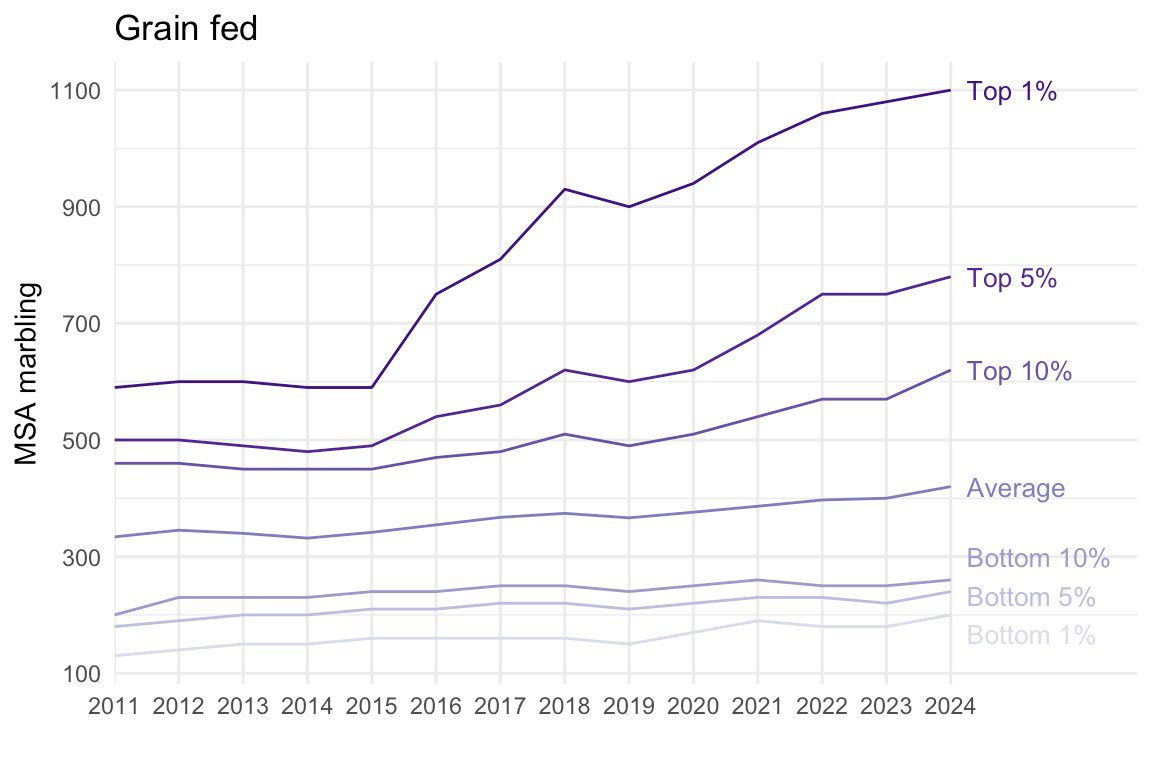
Marbling score range in MSA commercial dataset (2011 to 2024)
Marbling matters, but it’s not the whole story
Marbling is important, but MSA research shows consumers can detect differences in eating quality even when marble scores are similar. MSA measures 14 traits per carcase to accurately predict eating quality, not just marbling.
- Multi-trait model: Marbling has a greater influence in cuts like cube roll and striploin, but less so for rump or topside. MSA’s multi-trait model remains the most accurate and reliable system for predicting overall eating quality.
- Global comparison: Systems that rely heavily on marbling, like USDA Prime/Choice, don’t account for other factors affecting eating quality—such as HGP use and tropical breed content.
MSA’s evidence-based approach ensures every claim made under an MSA-backed brand reflects the true eating experience across the whole carcase.
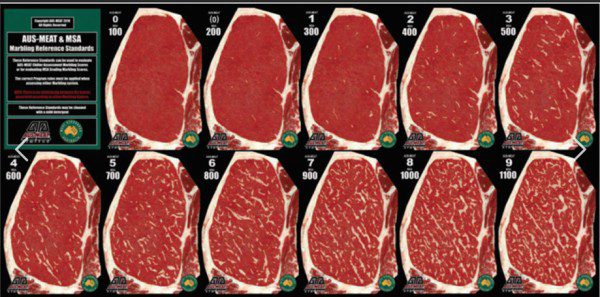
The AusMeat and MSA marbling reference standards
Innovation: The future of MSA
MSA continues to evolve, with priorities including research and commercialisation of new traits that explain both eating-quality and carcase-value variation.
- Objective and biological traits: Supported by artificial intelligence (AI), these include both traditional biological indicators and emerging Objective Measurement (OM) technologies, such as camera-based marbling assessment. These traits improve the accuracy of live-animal and carcase-value prediction and will underpin future MSA grading and Value Based Marketing (VBM) decisions.
- Genetic traits: Investments are focused on developing consumer sensory breeding values to support animal selection, genomic tools, and future MSA grading models.
- EQG Cipher: Introduced in 2017, the Eating Quality Graded (EQG) cipher allows brand owners to market product by predicted eating quality rather than dentition. Nearly half of MSA-licensed processors use it to communicate their promise directly to customers, capturing value from a greater range of animals.
- Marketing capability: Through the Meat Development Partnership (MDP), MLA supports brand owners in building brand equity, leveraging MSA credentials to strengthen market positioning and consumer trust.
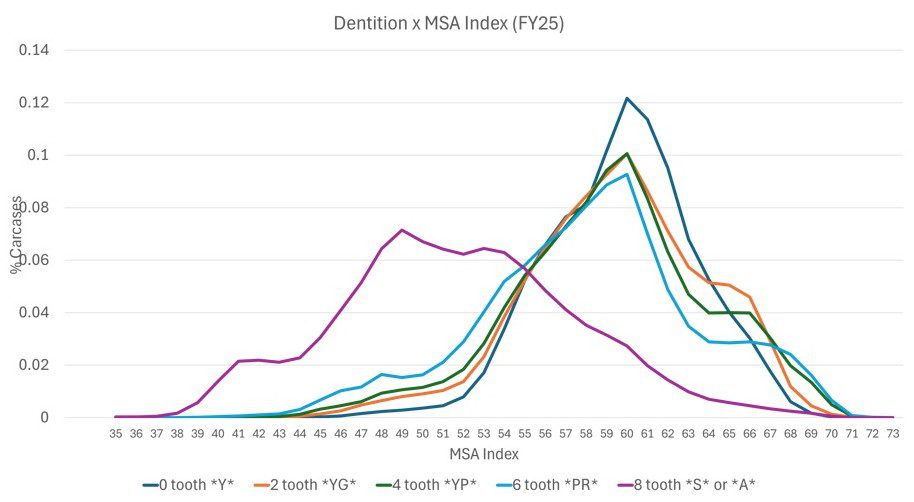
Distribution of eating quality by dentition, FY25 MSA commercial data
Get involved
Want to know how MSA can support your brand’s promise and profitability? Check out www.mla.com.au/about-mla/contact-us for resources, workshops, and support.
- Michael Crowley is the Managing Director of Meat & Livestock Australia.
Mick has covered the MSA ground very well. One further point regarding marbling is that, as used by MSA graders, marbling ranges in units of 10 from 100 to 1200 which is far more precise than the base AUSMeat 0 to 10 or the USDA and JMGA systems. Consequently within a "Marble Score 3" AUSMEAT category there are 10 smaller divisions that are used in conjunction with the 13 other traits that will best estimate the consumer response to the more than 200 cut x cooking method combinations calculated for any carcase, with each of these further adjusted for days aged for each muscle.
MSA is a voluntary system that the industry can ignore, or use at any depth; it can describe at very basic pass/fail level for a single tenderloin or accurately segregate into tightly defined brands across all cuts. Whatever the choice the ultimate consumer is remarkably good at grading what they eat, and assigning a brand value from experience!