
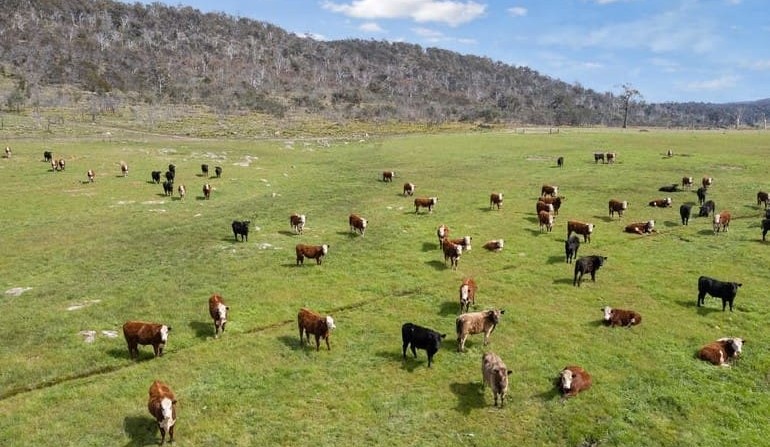
At first glance yesterday’s Federal Government announcement of $28.7 million to improve agricultural emissions accounting appears to pave the way for long-overdue recognition that existing greenhouse gas metrics unfairly punish emissions from stable herds of cattle.
 Independent scientists around the world have been making the case for years that treating short-lived gases like methane in the same way as long-lived gases like carbon dioxide is way too simplistic, because it ignores the fact they act very differently in the atmosphere and have different warming impacts.
Leading climate scientist Professor Myles Allen for example emphasises the point that the traditional method of accounting for methane emissions – known as GWP100 (Global Warming Potential 100) – overstates the impact of warming from stable herds of cattle by as much as 300 to 400 percent.
Just let that sink in.
This is no minor accounting error.
This is a 300-400pc inaccuracy built into the metric currently used in Australia and around the world to measure the warming effect of methane emissions from cattle.
The problem with GWP 100 is that it “pretends methane is a kind of Carbon Dioxide (CO2), and it isn’t”, Dr Allen explained to a Canberra audience last year.
He says another accounting system called GWP* (GWP star), and importantly one which United Nations rules explicitly allow each country to use in addition to or in place of GWP 100, provides a far more accurate measure of the warming effect of short-term greenhouse gases like methane from livestock.
He also says there is widespread global scientific consensus that methane and CO2 should be accounted for independently, which the adoption of GWP* enables.
 Some scientists and journalists have claimed this is a case of the livestock industry attempting to use “fuzzy math” or “creative accounting” in order to earn a “free pass” on livestock emissions. But this ignores the point that this comes from independent, objective scientists with no ties to the livestock sector who say emissions accounting systems must be fair, accurate and fit for purpose.
They also point out that GWP* is far from a “free pass” for the livestock sector, because it penalises increasing sources of methane emissions, such as herds that are increasing in size over time.
Yesterday’s announcement of $28.7 million over 10 years to improve greenhouse gas accounting at national to farm level would seem like a strong step in the right direction.
Detail provided so far indicates that the funding will be used to enhance the National Greenhouse Accounts methods and data collection processes, and to develop, publish and maintain voluntary emissions estimation and reporting ‘standards’ for the agriculture, fisheries and forestry industries.
“This measure seeks to leverage the significant investment industry and the private sector have already made in support of on-farm accounting,” the supporting doumentation says.
It adds that key stakeholders will be engaged in the implementation of the measures through the establishment of a technical advisory group and a reference group that will include representatives from industry, agtech providers, supply chain participants, the finance sector and First Nations Groups.
It is hard to imagine that funding will not address the ‘GWP100 versus GWP*’ elephant in the room, because to do so would be to ignore significant discrepancies in currently-used emissions accounting systems that clearly and unfairly over-penalise Australian cattle producers with long-term stable herds of cattle.
The devil will be in the detail, but at first glance the news of increased funding for ag emissions accounting is a positive step that should encourage more accurate and fair reporting which, importantly, reflects the latest science.
Great to see that Methane gas is being recognized as a "short term green house gas". We regularly are informed that methane (CH4) emitted today is gone in twelve years which can be concluded that every 100 molecules of CH4 emitted today will last 12 years in the air and suddenly convert to water and carbon dioxide . This is not the case as CH4 has a "half life " in air of less than 2 years . Of the original 100 some 50 will be converted to CO2 and water in less than 2 years , of those 50 left 25 converted to CO2 and Water by 4 years leaving 25 . After 6 years about 12 left , 8 years 6 left , 10 years 3 left , after 12 years 1 or 2 molecules of CH4 , or 1% to 2% of the initial amount burped , i.e. a short green house effect .
This on top of the CO2 generated was mostly in the air
during the last feed growing season by way of plant photosynthesis combing CO2 and water to form grass protein and carbo-hydrates i.e. feed for cattle .