
Latest listings on AgJobs Central recruitment page:
- Group director, Agribusiness (valuation) – (Boylan & Associates client)
- Farm Manager – Mathoura, NSW (Meridian Recruitment client)
- MC Truck Driver (Cavanaghs Transport)
- Data Analytics Specialist (Rimfire Resources client)
- Commercial & Procurement Manager – Moree, NSW (AMPS)
- National Business Manager – Agronomy/Seed/AgTech (Rimfire Resources client)
- Territory Sales Manager, Ag Machinery – NSW (Rimfire Resources client)
- Stud Groom/Farm Labourer – Moonie QLD
- Farm Operations Manager – Canobie Station, Qld (AA Co)
- Trainee Livestock Buyer – Birtinya, Sunshine Coast (Kilcoy Global Foods)
- Irrigation and Cropping Farmhand (Agricultural Appointments client)
- Stockperson – Identified Role Open To Aboriginal and/or Torres Strait Islander applicants (Northmark)
- Stockperson (Seasonal Contract) – Somerset Aggregation (Northmark)
- Cook/Domestic – Dalgonally Station, Qld (AA Co)
- Grain Storage Site Supervisor – SA (Lucas Group)
- Assistant Farm Manager – Oaklands, NSW (March client)
Click here to access these and other exciting meat and livestock supply chain jobs currently listed on AgJobs Central.
WORKING from home – at least for part of the typical working week – has become a common practice since COVID for many workers in metropolitan areas, but clearly has not caught on as strongly in regional, rural and remote areas.
A survey conducted by Roy Morgan Research released this week shows that overall, 47 percent of Australian workers – almost six million people – work from home at least some of the time.
However there is a clear divide among Australia’s 150 federal electorates. Working flexibility is concentrated in just 45 electorates, with the remaining 105 seats – the majority of working electors -continue to work on-site.
The nature of much of the work associated with red meat production means that working from home is less achievable. But with the diversity of employment now being seen across the sector, some of that may change.
City Vs Country
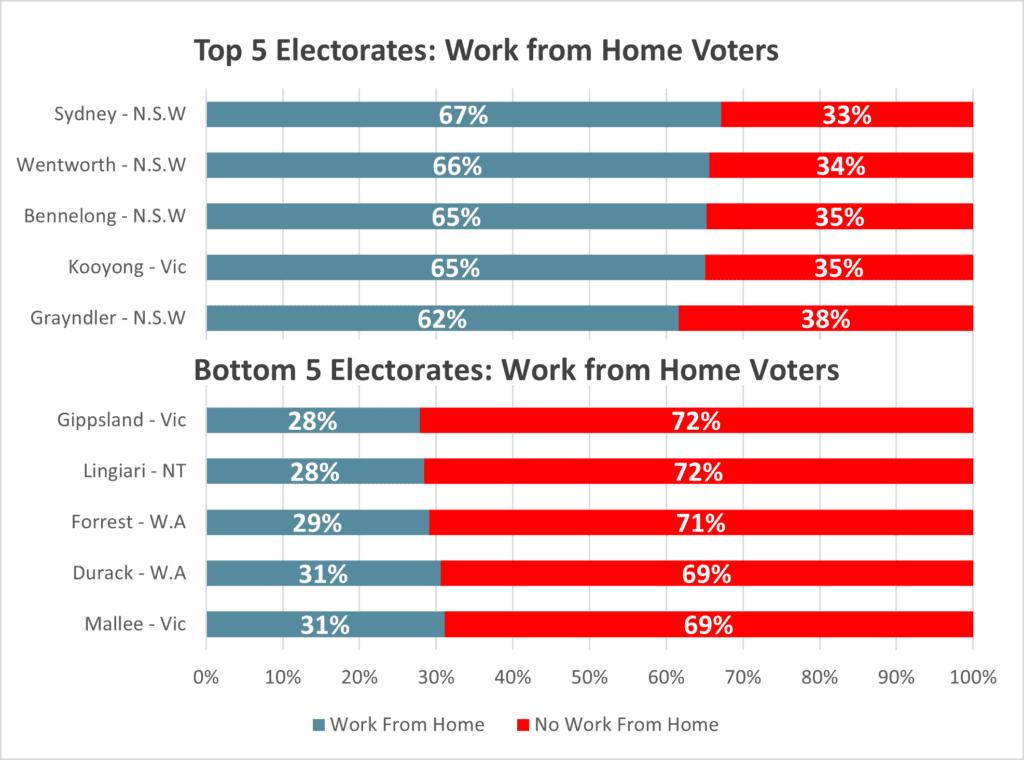
The highest work-from-home electorates in Australia are concentrated in the largest capital cities, including more affluent electorates like the seat of Sydney (led by Labor, where 67pc of working citizens get to work from home), followed by Sydney’s Wentworth (held by an Independent, 66pc), Bennelong (Labor, 65pc), Kooyong (Independent, 65pc) and Grayndler (Anthony Albanese’s Labor seat, 62pc) lead the nation.
All these affluent electorates are dominated by professional white-collar workers and are held by Labor or high-profile left-leaning Independents.
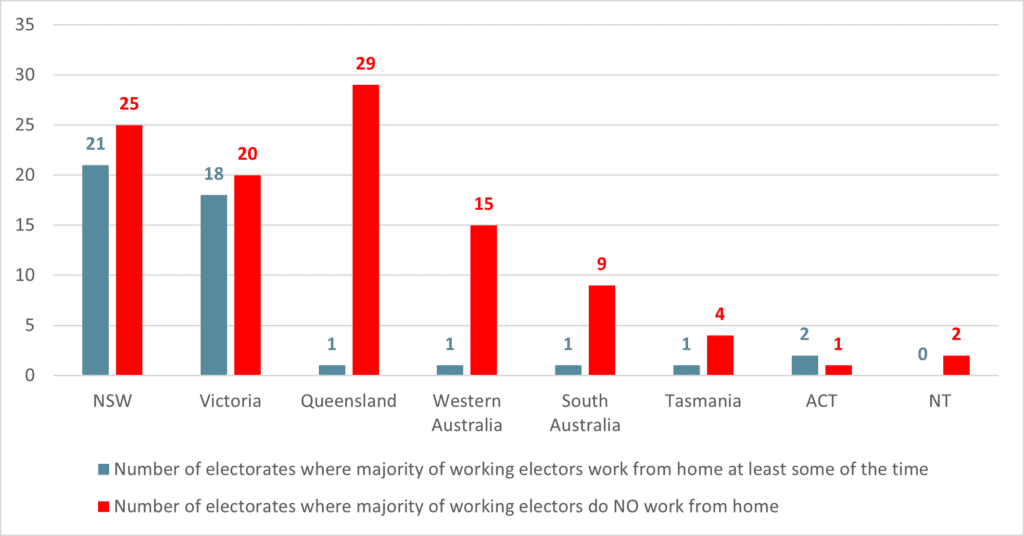
New South Wales and Victoria account for the bulk of electorates where working-from-home is the norm: NSW has 21, while Victoria has 18. Together, that’s 39 of the 45 majority-WFH electorates nationwide – and another two of these are located in the public sector dominated Canberra.
The remaining four electorates are isolated inner-city urban exceptions in Queensland, South Australia, Tasmania and Western Australia which each have a single electorate where a majority work from home: Ryan (QLD, Greens, 50pc), Sturt (SA, Labor, 53pc), Clark (TAS, Independent, 50pc) and Curtin (WA, Independent, 50pc).
Source: Roy Morgan. Click on image for a larger view
All other electorates see less than 50pc of workers functioning at least part time from home.
Overall, the data confirms that working from home is overwhelmingly concentrated in Labor’s metropolitan heartland, with independents and a handful of Liberal and Green seats forming the outliers.
“It’s a complex issue, reflecting a deep divide between urban and regional communities, different industries, and the varying opportunities Australians have to work from home,” Roy Morgan chief executive Michele Levine said.
In total, 59pc of a survey respondents working in the ‘Agriculture, forestry and fishing’ category said they were unable to work from home, even for part of the week.
The Federal electorates with the lowest levels of working from home are found in large regional and remote electorates, where on-site industries dominate.
Mallee, Victoria (Nationals, 31pc working from home), Durack (Northern WA, Liberal, 31pc), Forrest (WA, Liberal, 29pc), Lingiari (NT, Labor, 28%) and Gippsland (rural southeastern VIC, Nationals, 28pc).
Geography and the nature of industry combine to make in-person work the overwhelming norm in these seats, the study found.
For people in regional Queensland, only 40pc of employees had the opportunity to work from home; 39pc in regional NSW; 37pc in regional Victoria, 36pc in regional Tasmania; 34pc in regional NT (outside Darwin/Alice Springs); 33pc in regional South Australia and 31pc in regional Western Australia.
- Roy Morgan interviewed a representative sample of 36,606 employed Australian electors over the year to June 2025. The definition for ‘Working From Home’ includes Employed/ Self-Employed people who work from home either paid or unpaid.