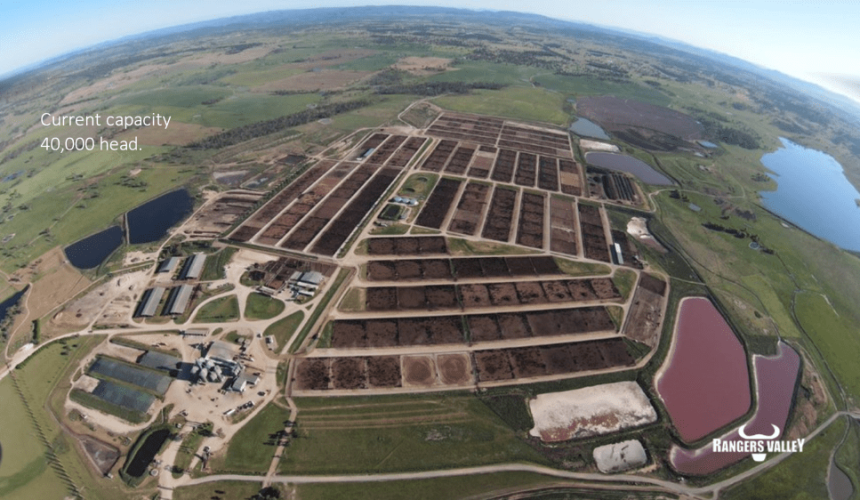
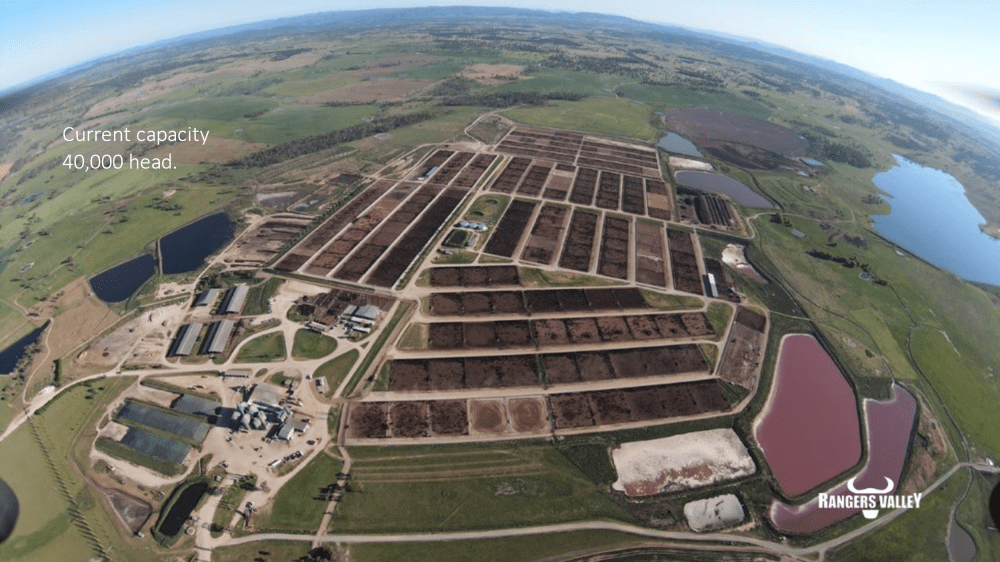
Aerial view of the 40,000 head Rangers Valley feedlot near Glen Innes in northern NSW
THE Menegazzo family’s vertically-integrated Queensland beef business, Stanbroke, has bought the Rangers Valley feedlot and grainfed beef business from its Japanese owners, Marubeni Corporation.
It’s been an open secret across the red meat industry for the past nine months that Marubeni was looking to divest its ownership of the 40,000 head capacity Rangers Valley feedlot near Glen Innes, and grainfed beef brands.
 The asset was ‘quietly’ put in front of a carefully selected group potential buyers, both Australian and offshore, since March. Since then, virtually all of Australia’s large-scale grainfed beef producers were linked to a possible purchase of the yard and support businesses at different times, mostly based on unfounded rumour.
Early in the process, Marubeni confirmed the process with Beef Central, but was limited in what it was prepared to say on the record.
The actual sale price has not been disclosed, but earlier assessment valued the cattle component on Rangers alone (40,000 head, comprising Fullblood and crossbred Wagyu and longfed Angus), at around $200 million, with a similar replacement value for the feedlot infrastructure, surrounding 4900ha of grazing and farming land, and suite of high-profile export beef brands covering Wagyu and longfed Angus streams.
If that suggested price is accurate, it represents easily the largest single feedlot sale transaction in Australia’s history. The only deal even remotely in the same ballpark was JBS’s sale and leaseback of its Australian feedlot assets in 2018. That deal with investor RFM did not include the cattle, but only the bricks and mortar. At the time of the sale, it was described as the largest asset transaction ever seen in the Australian grainfed beef industry.
Rangers Valley managing director Keith Howe will remain in his current role under the new ownership.
Beef Central understands the sale prospect attracted worldwide attention after the marketing process started early this year, both from established beef and cattle industry players in Australia and overseas, as well as institutional investors keen to get a foothold in the industry.
Developed by Japanese owner Marubeni since it bought the site as a 4000-head yard in 1988 (see history below), the Glen Innes Rangers Valley yard is a showpiece of feedlot infrastructure in Australia, featuring modern grain processing, cattle handling, feeding and data recording systems, and extensive permanent Ridgeback shed infrastructure.
The investment looks like a good fit for Stanbroke, which has expanded heavily into the premium end of the grainfed beef industry over the pasty decade, with its own Wagyu and Angus feeding programs through the company’s expanded Stanbroke (formerly known as Bottletree) feedlot near Chinchilla.
The combination of the Stanbroke feedlot and the Rangers Valley yard now gives Stanbroke a one-time feeding capacity of around 90,000 head.
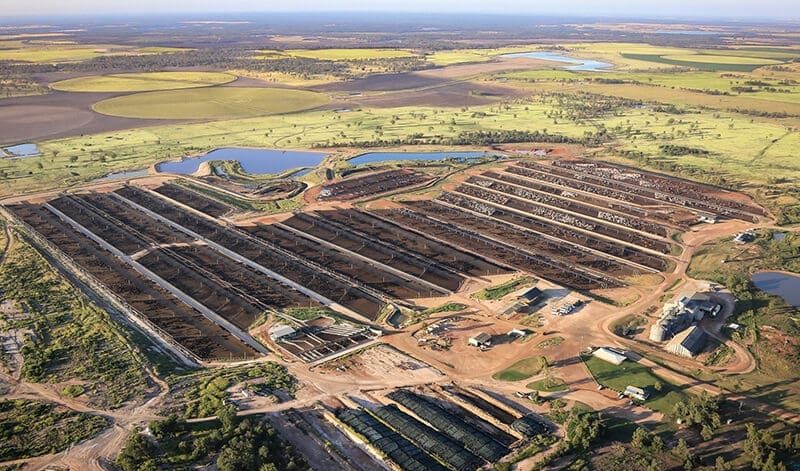
Stabroke’s original 50,000-head yard near Chinchilla on Queensland’s western Downs
The Stanbroke company also owns a significant export processing asset at Grantham in the Lockyer Valley southwest of Brisbane, with some capacity to process Rangers Valley grain-finished stock that are currently slaughtered at John Dee, Australian Country Choice, Teys Beenleigh and Casino Food Co-op.
Stanbroke Beef Pty Ltd’s vertically-integrated operations include pastoral assets covering a herd of 200,000 cattle and land holdings spanning some 1.2 million hectares of Queensland. Included are seven Gulf cattle stations and three backgrounding operations on the western Downs.
 The company also operates a branded beef business, meat wholesale/export division servicing customers across the globe, online retail sales and a fancy Brisbane steak restaurant called Establishment 203 (after the Grantham AusMeat establishment number).
The incorporation of Rangers Valley will also broaden Stanbroke’s feedlot geographic footprint, from the western Darling Downs to the NSW New England region.
Settlement is due to take place in early November.
Marubeni will continue to run a separate meat trading business out of Australia, as it has for decades.
Marubeni/Rangers Valley Cattle Station has issued the statement below:
To all Rangers Valley stakeholders, cattle producers, suppliers and customers, I am pleased to announce this shareholder change.
Marubeni Corporation has owned our business since 1988, and in that time, we have grown to supply 50 markets across the globe and amassed world-renowned brands that are lauded for quality, consistency and excellence. From November 1, our new total shareholder will be Stanbroke – an esteemed family-owned business that is well versed in the premium, end to end beef and cattle supply chain.
What does this change mean?
It will be business as usual at Rangers Valley. We will continue to operate as always with each key functional areas and team members continuing to support the Rangers Valley way – producing some of the world’s leading premium Wagyu and longfed Pure Black Angus programs.
The strength of the Stanbroke business is an important feature in this change, including provision of a future centralised meat processing operation. This shift to a more vertical integration of processing provides efficiencies and benefits for both the Stanbroke and Rangers Valley businesses.
Things that won’t change:
-
- Our premium long fed Pure Black Angus and Wagyu programs
- Globally recognised RV brands will continue
- Our procurement strategy – working with elite cattle breeders who supply high-performing feeder cattle – underpins the Rangers Valley brands
- Our team members will remain and still be here to serve our customers in the same way
I see this change as a positive step forward – it presents opportunities that strengthen the RV proposition. We look forward to the ongoing support of Rangers Valley suppliers and customers as our brands continue to lead the global premium beef market.
I would like to sincerely thank all our stakeholders—cattle producers, suppliers, customers, and processing partners—for your trust and ongoing support. You have played a crucial role in shaping Rangers Valley into the respected name it is today. I look forward to continuing this journey together.
-
- Keith Howe, managing director, Rangers Valley Cattle Station Pty Ltd.
Rangers Valley history
As outlined in Jon Condon’s book, “Grainfed: The history of the Australian lotfeeding industry”, few, if any, large-scale lotfeeding businesses worldwide have had the relentless, solitary, long-term focus on producing highly-marbled beef as Rangers Valley.
Since the yard started operations in 1988, it has focussed heavily on longfed 250-270 day Angus cattle designed to express optimum marbling. More recently, Wagyu cattle have been added to the programs, fed 350 days or longer.
Today, Rangers is built to an operating capacity of 40,000 head, but of interest to prospective buyers, it has a license and available water access to expand by an additional 10,000 head if required.
Marubeni’s original business model was to provide premium grainfed beef into the company’s large Japanese meat trading business, but over the past 15 years export markets have diversified dramatically, with the product now present in more than 50 markets around the world.
Keith Howe took over as Rangers Valley managing director from Don Mackay in 2017.
In addition to expansion in a number of stages, Rangers has been well financed, with a large upgrade to milling infrastructure in 2014, and the older half of pens rebuilt in 2021. More recently there has been major expenditure on permanent shedding infrastructure, sufficient to house around 2000 head during the final feeding stages.
Today, the expectation is for longfed 250-270 day Angus to hit marbling performance of 3-5, with a growing proportion higher than that. Carcase weights average 460kg, with Wagyu 440kg.
Around 10,000 head of cattle are routinely involved in backgrounding programs before entering the yards, either managed by Rangers Valley itself, or contracted out. A large Angus backgrounding program takes place in southern NSW involving around 5000 head, working with a large operator under a long-term arrangement.
Further backgrounding takes place on the New England, either at Rangers Valley itself, where up to 5000 young cattle are held, or on nearby properties.
One of the distinctions that sets Rangers apart from other large Australian lotfeeders carrying out longfed programs is its heavy reliance on locally-grown corn silage, used instead of sorghum or winter cereal silage. Areas on the New England are ideal for growing corn for silage and hay.
Corn silage is seen as a pivotal ingredient in the ration mix, with around 35,000 tonnes of high-protein, high-energy silage laid down in storage each year.
Beef brand programs are structured under Rangers Valley’s WX brands for F1 and Purebred Wagyu, sold by marbling score range, with Fullbloods under the Infinite super-premium program. Longfed Angus are packed under the Black Onyx (MS 3-4), Black Market (MS5+) and Black Tie carton lids.
Beef Central understands the brands were included as part of the sale deal along with the cattle on hand, making it a virtual ‘walk-in, walk out’ arrangement.
Great news. Congratulations to all concerned.
Congratulations Brendan and your team and your foresight to purchase Rangers Valley from the Marubeni Corporation. The initial 4,000 head capacity in 1988 to its 40,000 head capacity today stands testament to the management that has developed the business. Hats off to Keith Howe the ongoing MD for his management. But never forget Don Mackay who lead Rangers Valley through some very important years of measured expansion.
I am sure Ranger Valley will continue as a formidable leader in lotfeeding in Australia under its new ownership.