
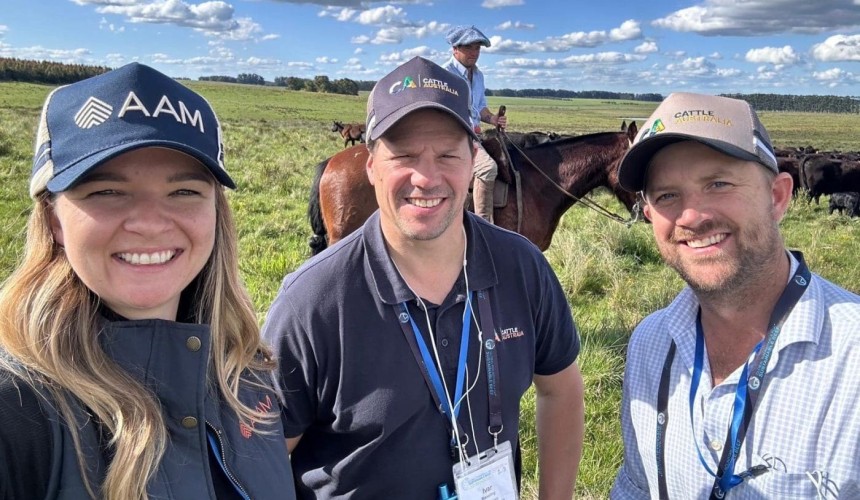
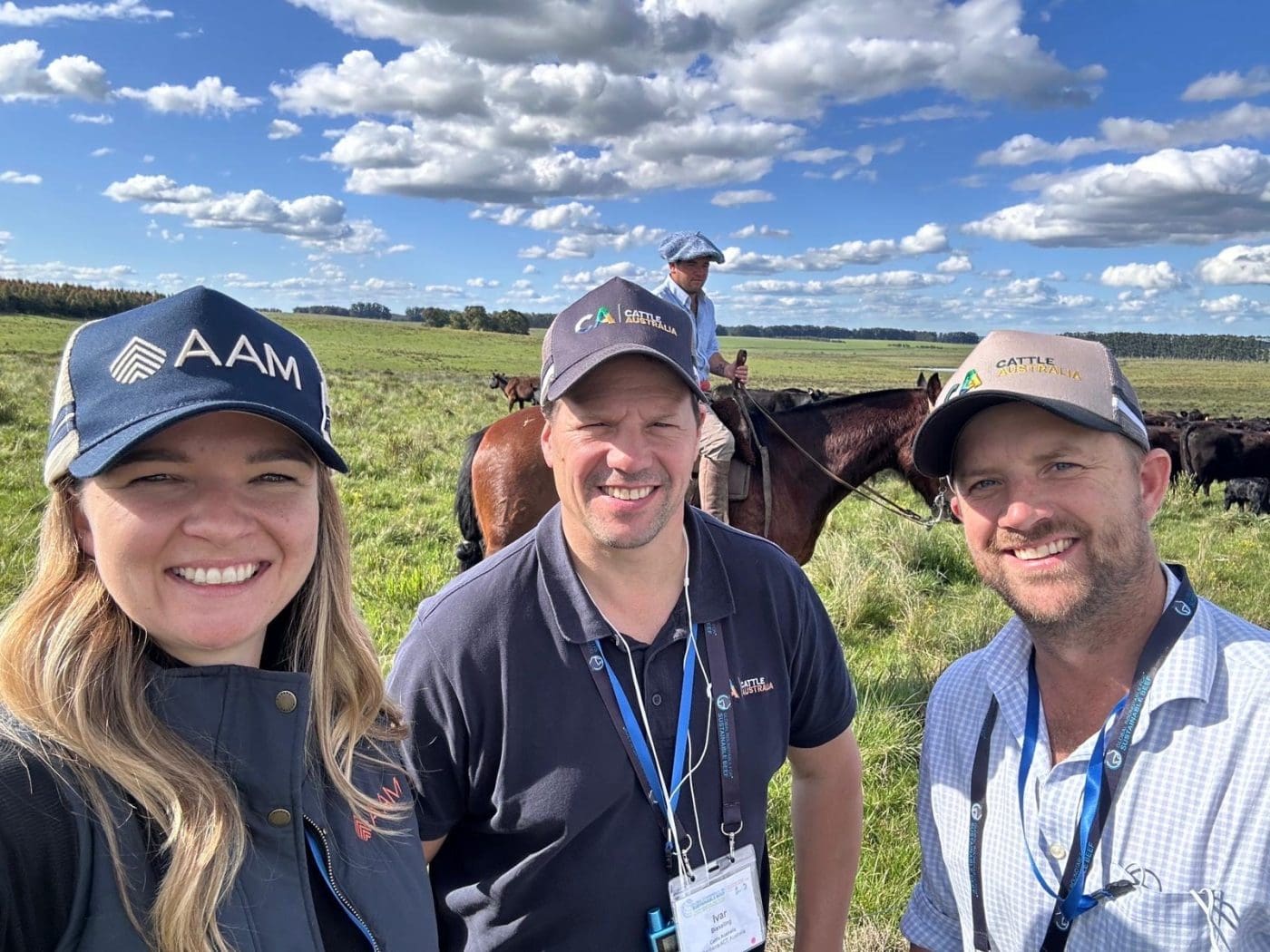
Australian Beef Sustainability Steering Group member Kari Moffat, Cattle Australia policy and strategy director Ivar Bisseling and Cattle Australia deputy chair Adam Coffey.
THE organisation put together to spearhead a global effort to demonstrate and improve the sustainability credentials of the beef industry has met in the South American country of Uruguay this week.
Several Australian delegates were on deck for the Global Roundtable for Sustainable Beef conference, including representatives from Cattle Australia, the Australian Beef Sustainability Framework and Beef Central Southeast Asia columnist Michael Patching. Michael will provide an account of his take on the gathering in his monthly column being published on Beef Central next week.
Attendees came from five continents and 24 countries, comprising producers, processors, retailers, allied services like banks, customers like McDonald’s, governments, research and development corporations, and 13 National Sustainability Roundtables like the (ABSF).
Cattle Australia deputy chair Adam Coffey is in Uruguay and he put together some of the key takeaways from the conference for Beef Central.
Global effort needed
Mr Coffey said with GRSB being a multi-stakeholder organisation, there were multiple contrasting perspectives heard at the conference, including some portraying the negative story about beef and others wanting myths busted and a change in the way beef production is being portrayed.
He said it was important for the global industry to work together to make sure beef production has strong representation.
“It was valuable to hear from the Sustainable Beef Roundtables from around the world about how they approach engagement, collaboration, and communications,” he said.
“This assisted the Australian delegation to identify opportunities to build on what we are currently doing and highlighted the need for cross-country collaboration.
“Visiting Uruguay farms and understanding their beef production systems brought home the importance of assisting consumers and stakeholders to go beyond assumptions by filling gaps in public information.
Research needed to demonstrate carbon sinks
One of the main drawcards of the conference was the global premiere of a new movie called a World Without Cows and a corresponding keynote speech by Alltech chief executive officer Mark Lyons, whose company funded the movie.
Mr Coffey said the movies had powerful demonstration of the industry’s ability to sequester emissions.
“It was an impressive example of commercial investment in exploring fundamental questions around greenhouse gas emissions and the role of cattle-producing landscapes,” he said.
“Evidence presented from one trial site showed a whole system net emissions sink – this emerging science challenges the prevailing narrative that ‘cows are bad for the environment’.
“Further research is needed on calculating global beef GHG emissions and nature positive production systems. The presentation also demonstrated the importance of communicating success stories in beef sustainability and the nutritional importance of beef.”
Growing divide between developed and developing countries
Mr Coffey said the conference was a stark example of the divide between developed and developing countries in their approach to ESG (environmental, social and governance) policies.
“In developed nations we talk of nature positivity, climate impact and sustainability metrics, while developing countries are focussed on putting food in mouths and ensuring nutritional needs are met,”
“These conflicting priorities highlight the complexity of the challenge of feeding an ever-growing population, while increasing production efficiency from a finite land resource and conserving our ecosystems.
“Market frameworks around issues like animal welfare, deforestation, emissions or indigenous people protection, need to be pragmatic, driven by producers and have real outcomes.”
I thoroughly enjoyed your article “Three Takeaways from the Global Sustainable Beef Conference in Uruguay.” However, I would like to respectfully address Mr. Coffey’s statement: “In developed nations, we talk of nature positivity, climate impact, and sustainability metrics, while developing countries focus on putting food on the table and meeting nutritional needs.” As a Colombian-born Australian animal scientist, I find this perspective somewhat unfortunate and biased.
This is particularly relevant given that your article emphasizes the importance of intercultural dialogue and proactive measures to enhance technical efficiency and sustainability in the beef industry.
<strong>May depend, to some extent, on each person's definition of "developing," Carlos. Editor</strong>
Thanks Carlos for your feedback. To clarify further, a key discussion during the conference centered around nutritional deficiencies in Africa and Asia, largely due to limited access to animal-sourced foods, which has resulted in widespread nutrient deficiencies. When considering sustainability in these regions, the conversation is distinct from that in Europe, Australia, and South America, where the focus tends to be more on environmental impacts rather than food security and nutritional needs.
I'd be happy to chat further if the editor sees it as appropriate to put us in touch.